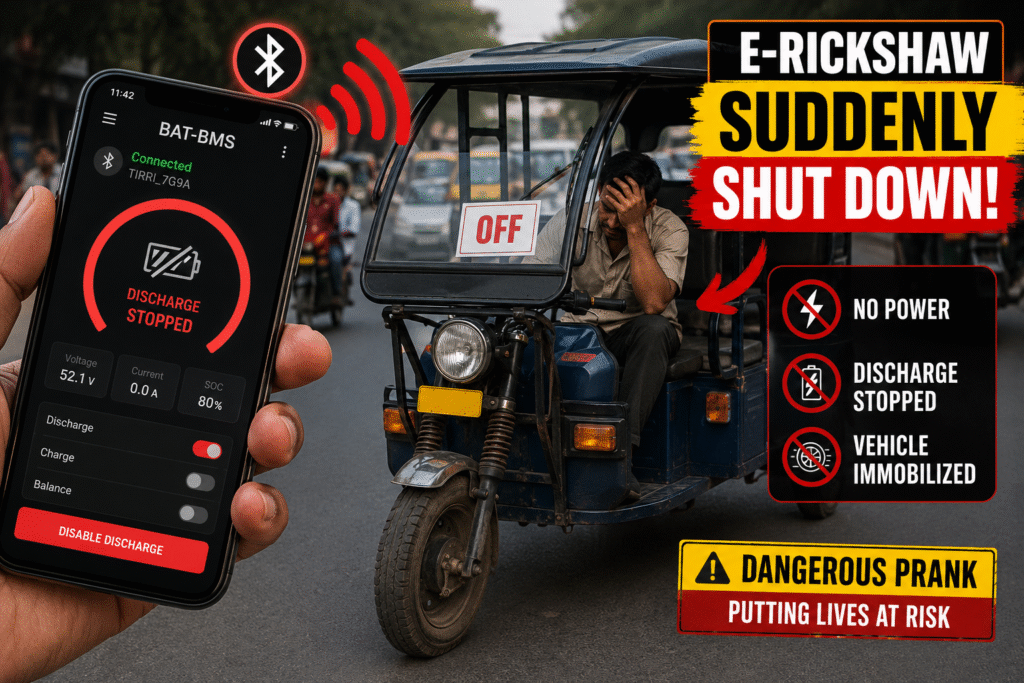
A new e-rickshaw Bluetooth hack is quietly draining driver incomes across the capital. Viral videos show strangers disabling e-rickshaws mid-ride using a simple phone app. Drivers say their daily earnings have nearly halved as a result. According to a report in The Indian Express, drivers once earned close to Rs. 1,000 a day. Now, they take home about Rs. 600. The gap reflects hours lost to sudden breakdowns and stranded trips. For daily-wage earners, that drop cuts deep into household budgets.
Inside the E-Rickshaw Bluetooth Hack
This trick does not involve breaking any code or password. Instead, it exploits a legitimate safety feature built into many batteries. Most e-rickshaws run on a Battery Management System, or BMS. This system tracks voltage, temperature, and charging current inside the battery.
Mechanics normally use the BMS discharge switch to cut power before repairs. However, several budget batteries pair over Bluetooth without any authentication step. Anyone within 10 to 15 metres can connect to an unsecured unit. A working app then lets them flip that switch remotely. Once triggered, the motor loses power instantly. This can happen even in the middle of traffic. Not every e-rickshaw faces this risk, though. Vehicles running on older lead-acid batteries lack Bluetooth entirely.
Rickshaws with proprietary, factory-secured BMS software stay unaffected too. Still, thousands of budget lithium batteries remain exposed across the city. This e-rickshaw Bluetooth hack keeps spreading precisely because those cheap batteries are so common.
Drivers Bear the Real Cost
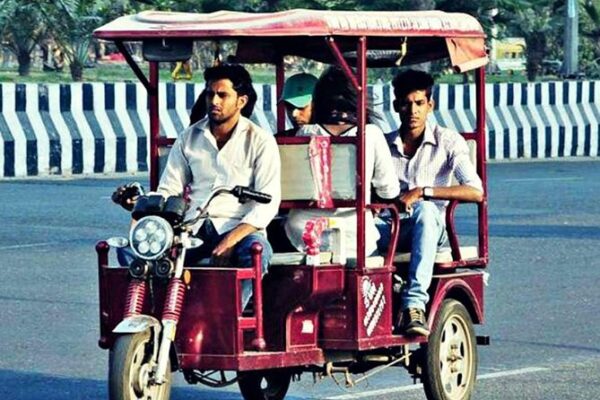
For drivers, this “prank” carries serious financial weight. One driver had rented his e-rickshaw for the day. He lost his entire morning’s income after his vehicle stalled without warning.
Social media influencer Amaan Siddiqui recorded the moment and shared it with ANI. He said the driver broke down after realising his rented rickshaw would not move. The man told Siddiqui he had lost between Rs. 400 and Rs. 500 that day.
Many affected drivers do not own smartphones. Few understand how Bluetooth-enabled batteries even work. As a result, they often assume a mechanical fault has struck their vehicle. Some end up paying strangers or mechanics to fix a problem that never existed.
Beyond the money, sudden stoppages raise fresh road safety concerns too. A vehicle losing power mid-traffic can easily trigger a collision from behind.
A Bigger Question for IoT Battery Buyers
This episode raises concerns well beyond Delhi’s e-rickshaw drivers. The same unsecured Bluetooth flaw likely exists in other lithium battery products sold nationwide. The e-rickshaw Bluetooth hack may simply be the first widely visible case. E-scooters, power backup units, and small EVs often use similar low-cost BMS hardware. If a battery’s Bluetooth module skips basic authentication, it stays exposed to interference. That risk will not disappear once regulators fix one single app.
Consumers rarely check whether a product’s Bluetooth link needs a password. Manufacturers, in turn, rarely disclose this detail on packaging or manuals. This gap points to a genuine need for clearer safety standards nationwide. Should India require mandatory security certification for Bluetooth-enabled batteries? No such rule currently exists for these low-cost components. The Bureau of Indian Standards already certifies electrical safety for many devices. Extending similar checks to Bluetooth battery modules could close this specific gap.
Until regulation catches up, buyers carry most of the risk themselves. Checking whether a battery’s app demands a password remains a simple, practical safeguard. It will not fix the industry-wide problem, but it helps individual buyers today.
Authorities Respond, But the E-Rickshaw Bluetooth Hack Remains a Threat
Officials have moved quickly on the app front, at least. MeitY Secretary S Krishnan confirmed the action at a CII cybersecurity summit. App stores removed two apps linked to the exploit soon after. Reports have named the apps as BAT-BMS, Epoch Li-ion, and Lossigy. BAT-BMS reportedly comes from Shenzhen Grenergy Technology, a China-based firm. Developers originally built the app to monitor solar and marine batteries, not vehicles. Meanwhile, the Delhi Transport Department has opened its own investigation. Transport Minister Pankaj Singh and department officials are reviewing the technical risks. They are also examining whether unsecured BMS units need new rules.
Krishnan added that his ministry would raise the issue with app store operators directly. He said platforms must screen more carefully before approving risky apps. Still, no timeline exists yet for updated battery security norms.
Investigations Continue; the E-Rickshaw Bluetooth Hack Highlights the Need for New Safety Rules
Investigators are still assessing how many e-rickshaws across Delhi remain vulnerable. Officials have not confirmed whether new safety rules are coming soon. Meanwhile, drivers keep working without knowing if their vehicle could suddenly stop. Any policy move from MeitY or the Delhi government will matter well beyond the capital.
Follow The World Times For More Such Updates!