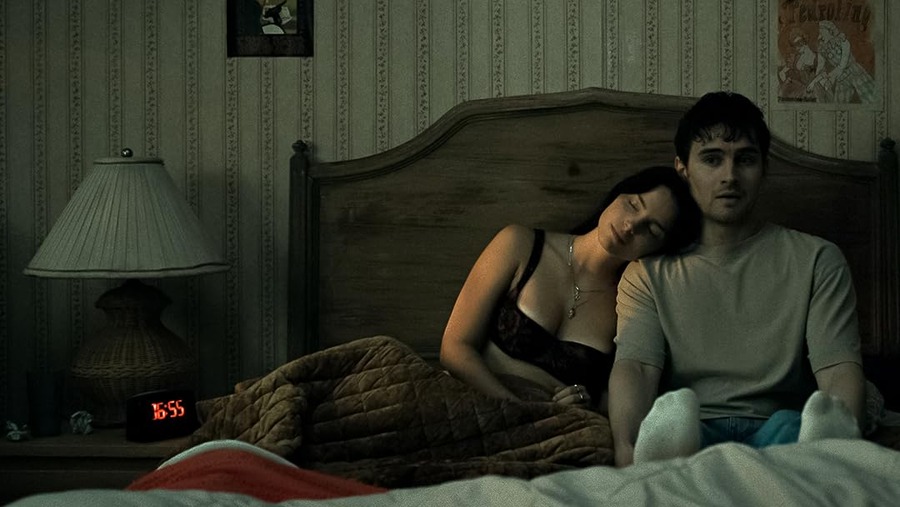
Move aside, Joe Goldberg; Curry Barker’s 2025 directorial, Obsession, is one step ahead. A boy obsessed with a girl, a supernatural wish, and the girl falls in love with him. This is the seemingly simple premise of Obsession. However, it goes beyond that as the movie becomes a lesson on desire, male entitlement, and the agency of women. It follows the horrifying incidents that unfold when Bear, a music store employee, buys a supernatural toy and wishes that his friend Nikki loves him. Unfortunately, his plan goes haywire when the wish comes with a devastating price. Here is a detailed breakdown of what happens in the movie and the insights that it offers to the audience.
(Disclaimer: This contains spoilers.)
Compulsive Desire is Mistaken as Love in Obsession

The premise of the film is straightforward – Bear desires to have his friend Nikki as his girlfriend. His compulsion to woo Nikki turns into a failed attempt to confess his love. He practices proposing to her but gets cold feet at the ultimate moment. This signals a structural failure in Bear’s character. He is not the one to take initiative directly. Rather, he has to indirectly trick her. Bear’s passivity goes a long way.
Although Bear asserts his love for Nikki a lot of times, does he really know her? To him, Nikki is the ultimate manic pixie dream girl, one who can change his life. Little does he know that she is an individual with agency over her life. Unable to communicate his feelings, Bear buys a One Wish Willow, a supernatural gateway. Unaware of the fact that some magic might happen, Bear wishes that Nikki loves him more than anyone else in the world.
The Outcome of Bear’s Wish
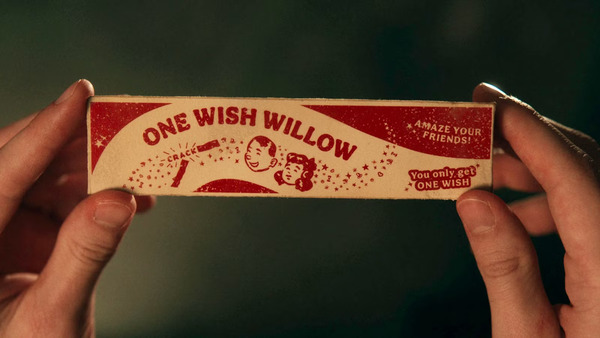
His wish does come true. Consequently, Nikki behaves in erratic ways from the moment she falls in love with him. Bear ignores all of them for the sake of his own mental peace. He loves that obsessive version of Nikki. The real Nikki is far from his ideal imagination.
The honeymoon phase wipes out the reality. The movie has a montage of the couple enjoying their days together. It might be a memory. It might be an imagination. Subsequently, when Nikki’s obsessive side takes control over her, Bear stays docile. He revokes Nikki’s pleas to let her go because he cannot accept that staying with him can ruin her life. He carries on the act publicly, notwithstanding Nikki’s repeated attempts to free herself. Desire and the love of control take the better of Bear. He never truly loves Nikki for who she is. It is the fictitious version that he proclaims to be in love with.
Male Entitlement and Its Catastrophic Consequences

Obsession presents a curious case of the perceived male entitlement in society. Circumstantially, in a patriarchal world, a man’s choice is an ultimatum. So when Bear chooses Nikki, it is him claiming his masculine power. Nikki, on the other hand, has no say. It is almost an ancient ritual of choosing a silenced bride.
Additionally, Bear suffers from the good guy syndrome. He presumes that he is kind, loving, and can be a dutiful boyfriend. But it is all from his perspective. He never tries to gauge what Nikki really wants. Inspired by Ian, he deems it right to call her Freaky Nikki, a title which she hates. The movie thus goes beyond the generalized notions of flirting, where back-handed compliments and insults are seen as effective devices to woo the girl.
His good guy complex restricts him from letting Nikki decide. Bear potentially rapes her as she loses her bodily autonomy. Not for once does he question her hallucinations or when she soils herself. He wants to keep up with the perfect image. Bear constantly lies to his friends about Nikki’s condition. He denies guilt and never attempts to cure her. Thus, the effects of male entitlement and privilege function hand in hand to stimulate Nikki’s sufferings.
Volition and Accountability in Obsession

Furthermore, male privilege gives Bear the volition to control Nikki’s possession. He does not wish to cancel his wish, but rather ‘alter’ it. Even when he measures the disastrous effects, he cannot let Nikki be free. The climax is a testament to the same. Bear’s cowardice annuls his suicide attempt. Even when he finally swallows the pills, he tries to vomit them out. Although he faces the consequences himself, in no way does Bear want an out for Nikki.
Bear’s death aids the fact that men often do not take accountability for their own actions. What seems like a sacrifice for love is indeed an escape. He flees from the scene, leaving Nikki back to her senses with three deaths on her hands. She has nowhere to go. She is the one left behind due to Bear’s obsession with her.
The Issue of Female Autonomy in Obsession

Nikki’s role in Bear’s life is ornamental. She is his dream girl and ideal projection of a girlfriend. Hence, Bear does not hesitate to rip off her free will in the movie. As soon as the wish functions, Nikki loses her sense of self. She is possessed by an obsessive entity. The movie, however, does not clarify whether it is a supernatural phenomenon or a case of psychological disorder.
Metaphorically, Nikki’s pathological obsession with Bear is an outcome of Bear’s desire to have a perfect girlfriend. She truly loves him more than anyone else and does not hesitate to corner him into seclusion. It is a girl losing herself to the obscure power of fake love. Nikki does not have a voice to champion her cause. The entity takes control over all her mental and physical functionalities. She is an unfortunate victim of Bear’s ideals.
Obsession: Where Female Consent is Deemed Useless

Nikki’s case is made stronger when Bear does not try to end her misery. Having lost bladder control, Nikki soils herself. The dramatic bodily horror combined with Nikki’s pathological outcome raises questions. The real Nikki tries to warn Bear of her physical inabilities. However, Nikki cannot do much. She is raped by Bear. Consent becomes a far-fetched option for her. On the other hand, Bear blames her for being obsessed with him. He suppresses the fact that he wished for Nikki to “love me (him) more than anyone else.”
Finally, when Bear commits suicide to free Nikki of the curse, she is left behind with all the wrongdoings. Her case is a curious presentation of the extent of consent and autonomy that a woman has. Additionally, it points out that an obsessed man will do anything to escape accountability and leave the woman stranded. Nikki’s gender becomes a tragedy. The movie essentially reminds the audience of the helplessness of women in relationships.
Obsession and Its Ripple Effects
Obsession has stirred many controversies among the viewers. Audiences are divided on whether Bear or Nikki was to be blamed for the tragedy that unfolded. Yet the movie makes a clear case of distinction. It is a man’s obsession that drives a woman to the heights of psychological and supernatural horrors. It truly becomes a cautionary tale of desire, love, and crosses the threshold of obsession into unhealthy results.
If you haven’t yet watched Obsession, you should do so at the earliest.
Follow The World Times for more such movie breakdowns!