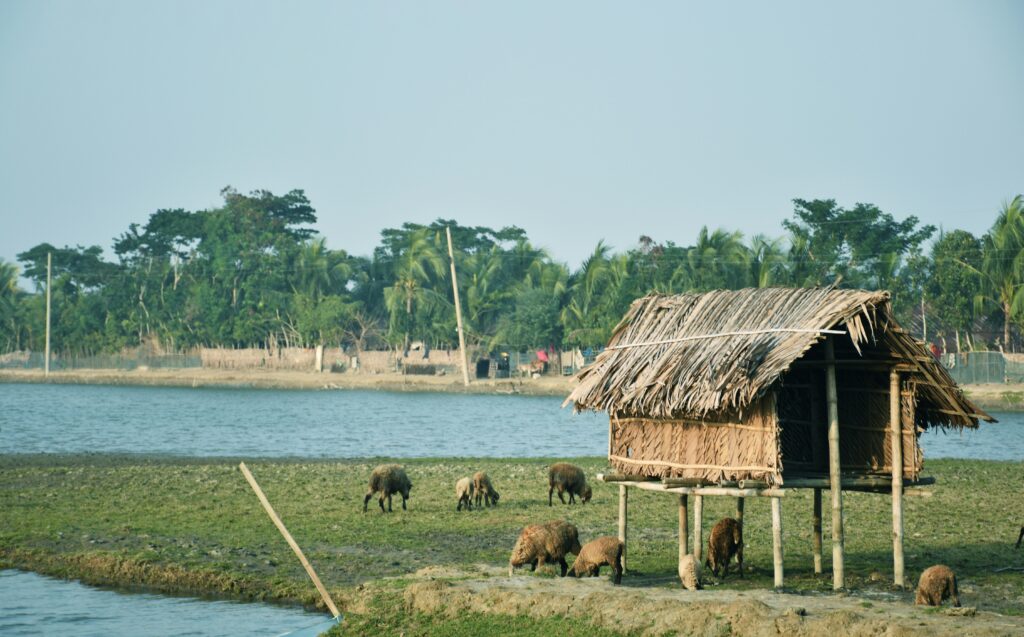
A part of India is disappearing into the sea. The Sundarbans sit where the Ganges, Brahmaputra and Meghna rivers meet the Bay of Bengal. This tidal mangrove forest stretches across India and Bangladesh. More than 4.5 million people live here. Tigers also call this place home, swimming between mangrove creeks like nowhere else on Earth. For these communities, however, the sea is no longer just scenery. It has become the central fact of daily life.
Indian Sundarbans: A Forest That Drinks Salt
The Indian Sundarbans hold 102 islands. Only 54 support villages and towns. The rest remain reserved forest. Sea levels here rise nearly twice as fast as the global average. As a result, salinity creeps into farmland with every high tide. Cyclones, too, strike more often each year. Crops fail, fish stocks shrink, and debt follows close behind. Some islands, however, feel this faster than others.
The Sinking Sundarbans Up Close

Ghoramara Island sits ninety kilometres south of Kolkata. Since 1990, it has shrunk from six square kilometres to three and a half. Researchers now expect it to vanish completely by 2050. In fact, whole villages inside it already lie underwater, including Khasimara and Lakshmi Narayanpur.
Ghoramara is not alone in this fate. Four islands across the Indian Sundarbans, Bedford, Lohachara, Kabasgadi and Suparibhanga, have disappeared over the past 25 years.
Together, they displaced roughly six thousand families. Lohachara, meanwhile, still holds a grim record. The island became the first inhabited place in the world lost entirely to rising seas. It once held 40,000 people. By 2011, however, only 5,000 remained. Cyclone Yaas made things worse in 2022.
The storm tore through Ghoramara. It also eroded land around Sagar Island’s Kapil Muni temple, a site many had assumed was safe. Sagar is where most Ghoramara families relocate. Now, sadly, Sagar erodes too. One Ghoramara resident, Sujit Mondal, has rebuilt his home several times. Asked how many, he answers simply: “At least four.”
People With No Name For What They Are
Indian law has no category for someone displaced slowly, over years, rather than by a single storm. Families moved from Lohachara to Ghoramara, for example, found themselves displaced again within a decade. The country’s disaster framework, therefore, offers no clear path for this kind of slow loss. These families are not officially cyclone victims. Nor do they qualify for the resettlement support given to people displaced by large dam projects. Instead, they simply move, usually to insecure land on the mainland.
The effects show up in small ways too. A primary school teacher in Ghoramara, for instance, watches enrolment drop every year, as parents quietly shift their children elsewhere. Meanwhile, men increasingly migrate to cities for work. Women, as a result, run the household, raise children, and care for the elderly, often alone. The world calls this climate migration. India’s policy, however, has yet to catch up with the term.
Living With the Tide and the Tiger
The Sundarbans hold the only tiger population on Earth adapted to mangrove swamps. The most recent census counted around 100 tigers on the Indian side, spread across nearly 1,900 square kilometres. Conservation work has helped stabilise these numbers. However, forest loss is shrinking tiger habitat too, pushing tigers and people closer together than either would prefer. Fishermen and honey collectors, therefore, need special permits to enter the forest’s core zones. This rule exists for good reason. Not everyone who entered in past decades came back out.
Locals still invoke Bono Bibi, the forest goddess, before risky trips into tiger territory. One nearby village, meanwhile, carries an informal name earned through decades of loss, the “widow village.” It rarely appears, sadly, in official reports about the region.
Planting Against the Sea
Restoration efforts have grown alongside the damage. Under the Government of India’s MISHTI initiative, conservation groups are replanting mangroves across unprotected zones of the delta. West Bengal’s own restoration drive has gone further still. It has planted over 123 million saplings across nearly 4,600 hectares, largely through women’s self-help groups. The results, so far, remain mixed but hopeful in places. One programme alone has engaged 2,500 women in nursery work and planting.
A women-led honey enterprise, in addition, now gives this work a steady income. Survival rates for saplings, however, still hover near 56 percent, against an 80 percent target. In Tridibnagar, meanwhile, women secured two kilometres of mud embankment, while also protecting forty acres of older mangroves. The maths, still, favours erosion. Roughly 110 square kilometres of core mangrove forest disappeared between 2000 and 2020. New planting elsewhere, unfortunately, offset only part of that loss.
More Than a Statistic
It is tempting to read the Sundarbans as numbers: hectares lost, tigers counted, families displaced. Every vanishing island, however, holds someone’s actual home, the place where they learned to fish or buried a parent. These communities did not create this crisis. Instead, they are simply standing where its effects arrive first.
The least the rest of the country can do, therefore, is pay attention before the map changes again.
Read More at India Water Portal | Earth Journalism Network | Mongabay India | WWF India
For more updates, stay tuned at The World Times