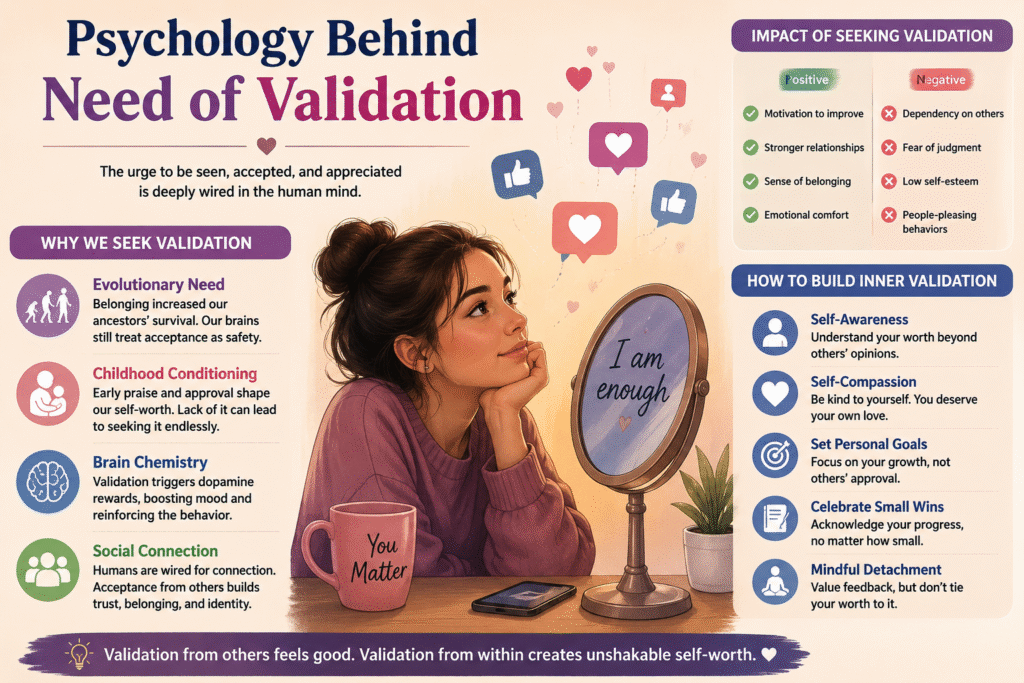
Nearly everyone has felt it: the small rush of relief when someone likes a photo, praises an effort, or simply says “you did the right thing.” This is validation, and the urge to seek it isn’t a character flaw. It’s a deeply wired psychological response with roots in evolution, childhood attachment, and brain chemistry.
Why Do We Need Validation

India’s only IPHM-accredited Trauma & Inner Child Healer Madhvi N Juneja in her interactions argued “You overlove because you feel if you over extend yourself finally that person will see value in me. You are coming from an unmeet need of you not recieving that yourself. Its because we need validation. We need aproval and save ourselves from rejection. ”
Psychologists Roy Baumeister and Mark Leary called this the “need to belong.” They said humans build relationships for survival, not vanity. Early humans stayed close to their group to stay alive. So the brain learned to treat social acceptance like food or safety.
However, that old wiring never left us. Today it shows up as a craving for likes, compliments, or a nod from the boss. Leary and Baumeister also created sociometer theory. It says self-esteem works like a gauge. The gauge tracks how much others include or reject us. When the gauge drops, we look outward for reassurance. We want proof that we still belong.
The Role of Childhood and Attachment
Much of our need for validation starts in childhood. Attachment theory says caregivers shape how we seek approval later in life. Kids who get warm, steady responses tend to grow into secure adults. They trust their own worth and need less outside approval. Kids who get mixed signals learn a harder lesson. They learn that love depends on good behavior or good performance. That belief often follows them into adulthood. Psychoanalyst Heinz Kohut called this “mirroring.” A caregiver reflects a child’s worth back to them. Steady mirroring builds a steady identity. Shaky mirroring leaves a gap. Many adults spend years searching for the reflection they never got.
Self-Esteem, Dopamine, and Social Comparison
Validation and self-esteem go hand in hand. When we doubt our own worth, outside approval fills the gap. It works because approval triggers dopamine. Dopamine is the brain’s reward chemical. It gives us a quick mood boost. But that boost fades fast. So we chase the same source again. This creates a short-term reward loop. Leon Festinger’s social comparison theory adds another piece. He said people judge their own worth by comparing themselves to others. Social media turns up the volume on this. It offers endless comparisons. It also offers instant feedback through likes and comments.
Abraham Maslow placed this need inside his hierarchy of needs. Belonging and esteem sit just above safety. Once people meet their basic needs, they seek acceptance and recognition. Maslow said the healthiest path uses that recognition as a stepping stone. It should support self-actualization, not replace it.
When Validation-Seeking Becomes a Problem
Seeking validation now and then is normal. It even strengthens our social bonds. But it becomes a problem when we can’t function without it. Some people can’t decide or feel okay unless others approve first. This pattern often links to anxiety. It can drive people-pleasing. It can make boundaries hard to set. Over time, it can weaken our trust in our own judgment.
Building Internal Validation
Psychologists Edward Deci and Richard Ryan developed self-determination theory. It splits motivation into two types. Intrinsic motivation comes from personal values. Extrinsic motivation comes from outside rewards. Shifting toward intrinsic motivation helps reduce our need for approval. Practicing self-compassion helps too. So does noticing mental traps like the spotlight effect and confirmation bias. These steps help us build our own compass.
Therefore, understanding validation doesn’t mean we should reject connection. It means we learn where the need comes from. Then approval from others becomes a bonus. It stops being a requirement for feeling whole.
Follow The World Times for more such updates.