
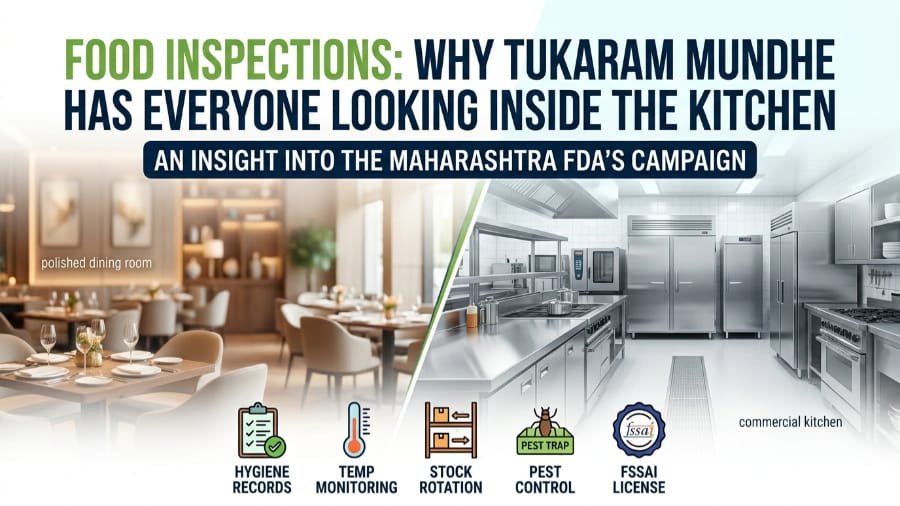
The food inspections led by Maharashtra FDA Commissioner Tukaram Mundhe have made an unlikely subject the centre of India’s food conversation: what actually happens inside a restaurant kitchen. The restaurant does everything right, at least on the surface. The lighting is warm and flattering. The plating looks like it was styled for a magazine, because increasingly, it was. The reviews are glowing. The waitlist is real. Somewhere between the amuse bouche and the bill, you’ve already decided you’ll be back.
We spend ten minutes choosing what to order. How often do we spend even ten seconds wondering what the kitchen looks like?
That’s the one part of the restaurant experience nobody designs for you. No lighting, no plating, no curated playlist. Just steel counters, walk-in fridges, pest traps, and whatever temperature the chicken has actually been sitting at since 11 a.m. For most of us, it stays permanently out of frame, a locked door somewhere past the waiter’s station that we’ve simply agreed not to think about.
This year, a lot of Maharashtra started thinking about it anyway. The person who got them thinking wasn’t a chef, a food critic, or an influencer. He was a government inspector.
Who Is Tukaram Mundhe and Why Are His Food Inspections Going Viral?

Tukaram Mundhe is a 2005 batch IAS officer of the Maharashtra cadre. He took charge as Commissioner of the Maharashtra Food and Drug Administration in May 2026.
Before food safety, Mundhe had already built a reputation in state administrative circles. People knew him for his strict approach and direct style. Multiple reports have described his frequent transfers during his career, with figures placing the number at roughly 25 transfers across 21 years of service. Those transfers have contributed to his image as an officer willing to take strong administrative positions. None of that alone would normally make headlines outside bureaucratic circles. The job changed everything.
As FDA Commissioner, Mundhe did not simply tighten paperwork. His teams walked into kitchens across the state, sometimes without advance notice. They inspected five-star hotel kitchens, cloud kitchens, sweet shops, IIT Bombay canteens, elite clubs, and quick commerce dark stores.
The FDA has branded the campaign “Safe Food, Safe Medicine, Safe Maharashtra.” The campaign has also made Mundhe one of the most recognizable civil servants in the state.
The Scale of the Food Inspections in Maharashtra
It is worth being precise here because numbers around this campaign have appeared in different forms. As of August 2026, the FDA has inspected more than 3,000 food establishments since Mundhe took charge. The food inspections cover restaurants, dairies, cloud kitchens, and quick commerce operations. The campaign has resulted in 165 licence suspensions and 764 improvement notices.
Earlier figures placed the number of inspections at around 1,131. That earlier tally also reported food stock seizures worth close to ₹50 crore and 56 restaurant licence suspensions.
The difference likely reflects different points in the campaign. The FDA has continued its inspections, which means cumulative figures can change quickly. Different reports may also group inspections and enforcement actions differently. Either way, the scale remains significant. These food inspections are not a symbolic gesture. Maharashtra has launched a sustained food safety enforcement drive, and the campaign has put restaurant kitchens under a level of public attention they rarely receive.
What These Food Inspections Actually Mean?
These numbers represent something less dramatic than they sound, and more useful. An improvement notice does not mean that authorities have shut a restaurant. It gives the establishment a chance to correct specific problems within a given period. A licence suspension carries more serious consequences, but it does not necessarily mean permanent closure. Authorities can restore a licence after an establishment meets the required conditions. The numbers therefore represent different levels of enforcement rather than one giant wave of restaurant closures.
When Food Inspections Reached Domino’s and Pizza Hut
The moment that pushed this story beyond ordinary food safety discussions came during a special FDA drive covering 104 chain restaurant outlets across Maharashtra in mid August 2026.
The inspection list included Domino’s Pizza, KFC, Pizza Hut, McDonald’s, Subway, Burger King, Starbucks, and Monginis. The drive resulted in two establishments receiving orders to stop business. Ninety-five establishments received improvement notices, while five had their licences suspended. Four of those five were Domino’s Pizza outlets. Three operated in Mumbai, including locations in Vile Parle West, Borivali West, and R City Mall in Ghatkopar West. Another operated in Malkapur in Satara district. Outlets linked to Sapphire Foods India, which operates several Pizza Hut and KFC locations, also faced action in Satara and Akola.
What Did the Food Inspections Find?
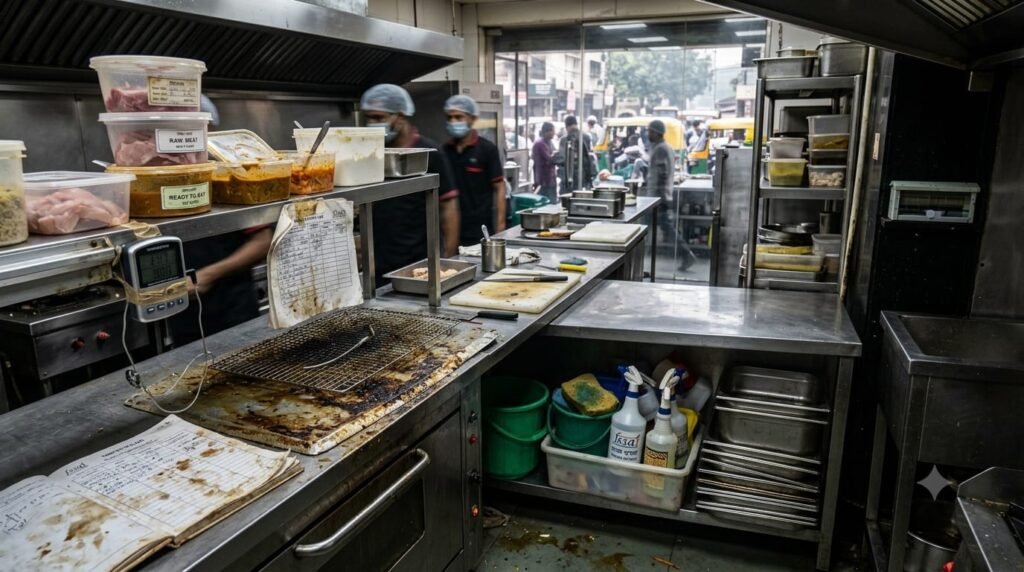
The violations officials reported were unglamorous but concrete. Inspectors flagged problems with pest control, temperature monitoring, and FIFO and FEFO stock rotation. FIFO means first in, first out, while FEFO means first expired, first out. Both systems help establishments manage food stock properly and prevent older or expired products from remaining in circulation. Officials also reported missing food grade certificates, inadequate segregation of vegetarian and non-vegetarian items, and gaps in cleaning schedules.
At the Borivali outlet, inspectors flagged problems involving storage, cleanliness, and testing records. Inspection footage also appeared to show rust and grease buildup inside at least one pizza oven. None of this means that Domino’s or Pizza Hut operate unsafe kitchens everywhere. It means that inspectors found specific compliance problems at specific outlets during specific inspections. That distinction matters. A viral headline can make an entire brand look guilty. A food inspection works differently. It examines a particular establishment, records particular findings, and takes action based on those findings.
Why Are Tukaram Mundhe’s Inspections Going Viral?
This is the genuinely interesting part of the story. It has less to do with Mundhe’s personality than with what his job has quietly reversed. Food content in India has flowed in one direction for the better part of a decade: toward the plate. Reviewers rate biryani. Influencers film the cheese pull. Restaurants compete for the most photogenic corner of the dining room. Food creators turn ordinary meals into carefully edited videos. The entire aesthetic economy of eating out focuses on how a dish looks just before you eat it.
Mundhe’s food inspections point the camera in the opposite direction. They show what happens before that moment, in a space customers rarely see. A video of an FDA team opening a walk in fridge does something a beautifully lit food reel cannot. It makes the invisible visible, even if only for a few seconds.
From Standing Ovations to Food Inspection Memes
That reversal seems to resonate beyond ordinary government department coverage. A video titled “Unstoppable Tukaram” showed an audience at Pune’s Bal Gandharva Ranga Mandir standing and applauding as Mundhe entered. The moment circulated widely online and added another layer to his growing public image.
An Instagram creator also posted a video praising visible cleanliness improvements at street food stalls he visits and credited Mundhe’s campaign. That video represents one consumer’s reaction rather than an official assessment of food safety. Still, it reflects the kind of public response that has helped turn the inspections into an internet story.
Somewhere along the way, Mundhe also picked up a nickname that stuck: “Singham”, after Ajay Devgn’s fictional, incorruptible police character. People online made the comparison. Mundhe did not create an official title around it. The nickname says more about the public’s appetite for visible enforcement than it does about food science.
At a public event, someone even asked Mundhe about a WhatsApp meme circulating about him. The meme imagined a wife asking her husband to invite Mundhe home so that he could inspect the kitchen and shut it down, saving her from having to cook. Mundhe laughed it off. It is a joke, not a policy. But it also explains something about the public mood. Humour and relief have become part of the story alongside genuine concern about food safety.
Food Inspections Versus Michelin Stars
Here is a distinction worth making because viral conversations can blur it quickly. A Michelin star and a food safety compliance report do not measure the same thing. A Michelin star evaluates culinary craft. It considers factors such as technique, creativity, consistency, and the overall dining experience. Food inspections ask a much less glamorous set of questions.
- Is raw chicken stored at a safe temperature?
- Is the kitchen’s pest control properly documented?
- Are staff following safe food handling practices?
- How well does the restaurant manage its food storage?
- And is its FSSAI licence valid and up to date?
A restaurant can succeed in one area and struggle in another. Award-worthy food can come from a kitchen with serious hygiene problems. A modest dhaba can run a remarkably clean and compliant kitchen without having the kind of plating that earns Instagram attention. Hygiene compliance is not more important than culinary skill, and culinary skill is not more important than hygiene.
They answer different questions. The problem is that customers can usually judge only one of them. We can taste the food. We cannot see what happened to it before it reached our plate.
What Do Food Inspections Reveal That Customers Never See?
Food safety guidance and the findings that have emerged from this year’s food inspections point towards a consistent list of factors that quietly determine whether a meal is safe. Proper cold chain storage and temperature monitoring matter because food can become unsafe when establishments fail to control temperature. Separation of raw and cooked food helps reduce the risk of contamination. Vegetarian and non-vegetarian ingredients also require appropriate segregation during storage and preparation.
FIFO and FEFO stock rotation help restaurants manage ingredients properly. Regular pest control, staff hygiene, cleaning schedules, and valid FSSAI licensing also form part of the less glamorous side of running a food business. None of this is visible from a dining table. You can ask a waiter about it, technically. Almost nobody does.
The entire trust relationship between a diner and a restaurant gets built on inference. Nice interiors suggest a clean kitchen. Expensive ingredients suggest quality. A long queue suggests popularity. A high rating suggests reliability. The food inspections led by Mundhe have made that assumption feel less comfortable.
Why Food Inspections Matter More in 2026
It is not a coincidence that this story has landed so strongly in 2026. Indian food culture has quietly changed shape over the last several years. A growing number of meals now arrive through delivery apps. Cloud kitchens operate without traditional dining rooms. Consumers order from restaurants they may never physically enter. There is no ambience to judge and no visible staff to observe. There is simply a photograph on a screen, a rating, a restaurant name, and eventually a delivery bag at your door.
That changes the meaning of trust. When you sit inside a restaurant, you can at least notice whether the dining room looks clean. With a delivery order, you cannot see anything beyond the food that arrives. This is where food safety regulation becomes more important to the average consumer.
Mundhe’s food inspections have made the process of checking visible to a much larger audience. Instead of food safety remaining something that happens quietly inside government offices, inspection teams have entered the public conversation. For once, people are watching the people who check the food rather than only the people who sell it.
The Other Side of the Food Inspection Crackdown
It would be a disservice to this story to stop at applause because the campaign has also faced legal scrutiny. One of the most significant cases involved Gurunanak Dairy and Sweets, a Pune sweet shop in Wadgaon Sheri. The FDA suspended the shop’s licence on June 12, 2026, following a food poisoning complaint and hospitalisations linked to the establishment. Mundhe has publicly maintained that the initial action was justified.
The situation became more complicated after the shop submitted a compliance report. A later inspection found that the shop had achieved 98 percent compliance, meeting 35 of 36 parameters. Despite that, the licence remained suspended for a period, resulting in reported financial losses for the business. The matter eventually reached the Bombay High Court.
What Did the Court Say About the Food Inspections?
A bench comprising Acting Chief Justice Ravindra V. Ghuge and Justice Gautam A. Ankhad revoked the suspension and ordered the FDA to pay the shop ₹5 lakh in compensation within 30 days. The court did not dismiss the importance of food safety enforcement. Instead, it questioned how the FDA handled this particular case.
The court described the department’s objective as laudable while criticizing the way the action continued after the shop had demonstrated substantial compliance. Mundhe said the FDA stood by its original action and would examine its legal options after reviewing the written order. He also called for the public to view food safety as a shared responsibility rather than a one-man campaign.
That case does not discredit the wider inspection drive. It also does not mean every FDA action should automatically receive public approval. What it demonstrates is that large-scale food inspections inevitably raise questions about proportionality and due process. Courts remain an important check on regulatory decisions. A restaurant losing its licence is not automatically the same thing as a restaurant being permanently proven unsafe. Both realities can exist within the same campaign.
What Should Consumers Learn From These Inspections?
Nobody needs to start touring restaurant kitchens before ordering a thali. A few simple habits can still help. Notice whether the FSSAI licence number is displayed where customers can see it. Pay attention to obvious warning signs such as visible pest activity, poor handling practices, or food sitting out for long periods.
If something genuinely seems wrong, consumers can use formal food safety complaint channels rather than relying only on social media or restaurant reviews.
A bad review tells other customers that you had a poor experience. A formal complaint can put the concern in front of the people responsible for investigating it. There is also an important lesson in the Pune case. A suspended licence is a serious regulatory action, but it does not automatically become the final word. Establishments can challenge decisions, demonstrate compliance, and seek legal remedies. Consumers should care about food safety. They should also care about fair enforcement.
The Kitchen, Finally, In Frame
Go back to that restaurant from the beginning. The warm lighting is still there. The carefully plated dish still looks beautiful. The five-star review still sits on the screen. Nothing about the dining room has changed. What has changed, at least for a while, is that a growing number of people in Maharashtra have started wondering about the door they have never walked through. Not because a celebrity chef told them to. Not because an influencer reviewed the ambience.
A government officer with a clipboard, a pest control checklist, and famously little patience for excuses opened that door on camera. Maybe the most interesting thing about the food inspections is not Tukaram Mundhe himself. It is what his inspections have made people notice. We spend hours deciding where to eat. We compare ratings, scroll through photographs, watch reviews, save restaurant reels, and debate what to order. But we rarely ask the simplest question. What happens before the food reaches us?
Sometimes the most important thing on a restaurant menu is not what you are ordering. It is what you never get to see.
Follow The World Times for more such updates.


Loved how the article was framed.
As far as the food industry is concerned, we need some major changes – both with the quality and the inspection levels!
Thank you so much! I completely agree stronger quality standards and more consistent inspections are definitely needed to bring meaning change to the food industry.