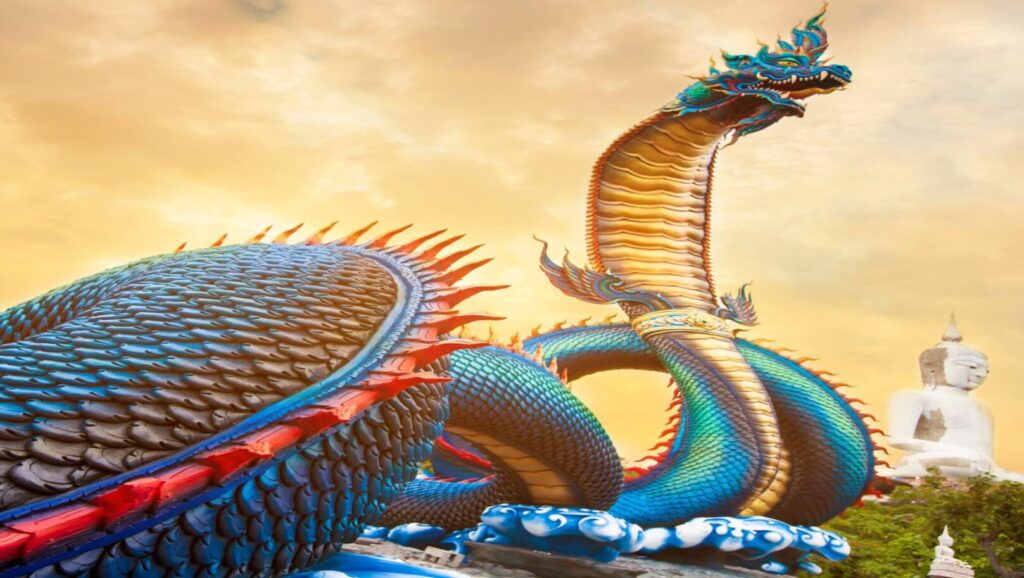
We know how culturally significant snakes are to the Indian subcontinent. But how much do the Nagas, or the snakes affect the culture of Thailand? Let’s find out!
What are Nagas?

Snakes, referred to as ‘Nāgas,’ symbolise fertility, protection, and guardianship over water bodies.
Annual observances like Nāga Panchami reflect their significance in local rituals.
Naga is the sacred name of mythical serpent in Southeast Asian and Indian literature.
In Thailand, the figure has deeply impacted in aspects of Thai traditional arts, especially in architecture and sculpture. Naga is a type of serpent worship that is widespread in Mainland China, India, Thailand, Laos, Cambodia, Burma, and Indonesia.
The origin of the Naga is related not only to the spread of Hinduism and Buddhism but also to various folk beliefs.
Significance in Thai Culture
The Thai Naga is more than just a serpent; it is a symbol of water, fertility, protection, and power.
The Naga is believed to live in bodies of water, such as rivers and lakes, particularly the Mekong River, which is central to the spiritual life and livelihood of many people in Thailand and Laos.
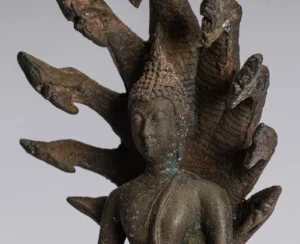
The Naga is regarded as a protector of the Buddha and Buddhism in Thailand.
Its image is frequently found at the entrances of Buddhist temples (wats). It serves as a guardian, warding off evil spirits and protecting the sacred space.
To read more about Nagas and how they influence the architecture and sculptures of Thailand, read: https://www.asianscholarship.org/asf/ejourn/articles/Phan%20Anh%20Tu3.pdf
The Naga’s coiled body and watchful eyes symbolise its vigilance in protecting the Dharma.
One of the most famous Naga legends in Thailand revolves around Phaya Naga, a king of the Nagas believed to reside in the Mekong River, particularly in the area near Nong Khai. According to local folklore, Phaya Naga is a benevolent serpent that protects the people of the region and controls the waters of the Mekong. This connection between the Naga and water is significant, as water is not only essential for agriculture but also plays a key role in Thai religious rituals.
Thai Festivals

The Naga continues to play an active role in Thai cultural and religious festivals, especially in regions near the Mekong River. The most famous festival linked to the Naga is the Naga Fireball Festival.
The Naga Fireball Festival, held annually in Nong Khai during the Buddhist festival of Ok Phansa, is one of Thailand’s most unique and mysterious events.
Thousands of locals and tourists gather along the banks of the Mekong River to witness the spectacle of glowing orbs, known as Naga Fireballs, rising from the water.
While scientists attribute the phenomenon to natural causes, local people believe the fireballs are a sign of the Naga paying homage to the Buddha.
Nagas in Thai Media

We have a number of Thai Dramas that focus on retelling the story of Nagas.
- The bride of naga: A pediatrician discovers her past life connection to a naga guardian while treating children with mysterious snake scales.
- The sign: A fantasy BL series features a naga prince as a primary antagonist, adding a modern twist to traditional mythology.
- Khemjira: A drama about a young man from a cursed family who must seek the help of a mysterious shaman to survive a vengeful ghost and break the curse that kills all male descendants before they turn twenty-one. There are a few references to the snake god, the shaman is believed to be a reincarnation of a Naga.
- The blaze of naga: This series follows two naga brothers with differing beliefs, leading to conflict within their ancient lineage.
- Nakee: An archaeology student falls in love with a beautiful girl who is the reincarnation of a powerful naga goddess.
- Poot Mae Nam Khong: A classic lakorn where the legend of the naga spirit in the Mekong River is a central theme.
Stay tuned to The World Times for more such content!