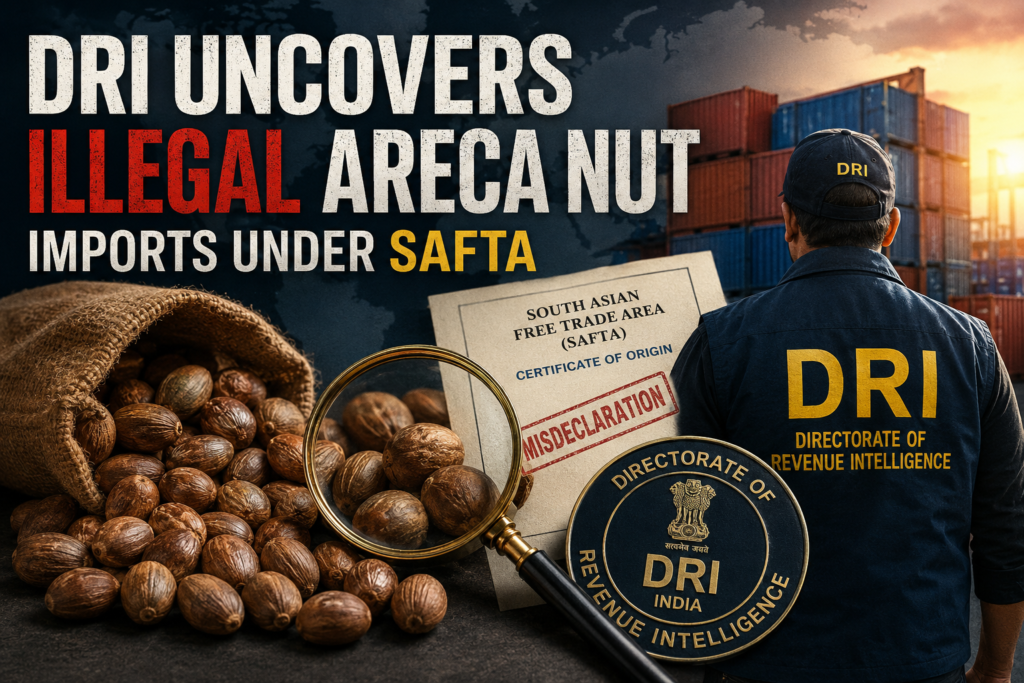
The Directorate of Revenue Intelligence (DRI) has uncovered a large network involved in illegal areca nut imports. The network falsely declared South-East Asian consignments as goods originating from Bangladesh.
According to the Ministry of Finance, the month-long investigation points to a potential customs revenue loss of more than Rs 2,500 crore. DRI has also arrested nine people. It seized around ₹75 lakh in cash, along with nearly 160 metric tonnes of areca nuts.
How the Illegal Areca Nut Imports Worked
India charges a 100% Basic Customs Duty (BCD) on areca nut imports. However, eligible imports from Bangladesh can receive full customs duty exemption under the South Asian Free Trade Area (SAFTA) agreement if they meet the required Rules of Origin.
DRI found that certain syndicates tried to exploit this provision. The groups sourced areca nuts from Indonesia, Thailand, Malaysia and other South-East Asian countries. However, they declared Bangladesh as the country of origin when importing the goods into India.
Investigators found that the network routed the consignments through an Export Processing Zone in Bangladesh. The operators then changed the containers and bags before sending the goods to India. They presented the consignments as Bangladeshi-origin areca nuts and claimed SAFTA benefits.
This method allowed the network to avoid customs duty on a large scale.
DRI Searches Reveal Evidence From Areca Nut Imports
After developing intelligence about the areca nut imports, DRI teams carried out simultaneous searches at several locations linked to importers, Customs Brokers and Importer Exporter Code holders in Kolkata and Visakhapatnam.
During the searches, officers recovered documents and other evidence that indicated the actual South-East Asian origin of the areca nuts. DRI also seized around ₹75 lakh in cash, which investigators believe represents proceeds from the illegal trade.
Officials also intercepted a live consignment containing around 160 metric tonnes of areca nuts.
The investigation indicates that the network operated on a significant scale over recent years. According to the Ministry of Finance, the activities may have caused a customs duty loss of more than ₹2,500 crore.
The Network Used Multiple Channels

DRI’s investigation found that the masterminds arranged the movement of areca nuts from South-East Asian countries to Bangladesh before sending them to India. The network also obtained SAFTA Certificates of Origin from Bangladeshi authorities to support the false declarations.
The operators charged Indian importers commissions for arranging routing, documentation, customs clearance and transportation. Investigators also found indications that the network used hawala channels and dummy entities to move and layer the money generated through the operation.
The case therefore goes beyond simple misdeclaration. It points to an organised system that connected overseas suppliers, intermediaries and Indian importers.
Action Against Customs Broker
The investigation also brought a Customs Broker firm under scrutiny. DRI found that the firm handled the clearance of most of the fraudulent areca nut imports identified in the case.
Following the investigation, the competent authority suspended the firm’s Customs Broker licence. DRI has so far arrested nine people in connection with the case, while the investigation continues.
Impact of Illegal Areca Nut Imports on Legitimate Trade
Illegal areca nut imports can put domestic growers and genuine businesses under pressure. When traders avoid customs duty through false declarations, they can sell the goods at prices that legitimate importers and businesses may struggle to match.
The practice can also cut government revenue and weaken the regulated trade system. In its latest operation, DRI disrupted a network that allegedly used false declarations, SAFTA concessions and customs duty evasion to bring large quantities of areca nuts into India.
Authorities are continuing the investigation as they look into the wider network and financial transactions linked to the areca nut imports.
Read more on PIB.
Follow The World Times for more such updates!