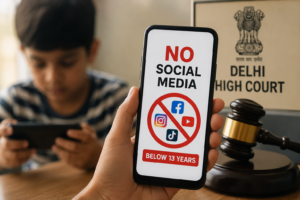
A Public Interest Litigation (PIL) seeks a ban on social media access for children below the age of 13. The petitioners filed it in the Delhi High Court. Along with this, the petition has also asked the Central Government to bring in a proper legal framework. The framework would protect children from harmful online content and the growing issue of digital addiction.
The matter came up before a Bench of Chief Justice DK Upadhyaya and Justice Tejas Karia on Wednesday. However, the hearing did not go ahead as planned after Justice Tejas Karia recused himself from the case. The petition is now likely to be listed before another Bench of the High Court.
Who Has Filed the PIL?
Kirti Dua, the mother of a three-year-old child, along with paediatrician Dr Sharad Gupta, filed the petition.
They have made the Union of India a respondent. They have done so through the Ministry of Electronics and Information Technology, the Ministry of Women and Child Development, the Ministry of Education and the Ministry of Health. The petition also names the National Commission for Protection of Child Rights (NCPCR).
Apart from government authorities, the petition includes several major social media companies as respondents. These are Meta, Alphabet (Google), Telegram, Snap Inc. and X Corp.
PIL Raises Concerns Over Child Safety
According to the petition, children are increasingly coming across sexually explicit and age-inappropriate content while using social media platforms. It also raises concerns over cyberbullying. It says many platforms use designs that encourage users to spend more time online, making them addictive.

The plea says these factors are affecting the mental, emotional and physical well-being of children. It argues that the issue is no longer limited to screen time alone. It also says there is a need to examine the wider impact social media can have on young users.
The petition points out that India already has laws such as the Information Technology Act, the IT Rules, the Digital Personal Data Protection Act and the Protection of Children from Sexual Offences (POCSO) Act.
However, it says that despite these legal provisions, authorities have not implemented them adequately. According to the plea, children continue to face online risks. This shows that authorities are not enforcing existing safeguards effectively.
What Does the PIL Seek?

One of the PIL’s key demands is for the Union Government to frame binding legislation and clear guidelines. These would restrict access to social media platforms for children below the age of 13.
The petition has also asked for strong age-verification systems and parental consent mechanisms so that access by children below the prescribed age can be checked properly.
In addition, it wants social media companies to be made more accountable for child safety. It says these platforms should take greater responsibility. They should protect minors from harmful content and put proper safeguards in place.
Previous Court Decisions Cited
To support its arguments, the petition refers to a number of judicial precedents. These include decisions of the Supreme Court and the Madras High Court on issues related to online child safety and child sexual abuse material.
It also mentions developments in foreign jurisdictions. Those jurisdictions have introduced stricter safeguards for minors using social media. According to the petition, these examples show that stronger protections for children in the digital space are possible.
What Happens Next?
The petition argues that India now needs a comprehensive statutory framework to deal with the growing problem of digital addiction and different forms of online harm affecting children. It says that while several laws already exist, authorities must implement them more effectively. It also calls for specific legislation that directly addresses children’s use of social media.
For now, the case is still at an early stage. Since Justice Tejas Karia has recused himself from hearing the matter, the Delhi High Court will now place the PIL before another Bench. The next hearing is expected to take place once the matter is assigned to the new Bench.
Read more on ANI.
Follow The World Times for more such updates!