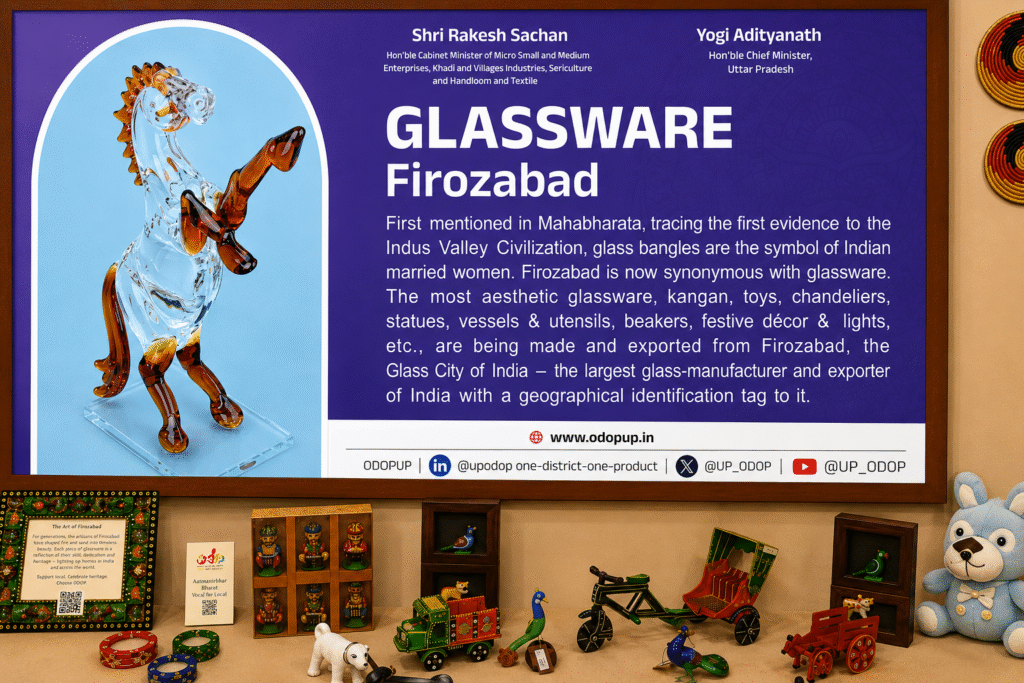
Tucked 37 kilometres west of the Taj Mahal, Firozabad quietly holds a world record that most travellers overlook. The city produces roughly 70 percent of India’s glass bangles and supplies glassware to buyers across five continents. Yet it remains far less celebrated than it deserves. Furthermore, Firozabad is not merely a manufacturing town. It is a living museum of one of South Asia’s oldest industrial crafts, a place where Persian aesthetics, Mughal patronage, and modern kiln technology fuse inside narrow workshop lanes every single day.
A Mughal Spark, a British Flame
Emperor Akbar established the first formal glass workshop in Firozabad around 1580 CE, during the height of the Mughal Empire. He specifically recruited master craftsmen from Persia and Central Asia, because Mughal courts prized translucent glassware as a marker of refinement and power. However, the industry remained largely artisanal until the nineteenth century. Under British colonial administration, trade routes expanded dramatically.
Consequently, Firozabad’s glassmakers gained access to cheaper coal, soda ash, and silica sand from the Gangetic plains. As a result, small furnace units multiplied across the town. By the early twentieth century, Firozabad had already displaced older glassmaking centres in Bengal and Rajasthan. Additionally, railway connectivity to Agra and Kanpur allowed finished goods to reach markets across the subcontinent within days rather than weeks.
Today, the Firozabad cluster hosts more than 75,000 small and medium manufacturing units within the city limits alone. Together, these units employ approximately 150,000 direct workers and an estimated 400,000 people in ancillary trades such as packaging, transport, and raw material supply. Moreover, the industry generates an annual turnover exceeding ₹10,000 crore (roughly USD 1.2 billion), according to figures cited by the Uttar Pradesh government’s MSME department.
Exports reach the Gulf Cooperation Council countries, Southeast Asia, the United States, and Europe, primarily through the Agra and Kanpur inland container depots. Notably, the bangle segment alone accounts for nearly 60 percent of total output by volume. Nevertheless, manufacturers have diversified significantly over the past two decades. They now produce chandeliers, laboratory glassware, solar-grade glass components, and decorative figurines that compete directly with imports from China and the Czech Republic.
Kanchhkars: The Artisans at the Heart of It All
Local craftsmen carry the title “Kanchhkar,” derived from “kanch,” the Hindi word for glass. These artisans master at least six distinct techniques: blowing, moulding, etching, cutting, polishing, and hand-painting. Consequently, a single finished chandelier may pass through twelve or more pairs of hands before it leaves the workshop. Traditionally, families transmitted these skills exclusively through oral instruction and direct observation. Sons watched fathers work the furnace at temperatures exceeding 1,400 degrees Celsius. Daughters learned the delicate art of bangle lacquering from their mothers and aunts. Therefore, the knowledge base stayed tightly concentrated within a small number of hereditary communities.
In recent years, however, the Uttar Pradesh government’s One District One Product (ODOP) initiative has begun formalising training. Under this scheme, young artisans receive structured instruction in modern design software, quality control standards, and export documentation. As a result, several workshops have successfully obtained BIS (Bureau of Indian Standards) certification for the first time.
Challenges the Industry Cannot Ignore
Despite its scale, Firozabad’s glass industry faces serious structural pressures. First, natural gas prices have risen sharply since 2021, squeezing the margins of small furnace operators who consume large volumes of fuel. Many units still use outdated pot furnaces, which consume three to four times more energy than modern tank furnaces. Chinese bangle imports, priced significantly lower due to automated production, have eroded the domestic market share for standard-grade Firozabad bangles. As a result, hundreds of smaller workshops have shut down or consolidated over the past decade.
Additionally, occupational health remains a pressing concern. Workers in buffing and polishing units inhale fine glass dust, raising the risk of silicosis, a severe and irreversible lung disease. Several civil society organisations and medical studies from King George’s Medical University in Lucknow have documented elevated silicosis rates among Firozabad’s glassworkers. Therefore, the industry urgently needs mandatory ventilation standards and personal protective equipment. Child labour, though declining due to stricter enforcement, has historically been a problem in bangle-stringing units. Sustained vigilance from district authorities and NGOs remains essential to protect the city’s youngest residents.
Policy Momentum and the ODOP Push
The central government designated Firozabad glass as a GI-tagged product under the Geographical Indications of Goods Act. This tag legally protects the brand name and restricts its use to authentic Firozabad products. Consequently, exporters can now command premium prices in international markets that value certified provenance. Moreover, the ODOP programme has built a common facility centre in Firozabad with centrally maintained cutting machines, polishing units, and a quality testing laboratory.
Small artisans access these facilities at subsidised rates, thereby reducing their capital expenditure significantly. Additionally, the programme connects artisans directly to the Government e-Marketplace (GeM) and to international buyers through virtual trade fairs. Nevertheless, implementation gaps persist. Many artisans remain unaware of the ODOP benefits. Therefore, district-level outreach and simplified registration processes are critical to ensuring that the policy’s gains reach the most vulnerable workshops.
What Travellers Find in Firozabad
Firozabad rewards curious travellers willing to step off the Agra tourist trail. The city’s bazaars—especially the lanes around Sadar Bazar and the glass wholesale market near the railway station—overflow with every conceivable form of glasswork. Visitors can browse stacked towers of bangles in hundreds of colour combinations, ornate chandeliers, hand-painted vases, and novelty figurines. Several workshops welcome visitors for informal tours during working hours.
Watching a Kanchhkar rotate a molten gather of glass at the end of a blowpipe, then shape it into a perfect sphere in under thirty seconds, is genuinely awe-inspiring. Therefore, travellers who time their visit between October and March—when temperatures are more comfortable—get the richest experience. Established destinations include Jain Glass and Handicraft, Firozabad Glass Emporium, and Antique Glass Bazaar. Additionally, the weekly Tuesday market near the collector’s office draws wholesale buyers from across India and occasionally from Nepal and Bangladesh.
Visitors who study Firozabad glassware closely notice recurring motifs: intricate lattice patterns, floral arabesques, and geometric star formations. These designs trace directly back to the Persian craftsmen Akbar imported four centuries ago. Moreover, certain colour combinations—deep cobalt blue paired with gold leaf, or turquoise with oxidised silver—mirror classical Iranian glasswork from the Safavid period. Over generations, Firozabad artisans blended Persian influence with Rajput and Mughal decorative sensibilities. They also absorbed techniques from Venetian traders who reached the subcontinent through Portuguese ports. Consequently, Firozabad glass occupies a genuinely unique position: it is neither purely Persian, nor Mughal, nor European, but a distinct synthesis that exists nowhere else on earth.
Firozabad: A City That Deserves Its Moment
Firozabad holds a mirror quite literally to India’s capacity for extraordinary craft. The city transforms raw silica sand into objects of beauty that travel to living rooms, temples, and markets across the world. Moreover, it does so through skills honed across four centuries of unbroken practice. However, that continuity is not guaranteed. Energy costs, health risks, competition from automated imports, and a skills gap among younger generations all pose real threats.
Consequently, Firozabad needs sustained policy attention, greater tourist engagement, and stronger international marketing to secure the next four hundred years of its molten legacy. India rightly promotes its grand monuments. Yet it must also celebrate the living workshops behind its city walls—places like Firozabad, where every bangle that catches the light carries centuries of human ingenuity inside its curve.
Follow The World Times for more such updates!