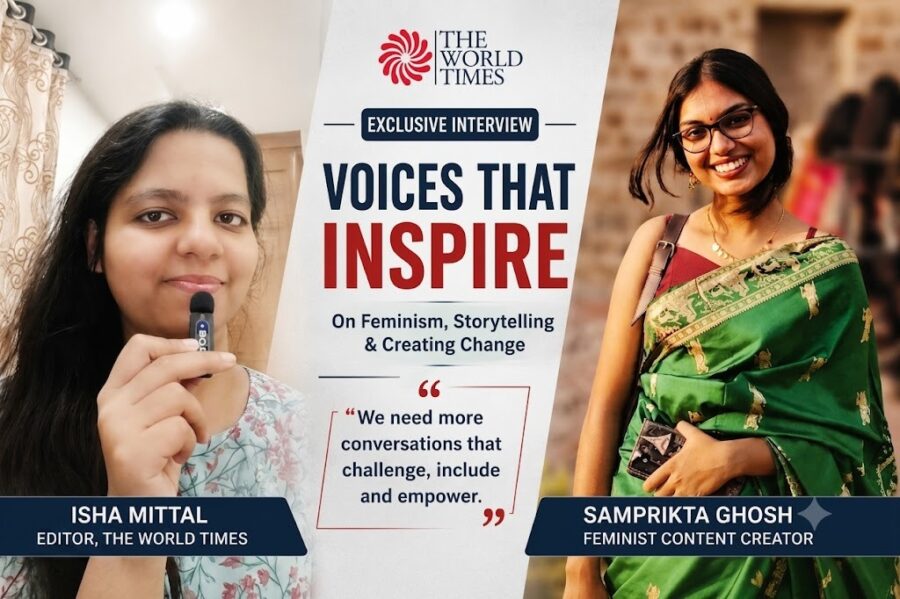
Interview with Samprikta Ghosh (Source: Isha Mittal via The World Times)
“What’s often missing is how some people are subject to all of these [forms of discrimination], and the experience is not just the sum of its parts.”
These words by Kimberlé Crenshaw highlight how experiences of discrimination are shaped not only by gender but also by caste, class, race, and other social identities.
Stories of dalit women often remain silent when discussions about gender justice are becoming more and more prominent. According to the National Crime Records Bureau (NCRB), approximately 81 to 84 rape cases are reported every day in India. However, far fewer data sources document the realities faced by women in rural and marginalized communities. A report submitted to the UN Special Rapporteur on Violence Against Women states that around ten Dalit women and girls are raped every day in India in 2019. Such statistics reveal how sexual violence continues to disproportionately affect women from marginalized communities, often remaining absent from mainstream conversations.
Samprikta Ghosh, a feminist academic, content creator, and socio-literary scholar from Miranda House, focuses on the intersections of gender, caste, class, and media. Through her research and social media presence, she examines how these forces shape everyday life. She aims to make discussions on social justice, representation, and contemporary culture accessible and engaging for wider audiences.
Treatment of Women in Chaaru: A Rebel Heart in The Times of Change by Samprikta Ghosh

Patriarchy is not a new phenomenon. It has historically confined women to domestic spaces and limited their access to education, employment, and public life. Literature reflects these realities and records the changing roles and treatment of women in society. From Jane Eyre, in which Jane seeks identity and independence in the Victorian era, to The Grip of Change and the poetry of Emily Dickinson and Eunice De Souza, literature has consistently documented women’s struggles against social constraints.
Samprikta Ghosh’s recently published novel, Chaaru: A Rebel Heart in the Time of Chains, is no exception. The novel explores the lives of women in nineteenth and twentieth-century Bengal and the challenges they faced in pursuing education and autonomy. Speaking about her book, she explains:
“I started writing the book when I was quite young. It was majorly related to the role of some educated, upper-class women in the independence struggle. Or I should say, in the independence of women from social taboos. It was also a bit inspired by the life of Kadambini Ganguly, the first woman doctor from Bengal and the second woman doctor in India after Anandi Joshi. It was closely related to the politics of Bengal in the nineteenth and twentieth centuries. I wanted to explore, with some blend of imaginary narratives that blurred the boundaries of time and space, what education could have meant to the few women who could and dared to access it in those times.”
Witch-Hunting: A Continuing Violence Against Women
Witch-hunting, or daayan pratha, remains a persistent form of gender-based violence in parts of India. People often brand vulnerable rural women as witches and blame them for illnesses, crop failures, and other local misfortunes. Widows, elderly women, and women from marginalized communities face the highest risk.
“It still happens. When you transgress social roles, or are too vulnerable at an intersection of identities like gender, caste, and class, it intensifies.” — Samprikta Ghosh
In one of her social media videos, Samprikta highlights how women are often treated as commodities and targeted in the name of honour, superstition, and social control. Such practices continue to have deadly consequences. Further in the video she emphasises:
“According to NCRB data, more than 2,500 homicides have been recorded since 2000 in which witchcraft or black magic was cited as the motive .”
What Is Feminism? How Has Social Media Shaped Feminism?
“A voice for all categories of women, beyond Instagram feeds and selective visibility of a few privileged” — Samprikta Ghosh
Feminism has no single definition. Scholars María Lugones and Elizabeth Spelman argued that feminism cannot be reduced to one framework because women’s experiences differ. What empowers one woman may not empower another. Feminism therefore recognizes diverse experiences and the many forms of oppression women face. During the conversation, Samprikta emphasized this diversity, stating:
“Personally, to me, feminism means acknowledging the fact that ‘women’ are not a homogeneous community, even if some common, embodied experiences are shared. All women experience discrimination, marginalization, and harassment based not just on their gender identity but through the intersection of their identities.”
As a feminist content creator, Samprikta views social media as a powerful tool for amplifying marginalized voices and creating spaces for dialogue. It enables activists and creators to reach millions of people, challenge dominant narratives, and raise awareness about social injustices. However, she also cautions against viewing social media as an entirely democratic platform. While it offers visibility, it does not represent all voices equally.
Discussing the importance of intersectionality, she explained:
“Dalit feminism has introduced a lens of both caste and gender into the discourse. It shows how society privileges the upper-caste male as the most preferred subject position. All others—whether an upper-caste woman, a Dalit man, or a Dalit woman—are hierarchically arranged in what Ambedkar described as a graded inequality. Their experiences of discrimination vary according to the intersections of caste, gender, and class. It is really important to acknowledge these varying experiences and the role identities play in shaping them.”
Samprikta further highlighted the limitations of digital activism and social media algorithms. According to her, online platforms often amplify dominant narratives while sidelining voices from marginalized communities.
“The algorithm only lets dominant mainstream narratives become trendy and reinforced. No one gets to know what the lowest strata of women face, why they face it, and why their voices never reach your Instagram feeds.”
She argues that social media creates an illusion of equal freedom of expression. In reality, social and economic hierarchies still shape visibility and influence. People with economic and cultural capital own major media platforms and business houses. As a result, these spaces often reflect privileged perspectives. Despite the apparent openness of digital platforms, many marginalized voices still struggle for recognition.
Challenges Don’t Stop You When Your Voice Speaks Against Injustice: Samprikta Ghosh’s Journey
In today’s social media-driven world, we often consume only the content placed before us and ignore uncomfortable realities. Digital platforms create echo chambers that reinforce existing beliefs. As a result, people dismiss, ignore, or normalize social issues, including gender-based discrimination. Many people see patriarchy as tradition rather than oppression. Generations have passed it down and accepted it as a social norm. Women, too, may internalize these beliefs and view restrictions and expectations as cultural responsibilities instead of signs of inequality.
For Ghosh, the RG Kar rape and murder case marked a turning point. The incident pushed her to speak more actively about gender justice, caste discrimination, and the realities of marginalized women. However, advocacy on social media comes with challenges. She says that criticism and backlash often come not only from men but also from women, revealing how deeply patriarchal values remain embedded in society.
Reflecting on what inspired her work, she says:
“As I said, the RG Kar rape case was one. Then my years as a student of literature as well as sociology, urged me to speak up. The more I was exposed to the brutal realities that marginalized women face, the more I knew I had to do something. I knew I wanted to work for the well-being of these sections. And writing is just one medium through which I do that.”
Samprikta Ghosh’s voice thus serves as a reminder that paying attention to those whose narratives are frequently left out of popular discourse is the first step toward real social change as feminism debates continue to develop. In this perspective, feminism encompasses not only gender equality but also acknowledging the various forms of discrimination that impact people’s lives and making sure that no voice goes unnoticed.
For more updates, follow The World Times