
Mira Nair, an Indian-American filmmaker, is known for making movies that don’t just show stories; they bring characters to life. Her films come from different corners of the world, ranging from India Cabaret to Mississippi Masala, set in the US, to Queen of Katwe in Uganda, and many more, as she describes herself as “An Indian filmmaker at home in the world,” explaining that her movies are international. Her lens on Indian societies and dynamics is filled with social texture, chaos, and drama that feel relatable, and as for culture, it is safe to say that every director has their own eye.
Mira Nair and the Women of India Cabaret

Mira Nair began her career with the documentary India Cabaret (1985). Through the film, she closely observes the lives of cabaret dancers and the world around them. In doing so, she explores how they entered the profession, how they spend their days, the dreams they hold, and the stigma and harassment they endure.
At the same time, the documentary exposes society’s hypocrisy. It highlights how ignorance, moral judgment, and social prejudice shape people’s perceptions. Consequently, viewers witness a stark contrast between the socially celebrated image of the “ideal” woman and the discrimination faced by cabaret dancers, who are often labelled immoral.
More importantly, the film goes beyond stereotypes. Rather than merely documenting their circumstances, it reveals their humanity. Through their stories, laughter, struggles, and disappointments, Nair offers a rare and intimate glimpse into their lives, emotions, and resilience.
Mira Nair Through Salaam Bombay!: Childhood on the Margins

Salaam Bombay! (1988) marked Mira Nair’s breakthrough as a feature filmmaker. In many ways, it echoed the realism of India Cabaret. The film follows a young boy who becomes separated from his mother and village and finds himself alone in Bombay. Through his journey, Nair explores themes of separation, longing, friendship, desire, and the harsh realities of urban life.
Furthermore, Nair cast many non-professional actors, which allows the performances to feel raw, natural, and deeply authentic. As a result, the film captures childhood innocence as it collides with poverty, exploitation, and violence. At the same time, it portrays children confronting realities they neither understand nor deserve to witness at such a young age. Consequently, the narrative becomes both emotionally powerful and socially significant. In recognition of its compelling storytelling and impact, the film won the National Film Award for Best Hindi Feature Film in 1989.
Between Home and Exile: Mississippi Masala

Mississippi Masala (1991), an Indian-American film set in Mississippi, follows a Ugandan-Indian family trying to rebuild their life after displacement. Unlike stories driven by intense tragedy or dramatic confrontations, the film quietly explores identity, migration, and belonging through everyday interactions.
Beneath the warmth and romance lies a constant feeling of being caught between places, where neither America nor their past fully feels like home. Through Mina and Demetrius’ relationship, Mira Nair doesn’t just show love between two people, but also the emotional conflict of race, culture, and community expectations.
Even amidst the humour and family chaos, there is a lingering feeling of search for acceptance, familiarity, and a place to belong. Therefore, the film feels gentle, but underneath that softness is a layered understanding of displacement and human connection.
Desire, Dignity, and Defiance in Kama Sutra: A Tale of Love

The Heart of Family in Monsoon Wedding

Followed by Monsoon Wedding (2001), as the name suggests, it is filled with family chaos, quarrels, and haste over a wedding. The characters go through a roller coaster of emotions, from confusion to confrontations, happiness to sorrow.
Furthermore, the story doesn’t just show the preparations of the wedding; it also depicts the attached sentiments of excitement and insinuating anxiety, simultaneously with hidden trauma. The characters might make the viewer think about their own emotional depth, connecting them with the audience. The story is full of lives that one might have personally witnessed, making the humour more empathetic and identifiable.
Hence, the film was awarded the Golden Lion (2001), Zee Cine Special Award for International Cinema (2002), and British Independent Film Award for Best Foreign Independent Film – Foreign Language (2002).
Identity, Memory, and the Meaning of Home: The Namesake
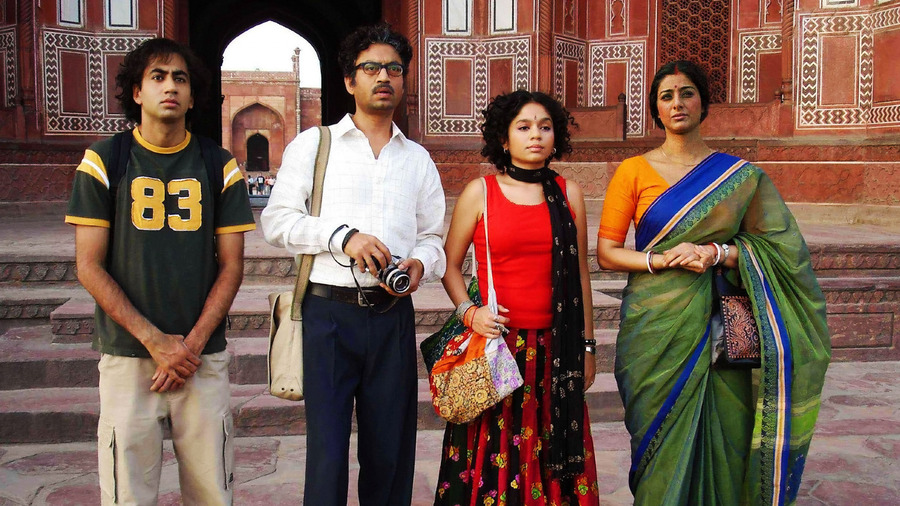
In 2006, she directed The Namesake, based on the novel by Jhumpa Lahiri, a story that is very different from her previous work, inclined towards how someone can’t completely understand another person’s perspective, and how it takes years and a lifetime to grasp the reason behind one’s actions. The story is based on a couple shifting from India to the US, where they start a family, and Ashok (Irrfan Khan) names his son “Gogol” (Kal Penn) after his favourite author.
Parted from his country, creating a generational gap, he finds his roots indirectly connected to India. During the film, Gogol explores his path in his career, the reason behind his name, and eventually his identity. The story will make one introspect within their core and personality.
The Many Worlds of Mira Nair
Mira Nair, honoured with the Caméra d’Or in 1988 and the Padma Bhushan in 2012, does more than make films. She tells stories that reveal overlooked lives, emotions, and experiences. Her creativity and artistic vision run through her body of work, and now she returns with Amri, a coming-of-age biographical drama based on the life of Amrita Sher-Gil. Moreover, this project holds particular significance for Nair. Through Amrita’s journey, the film explores how a young artist discovers her talent, develops her worldview, and finds inspiration in art and life. Anjali Sivaraman stars as Amrita Sher-Gil, alongside Priyanka Chopra, Emma Watson, Jaideep Ahlawat, and Jim Sarbh.
Nair has built her career on sharp observations of human relationships and emotions. Therefore, one of the most compelling aspects of Amri will be seeing how she brings Amrita’s complex inner world to the screen. Through this biography, Nair has the opportunity to explore ambition, creativity, identity, and self-discovery with the sensitivity that has long defined her work.
For more, stay tuned to The World Times