
Chloe Zhao’s 2025 directorial Hamnet is a historical drama adapted from Maggie O’Farrell’s 2020 novel. It narrates the story of how William Shakespeare and his wife, Agnes Hathaway, come to terms with the death of their 11-year-old son Hamnet. The movie garners attention for its subtle portrayal of how grief empowers people and inspires the transformative power of art.
Premise Of Hamnet
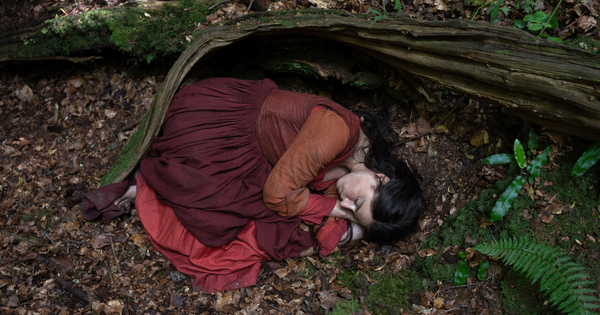
Hamnet dramatises the familial life of William Shakespeare. It intermingles folklore along with strong family values to paint a picture of love, guilt, and grief.
The movie starts with the accidental meeting of William and Agnes. Rumoured to be the daughter of the forest witch and an expert in herbal lore, Agnes becomes William’s point of attraction. They are quick to consummate their relationship. It is almost a natural kind of love that flows among them. William re-collects the legend of Orpheus and Eurydice to Agnes, while she cures him with her knowledge of herbs. Agnes predicts that William will have a successful future, followed by two children at her own deathbed.
After facing retaliation from his father for being useless at work, William embarks on a journey to London to begin a career in theatre. Meanwhile, Agnes gives birth to their daughter Susanna in the woods. She finds a quaint strength and tranquillity amidst nature. Complications arise when she has to deliver her second set of children, Hamnet and Judith. Unable to reach her coveted site in the woods, Agnes anxiously gives birth at home.
The birth of the children foreshadows their future. Judith is stillborn. Defying norms, Agnes holds her and brings her back to life. She embodies the nurturing abilities of Mother Nature, her only solace. Catastrophic rainy weather hints at the imminent travesty that will befall the lives of the children.
Hamnet’s Death Initiates a Grieving Ritual
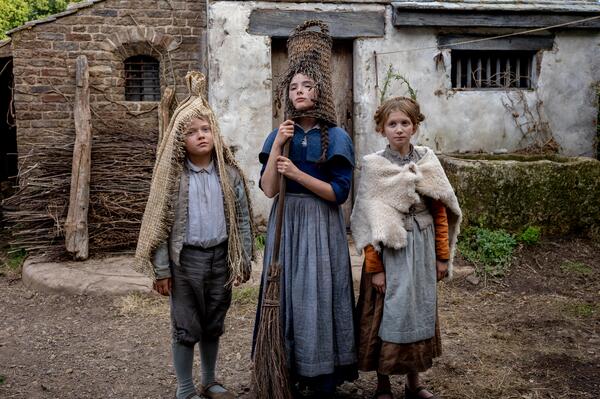
Hamnet and Judith grow up as mirrors of each other. They often swap places as a child’s play. However, life takes a shocking turn when Judith contracts the bubonic plague. She grows pale and white, and almost crosses the threshold of death. None of Agnes’s charms brings her back to life again.
It is then that Hamnet steps up. He tricks Death into believing that he is Judith. Hamnet falls terribly ill at the expense of Judith’s life. Yet this time, Agnes is unable to rejuvenate her child. Hamnet passes away, beginning the ritual of grief that haunts this family forever. Metaphorically, Hamnet becomes trapped in the stage, a representation of the grief that will haunt William. He calls out to his mother and prays to her hawk to set him free. The stage, which has been William’s heaven, demands a sacrifice from him – one that will be fulfilled through art.
Hamnet’s death initiates a negative spiral, disrupting the familial structure. Agnes and William grow apart due to their differences regarding their grief. William secretly blames himself for being an absent father, and Agnes fails in her duty as a mother to protect her children. Their life truly becomes a “walking shadow,” which is “full of sound and fury,” but signifies “nothing.”
The drifting apart is apparent when Agnes remains passive to William’s materialistic success. Their differential attitudes become a study in mourning and melancholia. While William finds a way to mourn his loss by transforming it into art, Agnes is unable to do the same. It becomes a profound, melancholic limbo for her.
The Creation of Hamlet
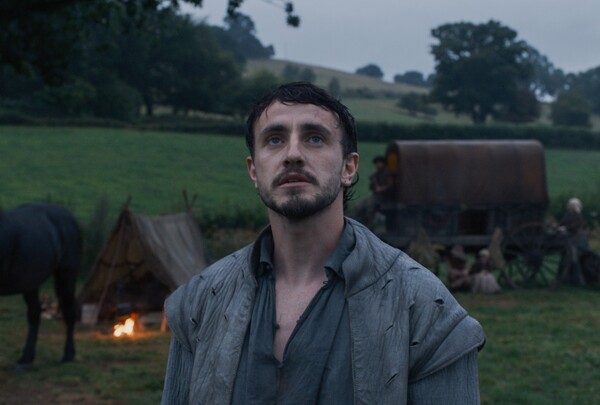
Grief always finds a way to exert itself into art, and Shakespeare is no different. Unable to bear the disillusioning reality of his son’s death, he pens one of his greatest tragedies, Hamlet, Prince of Denmark. However, very little has been discussed about the background of the play. The movie significantly succeeds in showing the family man behind Shakespeare, one who was distraught with pain. Consequently, he channels his mourning through his creation.
Meanwhile, William obsessively rehearses Hamlet in London and grows increasingly disappointed by his cast’s monotonous delivery. In particular, he repeatedly revisits the “To be or not to be” monologue, emphasising his own existential crisis. Thus, the play becomes a quest to achieve catharsis and allow those suppressed emotions to flow. In this way, it transforms into a purgatorial ritual.
Interestingly, this transference initiates a role reversal. In the play, it is Hamlet’s father who passes away, giving Hamlet one final chance at redemption. Through this narrative, Shakespeare indirectly expresses his desire to swap places with his son.
Agnes’s Realisation and the Film’s Message on Grief
Meanwhile, Agnes sees nothing ahead of her. Therefore, her brother, Bartholomew, takes her to London for the staging of the play. Initially, she is offended by William for profaning their personal misery. However, Agnes soon notices a peculiar connection: William himself plays the role of the father in the play. As a result, what could have been his final conversation with Hamnet finds release through the Ghost’s conversation with Hamlet.
Ultimately, it becomes quite obvious that Hamnet was never trapped by any supernatural agency. Rather, it was his parents’ lamentation that prevented his soul from being released. In this sense, grief becomes synonymous with a dead person’s entrapment. Furthermore, the film makes the audience realise that it is often their own grief, melancholy, and yearning that keep a loved one bound to the earthly realm. Consequently, folklore, myths, and hallucinations become subconscious attempts to preserve the last memory of a person.
Catharsis through the Play – Hamnet Transforms Into an Eternal Being
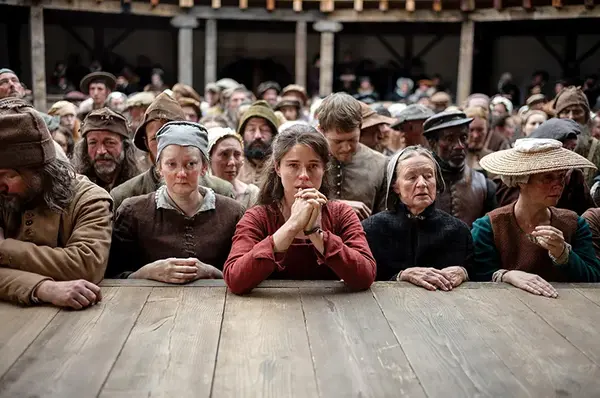
The tragedy becomes the ultimate rebirth for both Agnes and William, and consequently Hamnet. Hamlet is dressed in the same way as young Hamnet. His final duel with Laertes is reminiscent of Hamnet’s play acting with William. Hamlet might be a universal tragic hero, but in that moment, to the father beneath Shakespeare, he was just his son. Hamlet fulfils Hamnet’s dream of becoming an actor of that scale, someone who will live on through the ages.
At the end of the play, Hamlet traverses the barriers of space-time. He ascends from his role as the Prince of Denmark to be a mouthpiece for grief, hamartia, and tragic downfall. The audience erupts in tears at his death. They are filled with pity and fear at Hamlet’s fate. However, it is Agnes who finally comes to terms with her grief. She touches Hamlet’s hand, metaphorically touching her son. She envisions Hamnet on the stage asking for a release. The child is finally freed of his suffering. Agnes smiles, having received the purgation that she had been searching for. Shakespeare’s intended catharsis is rendered complete.
In another role reversal, William disappears into the backstage through a hole designed like a forest cave. He takes up Agnes’ role as the nurturing mother. In turn, he becomes the father who extrapolates his son to an eternal presence. He lives up to the role of being an artist. This Shakespeare is a creator, a faux-mother who gestates artistic creations that live on. Shakespeare fulfils his own poetic prophecy in Sonnet 18: “So long as men can breathe or eyes can see, So long lives this, and this gives life to thee.”
Follow The World Times for more movie breakdowns!