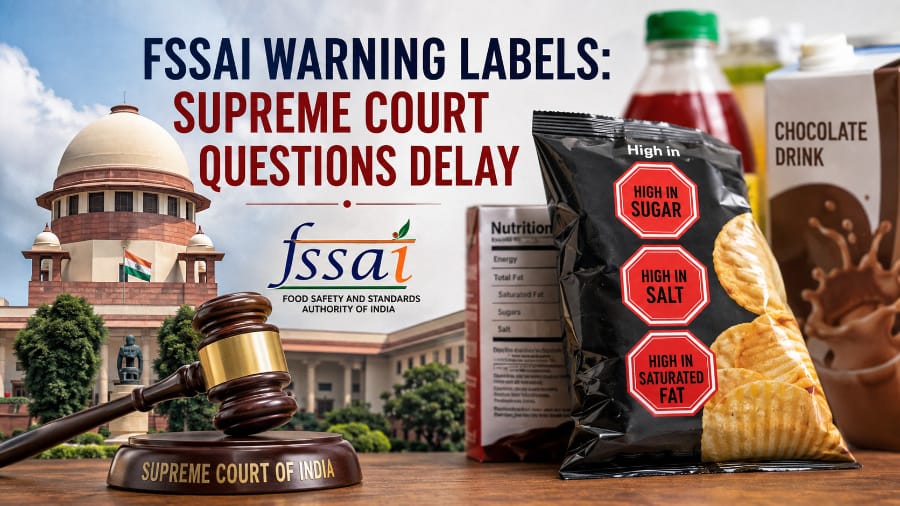
NEW DELHI, August 13: FSSAI warning labels on packaged foods high in sugar, salt and saturated fat have come under renewed scrutiny after the Supreme Court questioned delays in introducing a front-of-package labelling system.
A bench comprising Justices J. B. Pardiwala and K. Vinod Chandran heard a public interest litigation filed by the public charitable trust 3S and Our Health Society. The petition seeks directions to the Centre, states and Union territories to introduce mandatory front of package warning labels on packaged food products.
During the hearing, the bench reportedly questioned whether the government was giving public health enough priority. The Court also raised concerns about creating awareness among children as packaged and highly processed foods become increasingly common. The hearing has renewed the debate over how Indian consumers should receive nutritional information and whether existing food labels clearly explain product contents.
What Are FSSAI Warning Labels?
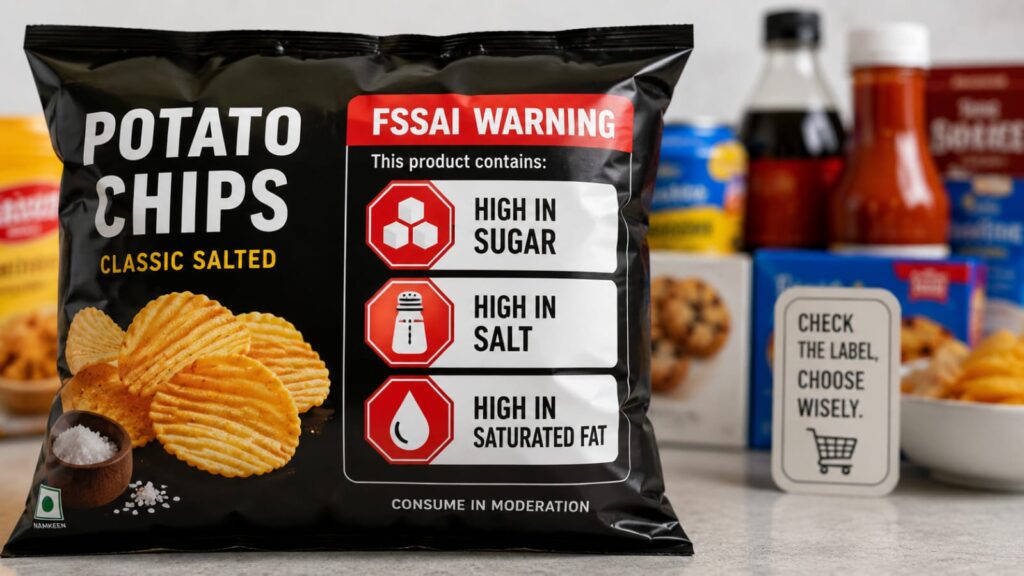
FSSAI warning labels refer to the proposed front-of-package information intended to alert consumers to high levels of nutrients such as sugar, salt or saturated fat.
Front of package labeling, commonly known as FOPL, places simplified nutritional information on the front of a package. The aim is to make key information visible before a consumer purchases a product. At present, detailed nutritional information generally appears on the back or side of food packages. Consumers may need to check serving sizes, nutrient quantities, ingredient lists and recommended daily values before assessing a product.
A front of package system could make this information easier to identify. Depending on the model adopted, labels could include warnings such as “high in sugar,” “high in salt” or “high in saturated fat.” Other systems may use colour coding, symbols, health ratings or numerical information. The debate over FSSAI warning labels is therefore not only about the design of packaging. It also concerns how quickly consumers can understand nutritional information and whether the proposed system gives them enough information to make informed choices.
Why Is the Supreme Court Hearing the Matter?
The case was filed by 3S and Our Health Society, a public charitable trust seeking mandatory front of package warning labels for packaged foods. The petitioners argue that consumers should not have to rely only on detailed nutrition tables printed on the back of packages. They want information about high levels of sugar, salt and saturated fat to appear prominently on the front.
The petition also raises concerns about children’s exposure to packaged foods and products marketed towards younger consumers. Reports indicate that the Court referred to the importance of creating awareness among children, particularly as junk food consumption increases. The petitioners’ position is that nutritional information should be simple enough for ordinary consumers to understand. This includes consumers who may not be familiar with technical nutritional terms or recommended dietary allowances.
What Has the Supreme Court Said About FSSAI Warning Labels?
The Supreme Court has expressed concern over the delay in introducing an effective front of package labeling framework. Reports indicate that the Court gave FSSAI another two weeks to reconsider its position and respond to concerns raised during the hearing. However, the Court’s remarks should not be treated as a final order introducing one specific warning label design.
The issue remains before the Court and the regulatory authorities. The Centre and FSSAI will need to clarify their position on the type of labeling system they support. The final outcome could involve warning symbols, numerical nutritional information or a combination of both. This distinction is important. Criticism from the Court about regulatory delays does not automatically mean that a new nationwide labeling system is already in force.
What Is FSSAI’s Position?
FSSAI has said that it has examined front of package labeling through consultation and expert review. According to material placed before the Supreme Court, the regulator prepared draft amendments, received more than 14,000 comments from stakeholders and referred the submissions to an expert committee.
FSSAI has had to consider several technical questions while developing the proposed framework. These include how to define high levels of sugar, salt and saturated fat and whether calculations should use serving sizes or a standard quantity. The regulator has also considered which categories of packaged foods should fall under the proposed rules.
Reports published in August indicate that FSSAI has considered displaying nutrient values and recommended daily limits in a tabular format. Under this approach, packages could show the amount of added sugar, saturated fat and salt in a serving. They could also show the percentage of the recommended daily intake represented by those quantities. This approach differs from a direct warning label.
A warning symbol aims to alert consumers immediately. A numerical table provides more detailed information but may require consumers to interpret the figures themselves. FSSAI’s approach reflects its position that food labeling rules should consider scientific evidence, stakeholder consultation and practical implementation.
Why Do Health Advocates Support FSSAI Warning Labels?
Public health advocates support FSSAI warning labels because they argue that existing nutrition panels can be difficult to understand while shopping. A prominent warning on the front of a package could help consumers identify products with high amounts of sugar, salt or saturated fat without reading several lines of nutritional information.
Supporters also argue that consumers can be influenced by prominent marketing claims on packaging. Words such as “natural,” “light,” “multigrain” or “healthy” may create a positive impression without providing a complete picture of a product’s nutritional content. A warning label would not necessarily prevent a product from being sold. Instead, it would provide additional information before purchase.
Supporters therefore describe front of package warnings as a transparency measure designed to strengthen informed consumer choice. The issue also has a particular relevance for children. Packaged snacks, sweetened beverages and processed foods are widely available and are often marketed to families. Health advocates argue that parents should be able to identify key nutritional information without having to interpret technical terms. The Supreme Court’s reported reference to children’s health has added to the public health dimension of the case.
What Are the Concerns About Mandatory Warning Labels?
A balanced discussion also needs to consider concerns surrounding mandatory warning labels. Food companies and industry associations may argue that any new system should rely on consistent scientific standards. They may also point to differences between food categories when determining nutrient thresholds.
Products are consumed in different quantities and serving sizes. As a result, applying one threshold across every category can raise practical questions. Serving size is another issue. A product may appear to contain a relatively small amount of a nutrient when the calculation uses a small serving. However, a consumer may eat several servings at one time. Using a standard quantity, such as 100 grams, could make comparisons between products easier. At the same time, such a calculation may not always reflect how consumers normally eat a particular product.
Food manufacturers may also face additional compliance costs if new FSSAI warning labels become mandatory. Companies could have to redesign packaging, replace existing printed material, update advertising and change parts of their supply chain processes. Smaller manufacturers could face additional difficulties if they have to discard packaging produced before a new regulation takes effect. Industry stakeholders may therefore seek a transition period.
There is also a broader debate over whether a warning symbol can provide enough nutritional context. A single warning does not explain the entire composition of a food. It also does not show how much of the product a person consumes or how that food fits into their overall diet. These are policy concerns raised in the debate and should not be treated as established facts.
Earlier FSSAI Proposals on Food Labels
FSSAI has considered changes to nutrition labeling rules before the current Supreme Court proceedings. In July 2024, the regulator approved a proposal to display information about total sugar, salt and saturated fat in bold letters and a larger font. The proposal also referred to displaying the percentage contribution to recommended dietary allowances. The proposal went through consultation, allowing stakeholders to submit suggestions and objections. It did not, by itself, introduce a nationwide warning label system.
FSSAI has also taken action concerning certain food related claims. In 2024, the regulator advised e-commerce platforms to remove the term “Health Drink” when it was not defined or standardised under food law. It also directed food businesses to remove the claim “100% fruit juices” from labels and advertisements for reconstituted fruit juices.
These actions are separate from the current dispute over FSSAI warning labels. However, they form part of a wider discussion about how food products are presented to consumers. The debate therefore involves both the nutritional information companies must disclose and the way consumers interpret claims made on packaging.
What Could FSSAI Warning Labels Mean for Consumers?
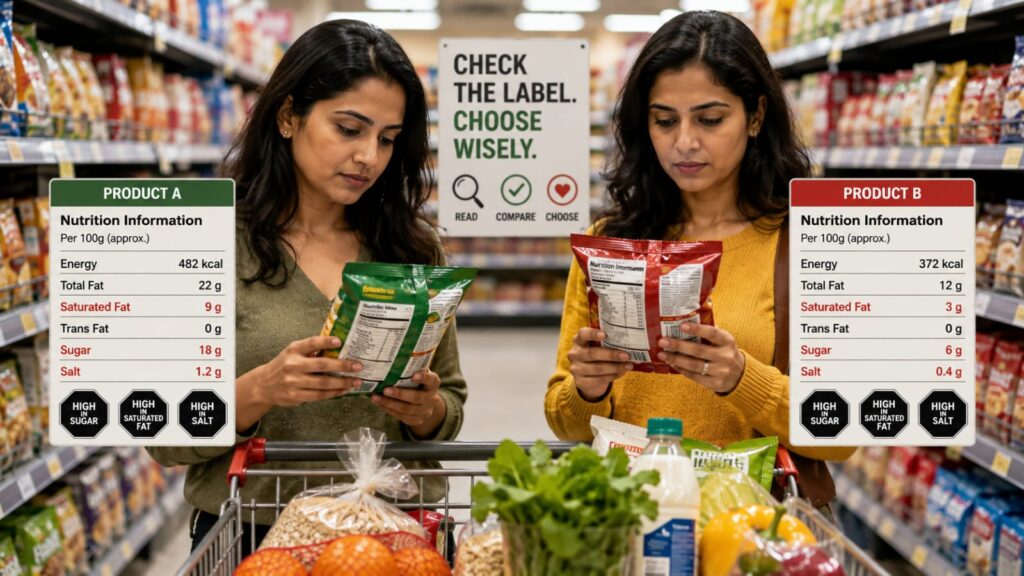
The Supreme Court hearing does not mean that every packaged food product must immediately carry a new warning symbol. Consumers should not assume that a particular front of package format is mandatory unless and until FSSAI issues an official notification. For now, consumers can continue checking the nutrition panel and ingredient list on packaged products.
Important details include total sugar, added sugar where separately disclosed, sodium or salt, saturated fat, serving size and the number of servings in a package. Consumers should also consider promotional claims carefully. For example, a product described as “low fat” may still contain significant amounts of sugar. Similarly, a product marketed as “natural” may still contain high levels of salt or added sugar.
The effectiveness of any future FSSAI warning labels will depend on several factors. These include the design of the labels, the nutrient thresholds, consumer awareness, enforcement and the availability of affordable alternatives.
What Happens Next?
The next major development is expected to be the response from FSSAI and the Centre after the additional time granted by the Supreme Court. Reports say FSSAI has been given two weeks to reconsider its approach to warning labels. The regulator could revise its existing proposal, continue supporting a numerical nutrition table or suggest a system combining nutritional figures with visual warnings.
Any final policy would need to establish several details. These could include the products covered, nutrient thresholds, label design, label size, compliance deadlines, enforcement procedures and penalties for violations. Until these details are formally notified, it would be inaccurate to say that India has already introduced mandatory FSSAI warning labels for all packaged foods high in sugar, salt and saturated fat.
Short Summary
The Supreme Court’s criticism of FSSAI has renewed attention on the delay in introducing clearer nutritional warnings for packaged foods high in sugar, salt and saturated fat. The Court has linked the issue to public health and children’s well being, while FSSAI has maintained that it has followed a process involving consultation and expert review.
The dispute reflects a wider tension between public health advocates seeking simple and visible warnings, regulators developing a scientifically workable framework and food companies concerned about implementation and compliance. For consumers, the eventual decision could change how nutritional information appears on packaged food products across India.
For now, however, the final system remains unresolved. The next response from FSSAI and the Centre will help determine whether India moves towards mandatory warning symbols, detailed nutrition tables or a combination of both.
Follow The World Times for more such updates.