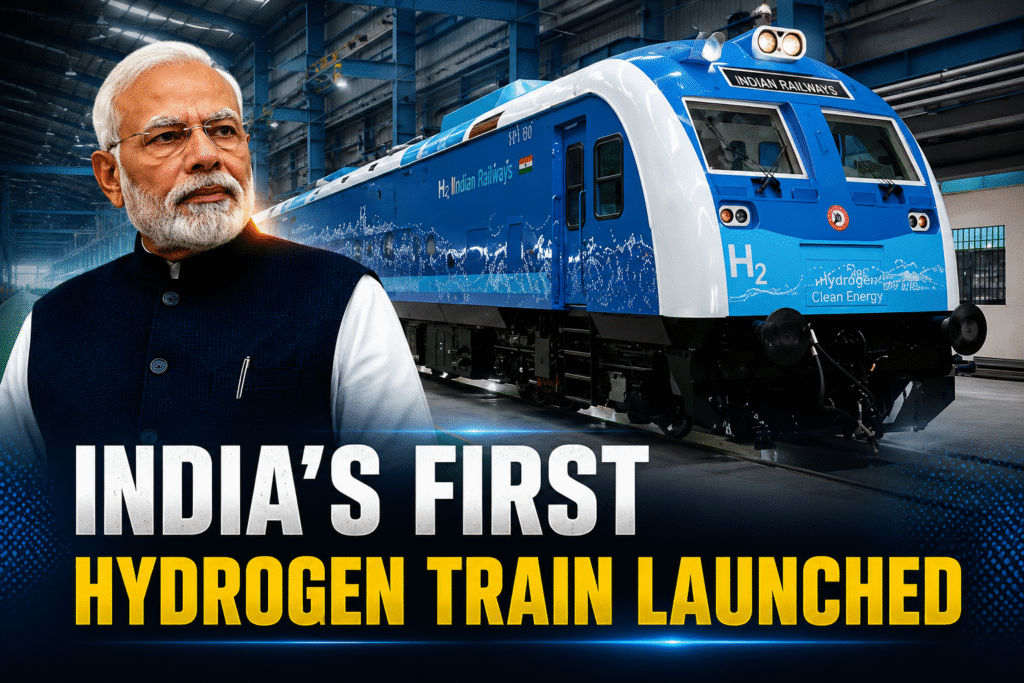
India’s first hydrogen train rolled onto the tracks on Friday. Prime Minister Narendra Modi flagged off the service at Jind railway station in Haryana. Consequently, the launch marks a major leap for the country’s green mobility push.
The 10-coach hydrogen train will run between Jind and Sonipat. It will cover the 89-kilometre stretch in about two hours. Additionally, the train halts at 12 intermediate stations along the route. Notably, officials say the train runs on a 3,200 HP propulsion system. This makes it one of the most powerful hydrogen-powered trainsets currently in operation. It produces only water vapour, leaving zero tailpipe emissions.
With this launch, India joins a select group of nations running hydrogen-powered trains. Haryana Chief Minister Nayab Singh Saini attended the event. Besides, Union Railway Minister Ashwini Vaishnaw was also present at Jind.
A Milestone for Make in India
Modi called the hydrogen train a strong example of Make in India. “This hydrogen train has been designed by Indian engineers themselves,” he said. He added that an Indian company manufactured it. Meanwhile, the train was built at the Integral Coach Factory in Chennai. Engineers designed, engineered, and integrated it entirely within the country. In fact, officials say this reflects India’s growing capability in advanced railway engineering.
Moreover, a hydrogen plant at Jind supplies fuel for the trainset. The plant produces hydrogen through electrolysis, a process central to green hydrogen generation. Therefore, this keeps the entire hydrogen supply chain rooted in India.
Indigenous Technology Meets Clean Mobility
The hydrogen train converts hydrogen into electricity through fuel cells. This electricity then powers the train’s traction motors. As a result, the process avoids emissions linked to conventional diesel-run trains.
Indian Railways has pushed hard toward sustainable transport in recent years. Accordingly, officials describe the hydrogen train as an important step in that direction. It joins other green initiatives already underway across the network. Alongside the launch, Modi also unveiled development projects worth around Rs 14,700 crore in Jind. The package includes highways, medical colleges, and a Sikh museum in Kurukshetra. Together, these projects aim to boost regional infrastructure alongside the rail launch.
Why the Hydrogen Train Launch Matters for Indian Railways
The hydrogen train launch signals confidence in domestic engineering capacity. In turn, Indian Railways can now design and build zero-emission trainsets at home. This reduces reliance on imported clean-mobility technology.
Government officials frame the project as proof of self-reliant innovation. Furthermore, the train’s performance could shape future decisions on hydrogen-powered fleets. For now, the Jind-Sonipat route serves as the technology’s first real-world test. However, officials have not confirmed a timeline for expanding hydrogen trains to other routes. Instead, Indian Railways is expected to monitor this trainset’s performance closely. Commuters and industry watchers alike will track how the technology holds up over time.
Source: PIB
Follow The World Times For More Such Updates!