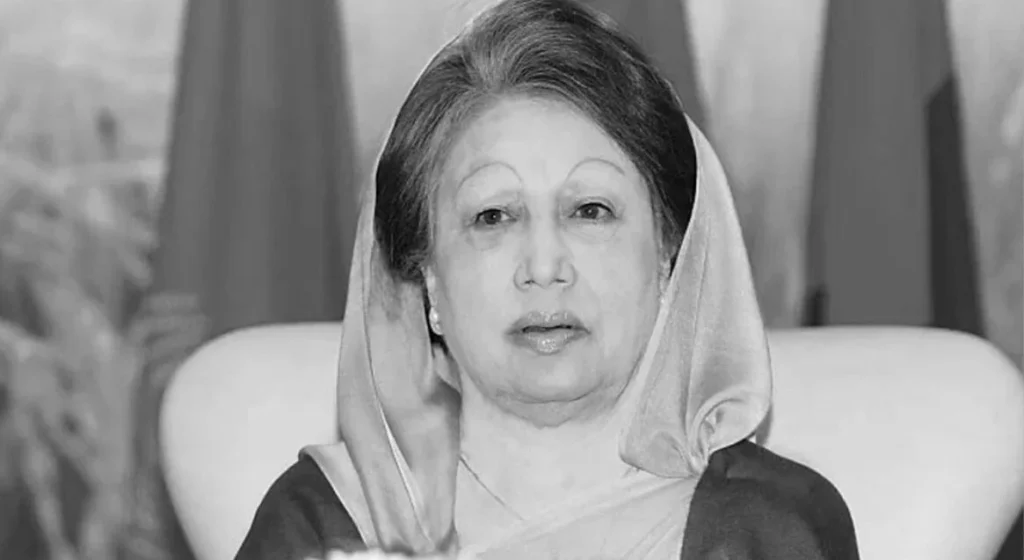
Former Bangladesh Prime Minister Khaleda Zia has died, marking the end of a political era that shaped the nation’s modern history.
From First Lady to Power Broker
Bangladesh’s three-time Prime Minister Khaleda Zia died on Tuesday, December 30, 2025, at the age of 80. Her death ended a political career that shaped the nation for more than four decades. She had hoped to make a final return to leadership after elections expected next year.
Zia, the country’s first female prime minister, served three terms in office between 1991 and 2006. She also played a pivotal role in Bangladesh’s transition from military rule to parliamentary democracy. She died in Dhaka, according to officials.
Khaleda Zia was born Khaleda Khanam “Putul” on August 15, 1945, in Jalpaiguri in British India. The town is now in India’s West Bengal. Her family moved to Dinajpur in East Pakistan following the 1947 Partition. She studied at Dinajpur Missionary School and Dinajpur Girls’ School before attending Surendranath College, later describing herself as largely “self-educated.”
In 1960, at the age of 15, she married Ziaur Rahman, then a Pakistan Army officer who later founded the Bangladesh Nationalist Party (BNP) and became president. For much of her early adult life, Zia remained out of public view, focusing on raising her two sons, Tarique and Arafat. This changed after her husband’s assassination in a failed military coup in 1981.
Twice Prime Minister, Decades in Politics
Zia entered politics after her husband’s death, formally joining the BNP in 1982. She rose quickly through the party ranks, becoming vice-chairperson in 1983 and chairperson in 1984. During the 1980s, she emerged as a leading opponent of the military regime of Hussain Muhammad Ershad. She earned a reputation as an “uncompromising” leader for repeatedly boycotting elections she said were illegitimate.
Her leadership peaked during the mass uprising of 1990, which she led alongside her rival Sheikh Hasina. The movement forced Ershad to step down. In February 1991, Zia led the BNP to victory in Bangladesh’s first widely accepted free and fair elections. She became the country’s first woman prime minister.
During her first term in office, Khaleda Zia moved quickly to restore parliamentary democracy, overseeing the passage of the 12th Amendment in 1991 that shifted Bangladesh from a presidential to a parliamentary system of governance.
A Chapter That Defined Modern Bangladesh
Her government also prioritized education, introducing free and compulsory primary schooling nationwide and extending free education for girls through Grade 10, a policy credited with boosting female enrollment.
On the economic front, Zia pursued market-oriented reforms, including the introduction of a value-added tax, the creation of a privatization board, and strong support for the garment sector, which became a major source of employment for women and a pillar of export growth.
Her leadership earned international recognition, with Forbes magazine repeatedly naming her among the world’s most powerful women during her third term, citing her initiatives in poverty reduction and education.
What led to Khaleda Zia’s death?
Medical reports and statements from her treating doctors said Khaleda Zia died due to complications from multiple organ failure, worsened by severe infections and long-standing illnesses.
She was admitted to hospital on November 23, 2025, with a serious lung infection that progressed into pneumonia and caused respiratory failure. Doctors said a subsequent chest infection placed heavy strain on her heart. Khaleda Zia had a history of cardiac disease and depended on a permanent pacemaker.
She had also been suffering for years from advanced liver cirrhosis, along with chronic diabetes and kidney complications, which significantly weakened her condition. Severe rheumatoid arthritis had further affected her health and mobility. Her medical team described her condition in the final days as “extremely critical,” citing complex, multi-organ complications. Despite being placed on a ventilator, her condition did not improve, preventing her transfer to London for advanced treatment.
What Her Passing Means Now
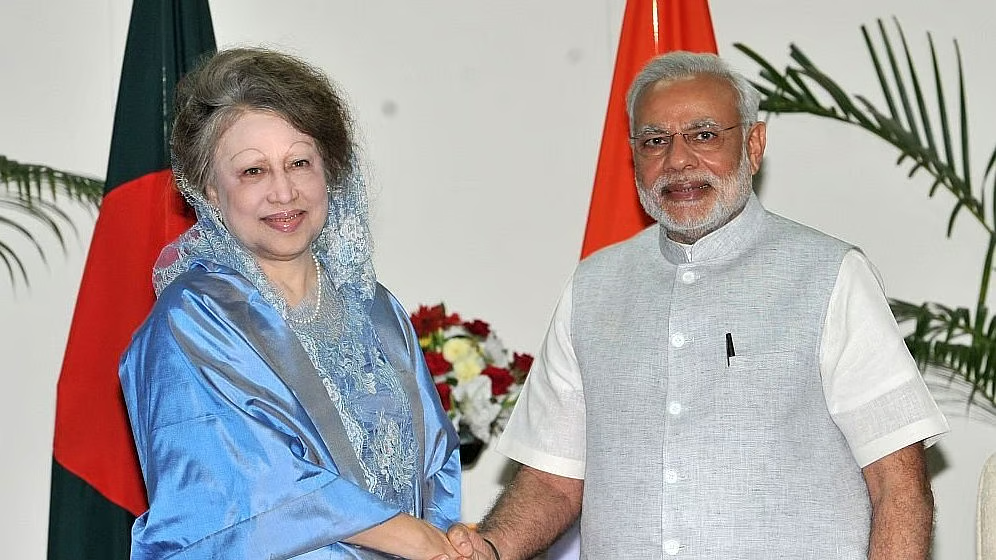
Her death brings a definitive close to the decades-long political rivalry between Khaleda Zia and Sheikh Hasina, a contest that shaped Bangladesh’s politics for more than three decades. While Zia has died, Hasina remains in exile in India following her removal from power in August 2024.
Zia is widely credited with helping restore democratic rule in the early 1990s after years of military governance. Leaders from across South Asia, including Indian Prime Minister Narendra Modi and Pakistani Prime Minister Shehbaz Sharif, paid tribute to her influence on regional diplomacy and development.
Farewell to a Defining Figure
Khaleda Zia’s death brings to a close a defining chapter in Bangladesh’s political story. Admired by supporters and contested by critics, her influence shaped national politics for decades. As the country looks ahead, her legacy will remain deeply woven into its democratic journey.
For more such informative articles stay tuned at The World Times.