
The Government of India issued a press release titled ‘India’s Labour Reforms: Simplification, Security, and Sustainable Growth’ on 21st November 2025. The press release announced the Labour Codes, and the major provisions of the law became effective immediately. ‘The Labour Codes’ consolidated the old 29 labour laws into 4 comprehensive labour codes to make these laws simpler and updated with today’s work environment. The 29 Labour Laws were consolidated into four labour codes after the discussions held in the tripartite meeting of the Government, employers, representatives from industries and trade unions during 2015-2019.
Constituents of ‘the Labour Codes’
The labour codes now include the following four laws:
- The Code of Wages, 2019
- The Industrial Relations Code, 2020
- The Code on Social Security, 2020
- The Occupational Safety, Health, and Working Conditions Code, 2020
The labour codes reform aimed to introduce positive changes in the operations of multiple sectors. These sectors include Fixed Sector Employees (FTEs), Gig & Platforms Workers, Contract, Women, Youth Workers, Beedi & Cigar Workers, MSME Workers, Audio-Visual & Digital Media Workers, etc. The labour reforms aim to empower labourers across all sectors and form the cornerstone of Aatmanirbhar Bharat. The government underscores that employment in India has shown a remarkable rise, with the addition of 16.83 crore jobs in just six years.
Hence, the codification of labour laws will emphasise inclusivity and sustain labour empowerment. The press release also highlighted that the proportion of people below the international poverty line has declined, and India has become one of the largest systems in social protection.
The Code of Wages, 2019
The Code of Wages, 2019 introduced to strengthen workers’ rights across the country. To promote uniformity in wages for employers in both the organised and unorganised sectors. It consolidated the provisions of four laws into one comprehensive code. The four laws are as follows: the Payment of Wages Act, the Minimum Wages Act 1948, the Payment of Bonus Act, and the Equal Remuneration Act 1976.
The major highlights of the code are provisions like Universal Minimum Wages, which establish a right to minimum wages for all employees across all sectors. The code sets up a statutory floor wage, which will be based on minimum living standards, subject to the regions. The criteria for Wage Fixation are also introduced; here government will determine the minimum wages based on factors like workers’ skill levels, geographic areas, etc. It introduces Overtime Compensation, where employers need to compensate all employees for overtime work at twice the normal rate for work done beyond regular working hours. Besides, it also introduced provisions such as Compounding offences, Decriminalisation of offences, and Gender Equality in Employment.
The Industrial Relations Code, 2020
This code is simply based on laws related to trade unions, conditions of employment in industries, and settlement of industrial disputes. It amalgamates and simplifies the existing provisions of the Trade Unions Act, 1926, the Industrial Employment Act, 1946, and the Industrial Disputes Act, 1947. The code is based on the belief that the survival of the worker depends upon the survival of the industry.
The key highlights of this code are fixed-term employment (FTE), which allows direct, time-bound contracts and reduces excessive contractualization. It recognises the Trade Union, introduces a re-skilling fund, expands definitions of workers and strikes, and broadens the definition of industry. The code also ensures proportional representation of women in grievance committees.
The Code on Social Security, 2020
The Code on Social Security amalgamates and rationalises the existing nine acts on social security. This code has been introduced to make social security accessible to all workers, including gig & platforms workers, and unorganised sector employees. It aims to cover a wide range of social security components, such as life, health, maternity, and benefits of provident funds. Moreover, the code envisions the introduction of digital systems for greater efficiency.
The key highlights of this code are Expanded EISC (Employees’ State Insurance) coverage, which now applies to the whole of India, eliminating the existing criteria of ‘notified areas.’ The time-bound Employees’ Provident Fund (EPF) inquiries and reduced EPF Appeal Deposit are also introduced under this code. The code instructs the inclusion of Gig and Platform Workers to enable social security coverage. It expanded the definition of dependents and introduced a uniform definition of ‘wages’. Alongside, it is deemed to cover commuting accidents, among other prominent components of this code.
The Occupational Safety, Health, and Working Conditions Code, 2020
The code on occupational safety, Health and working conditions has been drafted after amalgamating and simplifying the relevant provisions of the 13 Central Labour Acts. This code is introduced to balance both workers’ rights, ensuring safe working conditions, and also creating a business-friendly environment. Hence, the code vision is to enhance economic growth and employment, making India an efficient, fair and future-ready labour market.
The key highlights of this code are provisions such as unified registration, its extension to hazardous works, widen the definition of migrant workers. The code necessitates free annual health check-ups for employees. It instructs the employment of women in all types of establishments during night shifts. This code also orders to develop a national database for organised workers. It also mentions setting up a single tripartite advisory board on the National Occupational Safety & Health Advisory, and revised regulations of Factory Thresholds.
Need for the Codification of Labour Laws
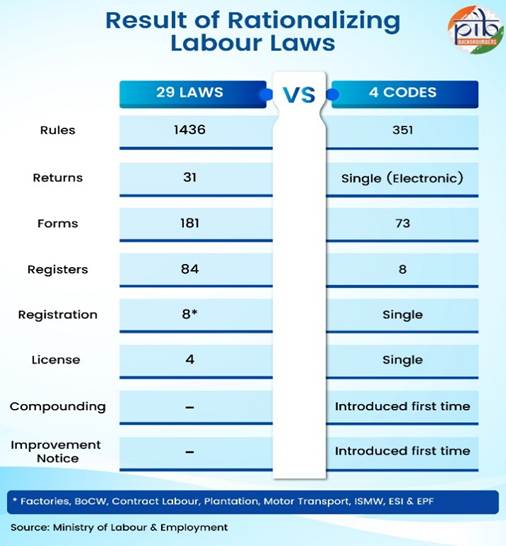
The government notes that reforms in labour laws are a continuous process; it needs to be modernised to streamline the legislative framework. The reforms in labour laws take place in view of the evolving economic and industrial conditions prevailing in the country. The reforms in labour laws and the codification of existing labour laws into the four broad codes have been done to address long-standing challenges and increase the efficiency of the system. The key reasons behind these reforms are to simplify compliance, streamline enforcement, and to modernise the existing outdated laws.
Additionally, another important reason behind this rationalisation is to introduce the concept of a Single Registration, Single License, and Single Return. This will simplify the complex registration and licensing framework and assist in spurring formal employment. Overall, the codification is expected to enhance the ease of doing business and promote employment generation. These codes also aim to ensure a safe, healthy working environment and wage security for every worker.
However, the newly enacted codes are subject to criticism by various experts and trade unions. They argue that these laws are providing an upper hand to the employers, and they have greater freedom. While the employees, especially those of marginalised sectors, have had their most basic rights as workers restricted.
For more such informative articles, stay tuned to The World Times.