
From research labs to government policy, AI has become a new measure of national power. Consequently, the global race for supremacy in this field is intensifying. New rankings reveal which nations are leading—and which are rapidly catching up.
Nations Jostle for AI Supremacy
Stanford University has unveiled its Global AI Vibrancy Tool, an interactive dashboard. Specifically, it was developed by the Institute for Human-Centered AI (HAI) to compare and rank national artificial intelligence ecosystems worldwide. The platform assesses 36 countries, with partial data available for up to 67 countries. In this way, it offers a snapshot of how nations are performing in the fast-evolving race.
The rankings are based on 42 indicators grouped into key pillars, including research and development, economic activity, infrastructure, and talent. These measures track factors such as academic publications and patents. Moreover, they also capture levels of private investment and the growth of artificial intelligence startups. Additionally, they consider access to computing power and the size of the tech-ready workforce.
Further, the tool also evaluates policy and governance frameworks and responsible development efforts focused on safety and fairness. In addition, it considers public opinion to gauge societal trust in artificial intelligence technologies. This provides a broad view of both technological capacity and public readiness.
The Leaders Setting the Pace
Stanford University’s Institute for Human-Centered AI (HAI) has released the 2025 edition of its Global AI Vibrancy Tool, based on 2024 data. It ranks the United States, China, and India as the world’s top three nations in this domain. Notably, India has recorded a notable rise to third place, surpassing several advanced economies, including the UK and South Korea.
The interactive index assesses countries across multiple indicators. These include talent development, research output, infrastructure, private investment, policy frameworks, responsible artificial intelligence practices, and public opinion. As a result, strong government initiatives, expanding research capacity, improved computing infrastructure, and growing private-sector participation have driven India’s rise in the rankings.
The United States retained the top position with a score of 78.60, followed by China in second place with 36.95. India secured third place with a score of 21.59. Meanwhile, South Korea ranked fourth, underscoring Asia’s growing influence in the global artificial intelligence landscape.
India’s Rise in the League
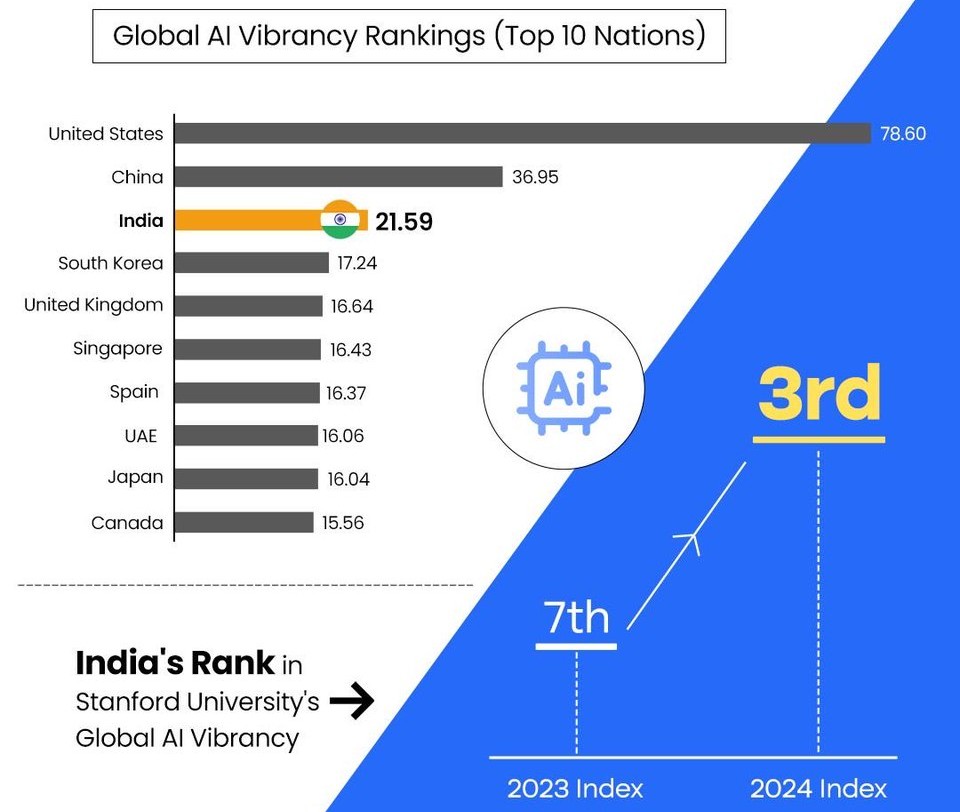
India has emerged as the world’s third most competitive country in this league. According to this ranking, this is based on Stanford University’s 2025 Global AI Vibrancy Tool. With a score of 21.59, India now trails only the United States (78.60) and China (36.95). Therefore, this marks a sharp rise from its seventh-place ranking in 2023.
This jump has been driven by strong gains in technological talent, research, government support, and startup activity. India ranks among the top three globally for technology talent, leads in year-on-year tech hiring growth, and is a major contributor to artificial intelligence projects on GitHub. Additionally, government initiatives such as the ₹10,300-crore India AI Mission and a growing startup ecosystem, backed by $1.4 billion in private investment, have further strengthened the country’s tech landscape.
For India, the ranking is a major boost. Therefore, it reflects rising investments in this field, increasing research output, a strong startup ecosystem, and a massive pool of engineers and developers.
A Three-Way Race for AI Dominance
The global race for leadership in this technology is increasingly shaping up as a three-way contest, with the United States, China, and India emerging as the dominant players, each with distinct strengths and limitations.
The United States continues to lead in advanced software development, cutting-edge research, and access to high-end chips, driven by deep private investment and a mature innovation ecosystem. China, meanwhile, leverages scale, state-backed hardware manufacturing, and vast data access to accelerate artificial intelligence deployment, though it faces constraints in advanced semiconductor technology. India’s advantage lies in its vast talent pool, rapidly expanding startup ecosystem, and software expertise, even as it works to strengthen domestic chip capabilities and large-scale computing infrastructure.
Together, these differences are shaping the contours of a rapidly intensifying global rivalry in this sector.
Power Shifts in a Digital World
National AI capability rankings are redefining global power, placing technological strength alongside military and economic influence. Countries leading in this space are gaining strategic advantages in defense, trade, and narrative-building, thus reshaping how influence is measured on the world stage.
The race—driven largely by US-China rivalry—is creating a fragmented digital order and new alliances centered on technological talent, data, and critical hardware. As a result, nations with key roles in the artificial intelligence supply chain are gaining geopolitical leverage, while advanced tools are increasingly shaping diplomacy and international negotiations.
The latest competitiveness ranking highlights how technological leadership is rapidly reshaping global power. While the top nations pull ahead through talent, investment, and policy support, the race remains fluid and fiercely contested. In the years ahead, sustained innovation—not just rankings—will determine who truly leads the this era.
For more such informative articles, stay tuned at The World Times.