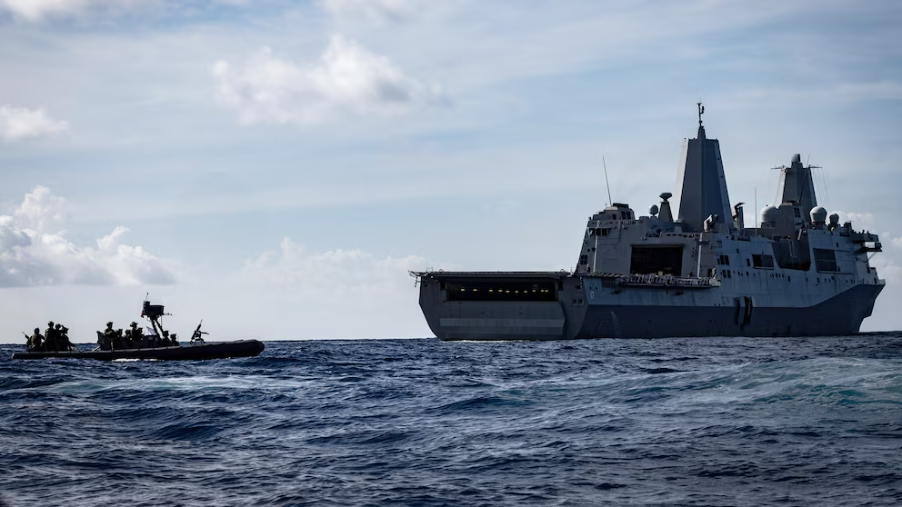
In a stark escalation of the USA anti-narcotics campaign, the United States military has announced strikes on five alleged drug smuggling vessels located in the Eastern Pacific Ocean between December 30 and 31, 2025. The operations conducted were under the auspices of the US Southern Command. They targeted a convoy of small, high-speed boats. These were transiting along the international waters, which were well known for illegal trafficking. According to official statements, intercepted intelligence confirmed that groups designated as terrorist organisations operated the vessels and engaged in narcotics smuggling.

The sequence unfolded rapidly: on December 30th, an initial missile strike on the lead vessel killed three crew members. The Pentagon categorized them as ‘narco-terrorists.’ As occupants of the two other trailing vessels abandoned their ships and jumped overboard, the follow-up engagements sank their crafts, which prompted an immediate search and rescue effort by the US Coast Guard. A C-130 aircraft was dispatched to do the reconnaissance. Authorities found eight individuals in distress and broadcast distress signals to nearby mariners for assistance. The next day, December 31, a separate action hit two more boats, resulting in five additional fatalities. However, authorities recovered no drugs from the wreckage.
The two-day blitz brings the toll from these specific strikes to eight confirmed deaths, with a potential for more survivors, who remain unaccounted for as of January 2, 2026. Video footage that the Southern Command released shows debris-strewn seas and a small vessel instantly erupting into flames, underscoring the precision yet finality of the munitions deployed, likely AGM-114 Hellfire missiles fired from drones or naval assets.
Operation Southern Spear—From Interdiction to Annihilation
The September 2020 launch of Operation Spear was the Trump Administration’s aggressive strategy on border security. Operation Southern Spear marks a radical departure from decades of Coast Guard-led seizures. It began as targeted airstrikes on Venezuelan speedboats in the Caribbean. The strike claimed the lives of 11 people in its inaugural raid on September 1. Then, it expanded into a hemisphere-wide offensive.
By late 2025, there were over 25 maritime strikes and two land-based attacks (including a December 29 drone hit on a Venezuelan loading dock), which resulted in more than 115 fatalities, with 23 incidents in the Pacific alone.
The evolution of the campaign is evident in its tactics: Early actions focused on “go-fast” boats, but recent ones incorporate “double-0 tap” protocols, where secondary strikes target survivors to prevent evasion. An October 16 incident, in which forces killed two men clinging to a semi-submersible after the initial hit, sparked internal backlash and contributed to the resignation of the Southern Command’s admiral.
Supporters argue that this deters trafficking, with interdictions recovering over 1000 kg of cocaine in joint ops, but critics see a pattern of overreach.
Human rights concerns of USA

Legal scholars and UN experts decry that the strikes are extrajudicial executions, which violate international maritime law and the right to life under human rights conventions. The Inter-American Commission on Human Rights has filed cases, arguing that no “imminent threat” justifies lethal force in peacetime. Domestically, Democrats like Reps. Ro Khanna and Thomas Massie decry the lack of congressional briefings, while a Reuters/Ipsos poll shows support eroding to 51% amid these revelations.
On the international stage, the backlash is fierce: Colombia’s Gustavo Petro suspended US intelligence ties and accused Washington of murder; Venezuela’s Nicolas Maduro declared “regime-change terrorism”; and allies like the UK and Canada have paused data sharing over legality fears. Even Mexico, a partner in Border Ops, has quietly intercepted the suspect vessels to avert US strikes on its waters. Pope Leo XIV called for migrant compassion, while China and Iran are amplifying the condemnation of US imperialism.
Implications for the USA

As 2026 comes in, Operation Southern Spear tests the boundaries of the USA and American power projection. Proponents, including Sen. Lindsey Graham, are also predicting that it will choke fentanyl flows, which will potentially save thousands of lives. Yet, escalation risks, such as the December Land strike, signal towards a broader Venezuelan targeting; this could ignite proxy conflicts or diplomatic isolation.
In balancing security imperatives against ethical red lines, these strikes highlight the perils of militarizing complex social ills. As searches for Pacific survivors continue, the world watches whether evidence will vindicate the operations or expose a tragic overreach.
For more updates, follow us on The World Times.