The United Nations has announced a sweeping $577 million budget cut for 2026, a move that will sharply reduce staff numbers and reshape operations across multiple agencies.
Budget Pressures Hit a Breaking Point
Several major donor countries have significantly cut their foreign aid and humanitarian budgets, with the US notably closing its aid agency (USAID) in 2025 and cutting programs. Other countries like Germany and France have also announced major reductions in funding.
The number of people in need of humanitarian assistance has skyrocketed due to protracted conflicts (e.g., in Sudan and Gaza) and climate-related disasters. Over 300 million people worldwide rely on aid for survival.
The gap between needed funds and received contributions has grown consistently. In 2023, only 45% of UN-coordinated response plans were funded, the lowest coverage on record, leading to a gap of $31.5 billion. The shortfall continued into 2025, forcing agencies into a “triage of human survival” to prioritise aid for only the most urgent needs.
The budget crisis has forced the UN and its partners (such as the Office for the Coordination of Humanitarian Affairs (OCHA), UNHCR, and UNICEF) to make difficult decisions, scale back operations, and make life-or-death choices about which programs to sustain, impacting millions of vulnerable people.
A $577 Million Blow to the System
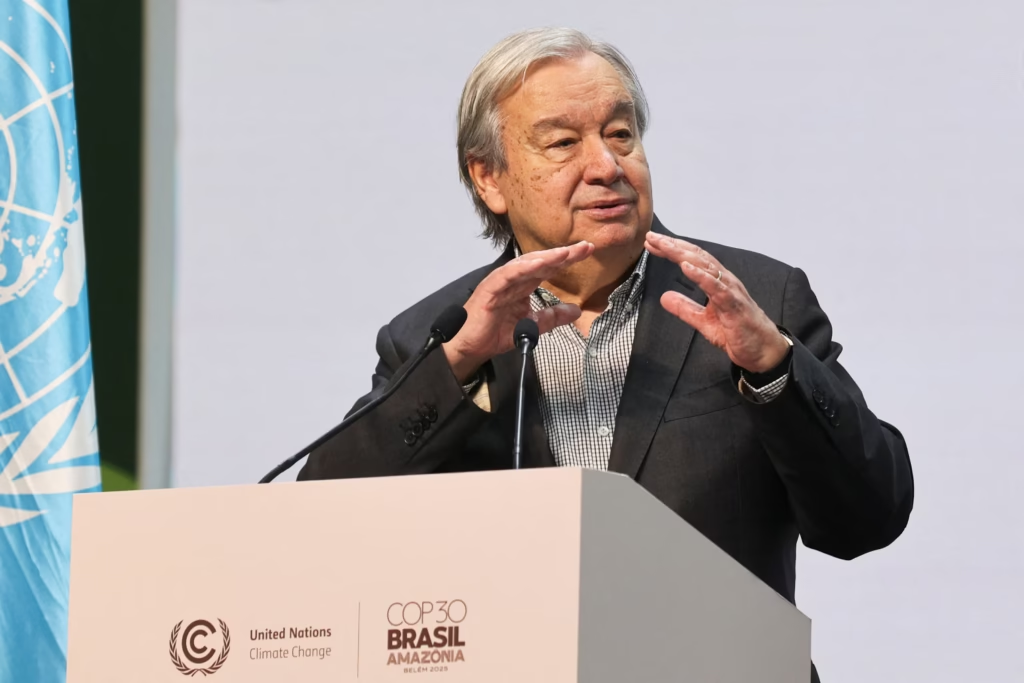
The United Nations Secretary-General proposed a reduction in the United Nations (UN) regular budget for 2026. This is part of the “UN80” reform initiative to modernise. Operations and reduce costs amid an ongoing cash crisis caused by significant unpaid member dues, particularly from the United States.
The 2026 budget is proposed to be $3.238 billion, a reduction of $577 million, or 15.1%, compared to the 2025 appropriation. The cuts are intended to fall primarily on support and back-office functions rather than frontline program delivery.
Functions like payroll processing are planned to be consolidated into a single global team. The plan involves relocating functions to lower-cost locations. Special Political Missions will also face significant cuts of more than 21% compared to 2025 levels, largely due to mission closures and streamlining of staff.
Some concerns were raised by diplomats that the cuts might disproportionately affect development-related programs and junior staff, which the Secretary-General disputed, insisting that the development pillar faces the smallest proportional reduction.
The proposed staffing table is revised to 11,594 posts, a reduction of 2,681 posts, or 18.8%, compared with the approved staffing table for 2025.
Voluntary exit programs are being used to try to limit involuntary job losses. The reduction for special political missions specifically involves a proposed net decrease of 1,215 posts. The final budget and job cuts require approval from the full UN General Assembly later this month.
Thousands of Roles on the Chopping Block
Following budget cuts, the UN plans to reduce its workforce by 18.8%, or approximately 6,900 employees, starting in January 2026. The reductions, part of the UN80 reform initiative, are a response to a liquidity crisis caused by unpaid dues from member states.
Estimated job losses across regions
While exact regional breakdowns are not fully detailed, some information is available:
The cuts are targeted rather than across-the-board, with smaller adjustments for regional economic commissions. Core programs and activities directly supporting Member States, especially Least Developed Countries, Landlocked Developing Countries, and small island developing States, are shielded from reductions.
Some functions are being relocated from high-cost duty stations like New York and Geneva to lower-cost ones, and two leases in New York are set to be terminated by 2027. A quarter of peacekeepers in nine operations were cut in October due to a lack of money. The budget for special political missions will also be reduced for 2026, leading to mission closures and scaled-back operations.
How the Cuts Could Hamper United Nations Missions
UN funding cuts are expected to severely hamper peacekeeping operations, slow down humanitarian aid delivery, and cause possible delays in climate programs and broader development goals by creating security vacuums and forcing the reduction or cancellation of vital services.
A severe funding shortfall is forcing the United Nations to scale back peacekeeping missions and humanitarian programs worldwide. Peacekeeping operations face a 25% reduction in personnel, fewer patrols, and the closure of field offices, raising the risk of security vacuums in volatile regions like the DRC and South Sudan.
Humanitarian agencies, including WFP and UNHCR, are also cutting essential food, health, and protection services as global funding drops sharply, leaving millions of refugees and vulnerable communities without support.
The budget crisis is further undermining progress on the Sustainable Development Goals, weakening climate action and development programs, and increasing instability in fragile states.
A Leaner United Nations Faces a Heavier World
As conflicts deepen and climate disasters rise, the UN now faces the world with fewer hands and tighter resources—at a moment when the world needs it most. As the United Nations trims its workforce, millions worldwide may feel the ripple effects, making this budget cut more than just an accounting decision—into a test of global solidarity.
For more such informative articles, stay tuned to The World Times.