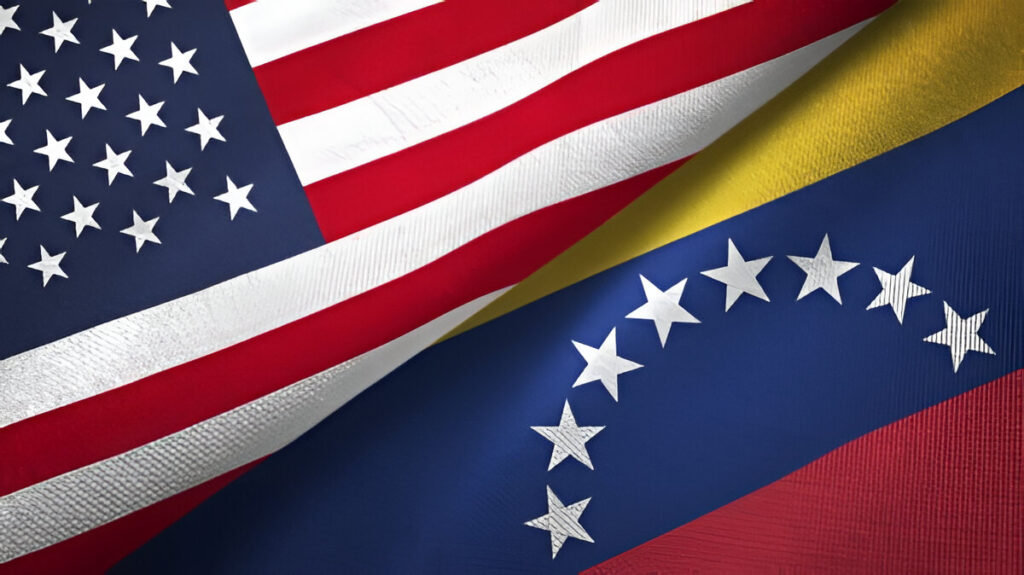
From announcing a “blockade” of sanctioned oil tankers moving in and out of Venezuela to attacking and pursuing Venezuelan ships and boats, the U.S.-Venezuela tensions are showing no signs of abating.
“They took our oil rights… They threw our companies down, and we want it back.” These are the words of the U.S. President Donald Trump explaining the reasons behind the ongoing conflicts.
However, looking at a bigger picture, the U.S.-Venezuela conflict has been caused by a mix of several contested areas. These include oil, sanctions, seizures and even regime change.
Background
In August 2025, Trump signed a secret directive. Under this directive, the Pentagon was given the authority to use direct military force against cartels in Latin America.
Since September 2025, the U.S. has been increasing its military and naval operations near Venezuela to counter narcotic trafficking networks.
According to U.S. officials, the military has carried out at least 26–28 strikes on small boats accused of drug smuggling in the Caribbean Sea and eastern Pacific Ocean, resulting in more than 100 reported deaths.
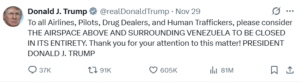
The U.S. has also seized two Venezuelan oil tankers, with one under process of pursuit and announced a blockade of “sanctioned oil tankers” entering or leaving Venezuela. These steps tighten pressure on the country’s oil-dependent economy.
Washington has deployed its largest naval buildup in the region in decades, including destroyers, submarines, thousands of troops and the world’s largest aircraft carrier, USS Gerald R. Ford.
Trump has even declared a bounty of $50 million for eliminating the Venezuelan President Maduro.
The operations are part of a broader effort to increase pressure on Venezuelan President Nicolás Maduro, who faces U.S. charges related to narcoterrorism.
U.S.-Venezuela Relations: From Cold War Allies to Adversaries
For more than 50 years during the 20th century, Venezuela was one of the closest allies of the United States in Latin America. After Venezuela’s democratic transition in 1958, Washington saw it as a perfect partner mainly due to its stable democracy, strategic location, and vast oil reserves.
This partnership collapsed after Hugo Chávez came to power in 1999, who rejected U.S. influence and launched the Bolivarian Revolution, promoting economic nationalism and anti-U.S. foreign policy. After death, Nicolás Maduro continued this line. As time passed, Venezuela made stronger ties with Russia, China, and Iran, moving away from Washington.
Main Reasons for the U.S.-Venezuela Conflict
The Trump administration has mentioned various justifications for its actions against Venezuela:
Narco-Terrorism:
The U.S. claims Venezuela has become a narco-terrorist state, alleging that Maduro and senior officials are directly involved in drug trafficking networks harming American society.
National Security Threat:
The U.S. considers the Venezuelan criminal networks as terrorist organizations, which allows the U.S. to frame military action as a national security necessity. This has helped the U.S. to bypass diplomatic and legal constraints.
Illegitimate Government and Regime Change:
Washington argues that Maduro rigged the 2024 elections, making his government illegitimate and justifying regime change to “restore democracy.” In response, Maduro has stated, “They seek a regime change to impose a puppet government…” that serves the U.S. interests.
International Reaction and the Question of Double Standards
International reaction is mainly limited to statements of concern and formal condemnations, particularly from multilateral institutions. However, U.S. action has not been challenged through restraints yet.
This shows a broader imbalance in global politics:
- When the U.S. intervenes militarily, it is framed as security or democracy promotion.
- When other states take similar actions, they are called aggressors or violators of international law.
The same actions are judged differently depending on who exercises power. It’s clear that the U.S. has actually become the ultimate decider of legitimacy in global affairs.
What is unfolding in Venezuela gives rise to an unsettling question:
If regime change can be justified through power rather than law, who decides where this logic stops?
Venezuela today may be the example, but tomorrow, the same reasoning could be applied elsewhere.
For more such informative articles, stay tuned at The World Times.