The World Inequality Report 2026 (WIR 2026) is the third edition of this landmark global analysis. The report presents one of the most comprehensive data-driven examinations to date of economic and social disparities in income, wealth, gender participation, and environmental impact across the world, including in India. Written by a consortium of over 200 economists and researchers, and led by noted experts including Thomas Piketty, it underscores persistent and accelerating inequalities that have deep implications for growth, democracy, and climate justice.
Widening Economic Divides: Global and Indian Context
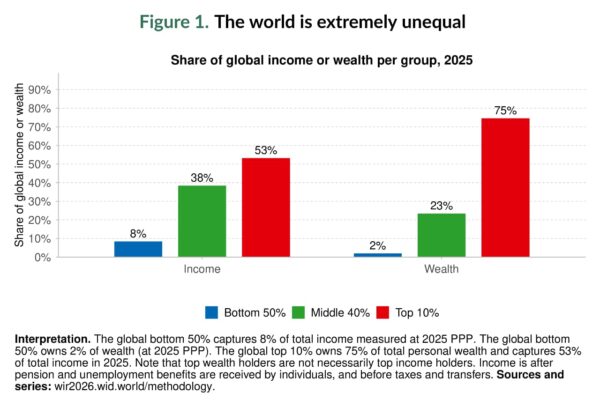
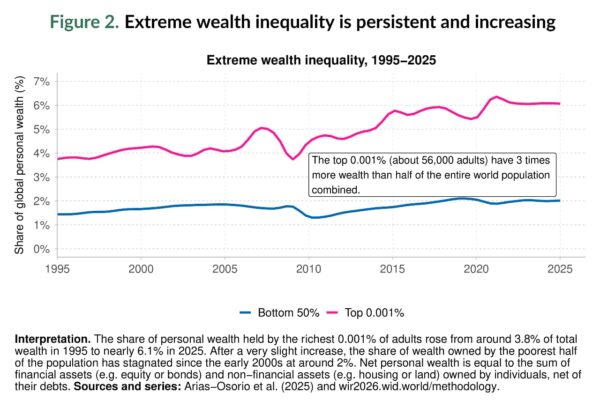
At the global scale, the report finds that income and wealth remain concentrated at the very top of the economic ladder. The top 10% of earners worldwide receive more income than the bottom 90% combined. The bottom 50% of the global population captures less than 10% of total income. Wealth disparities are even more extreme: the global top 10% owns about 75% of all wealth. In contrast, the bottom half holds just 2%. Moreover, a tiny fraction of roughly 0.001% of the population (about 60,000 individuals) now controls three times as much wealth as the poorest half of humanity.
In India, the World Inequality Report paints a similarly stark picture. Income inequality has barely improved in recent years as the top 10% of earners capture around 58% of national income. In comparison, the bottom 50% receive only about 15%, figures largely unchanged from the previous report cycle. On the wealth front, the richest 10% hold roughly 65% of total wealth, with the top 1% alone owning about 40%. By contrast, average annual income stands at around €6,200 (in purchasing power parity terms), and average wealth per person at about €28,000 (PPP).
A distinctive insight of WIR 2026 is the geographic shift in global inequality. Countries like China have seen large portions of their population rise into the global middle class over the past four decades. India’s population remains disproportionately represented within the bottom half of the global distribution. This indicates limited mobility into higher-income strata relative to some peers.
Gender Inequality: A Persistent Structural Divide
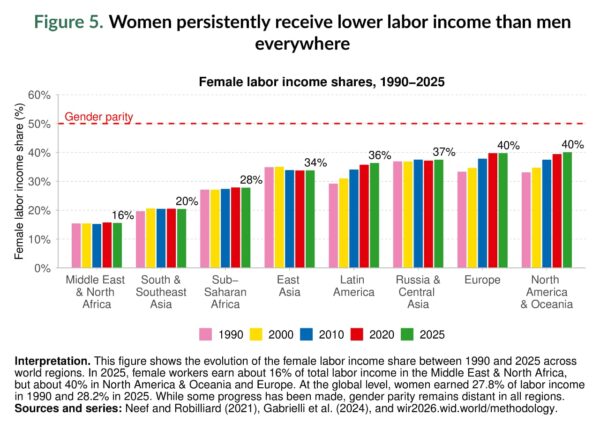
Gender disparities remain a central theme in the World Inequality Report. Globally, despite gains in education and labour market participation, women continue to be undervalued in terms of income and opportunities. Across regions, women earn only a fraction of the labour income compared to men. Even excluding unpaid work, women’s hourly earnings are about 61% of men’s; when unpaid household and care work is factored in, this falls to just 32%. Women’s total share of global labour income remains around 25%, a figure that has changed little since 1990.
In India, female labour force participation is exceedingly low at about 15.7%. However, it has shown little improvement over the past decade. Persistent structural barriers, cultural norms, and limited institutional support for childcare and work flexibility contribute to this stagnation. These gender gaps not only reflect inequality in earnings but also influence wealth accumulation, social status, and economic security over a lifetime.
Climate Inequality and Emissions Burdens
The report also connects inequality to environmental outcomes. It finds that the world’s wealthiest individuals and households disproportionately contribute to carbon emissions linked to private capital ownership. The bottom 50% of the population account for only around 3% of these emissions. On the other hand, the top 10% contribute approximately 77%, with the top 1% alone responsible for 41%. This unequal distribution of emissions highlights how climate change is a shared global challenge. It is driven mainly by the affluent, even as the poorest bear the brunt of its consequences.
Policy Imperatives: Redistribution, Inclusion, and Climate Justice
The World Inequality Report 2026 emphasises that inequality results from deliberate policy choices, not from economic inevitability. It highlights the effectiveness of progressive taxation, redistributive transfers, and robust public services in reducing disparities. Wealth taxes, closing tax loopholes, expanding social protections such as cash transfers and unemployment benefits, and investing in universal quality education and healthcare are among the recommendations. To address climate inequality, the report calls for an equitable framework that holds high emitters accountable and incentivises green technologies.
In an interconnected world, the significance of this report lies not only in its stark portrayal of inequality but in its evidence-based call to action. It urged policymakers, civil society, and citizens alike to confront structural disparities that affect economic opportunity, social cohesion, gender parity, and environmental sustainability.
For more such informative articles, stay tuned to The World Times.