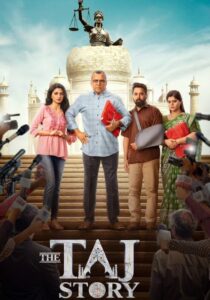
“Paresh Rawal in The Taj Story—where history meets courtroom fire.”
Image Source: The Hollywood Reporter India
The Taj Story, released on October 31, didn’t arrive with thunder, it arrived with tension. Starring Paresh Rawal in a role that’s equal parts firebrand and philosopher, the film dares to fictionalize a courtroom battle over the Taj Mahal’s origins. It’s a premise that walks a tightrope between history and imagination, reverence and rebellion.
Directed by Tushar Amrish Goel, the film opened quietly, earning ₹1 crore on Day 1. But what followed was unexpected: a slow, steady climb powered not by marketing blitzes, but by curiosity. By Day 9, it had crossed ₹13.65 crore, with weekend audiences showing up in growing numbers; some drawn by Rawal’s gravitas, others by the film’s audacity.
Critics remain divided. Some call it bold, others call it bait. But audiences are leaning in, whispering about it in WhatsApp groups, debating it over chai, and sharing clips that linger. The Taj Story isn’t just a courtroom drama, it’s a cultural provocation. And in a landscape where films often burn bright and vanish, this one is smoldering: slow, deliberate, and impossible to ignore.
A Courtroom, A Monument, A Metaphor
Image Source: JustWatch
In The Taj Story, the courtroom isn’t just a legal setting; it’s a crucible of memory, identity, and belief. Paresh Rawal steps into the role of a man who dares to question the origin of India’s most iconic monument, not out of arrogance, but out of a restless need to understand what history chooses to remember; and what it forgets.
The case he brings isn’t just about bricks and marble. It’s about belonging. About who gets to claim legacy, and who gets written out of it. As Rawal’s character challenges the state, the courtroom transforms into a theatre of ideas, where faith, politics, and personal conviction collide in monologues that feel less like arguments and more like confessions.
There’s tension in every scene, not just between characters, but between ideologies. Between reverence and revisionism. Between the desire to preserve and the impulse to provoke. And that’s where the film finds its pulse: in the discomfort, in the questions that don’t have easy answers.
Some viewers have embraced the film’s boldness, calling it a necessary provocation. Others have pushed back, labeling it heavy-handed or politically loaded. But either way, The Taj Story refuses to be ignored. It’s not just telling a story, it’s asking us to confront the stories we’ve inherited, and the ones we’ve never been allowed to tell.
Box Office Resilience and the Power of Curiosity
Image Source: IMDb
The Taj Story didn’t explode onto screens, it crept in, quietly, like a question you can’t shake. Day 1 was modest, just ₹1 crore. But something shifted. By Day 2, the numbers doubled. By Day 3, they climbed again. The first weekend closed at ₹5.75 crore, not blockbuster territory, but enough to signal that people were listening.
Weekdays brought a slower rhythm, but the film held its ground. ₹1.6 crore a day: steady as a heartbeat. And by Day 9, it had crossed ₹13.65 crore, not because of marketing muscle, but because of something more elusive: curiosity.
Audiences came for Paresh Rawal. They stayed for the discomfort. For the questions. For the tension between reverence and revision. Social media lit up with polarized reactions, some called it“brilliant and brave,” others“blatant propaganda.” But the buzz was undeniable. The Taj Story had become more than a film, it was a conversation.
In a landscape where most movies peak and vanish, this one is lingering. Not loud, not fast, but persistent. And sometimes, that’s how change begins.
Stay updated with the latest news on The World Times. Get all the trending City News, India News, Business News, and Sports News.