
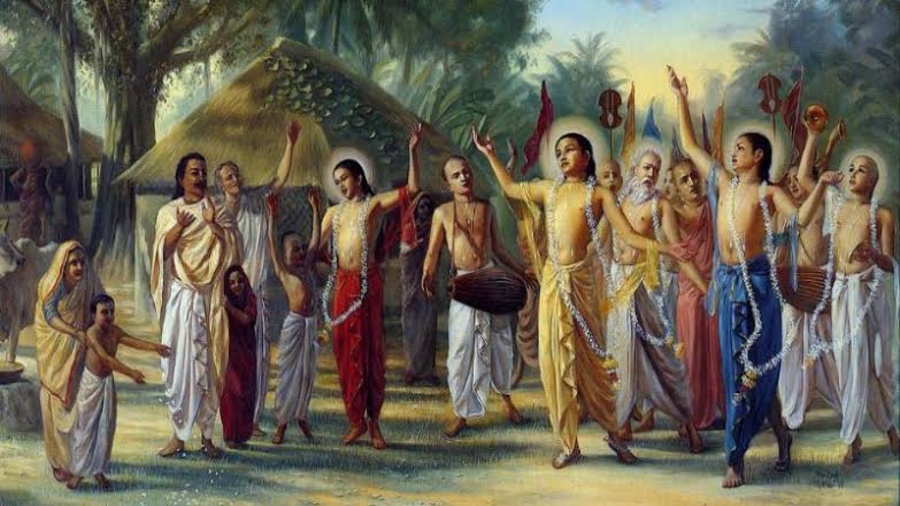
Most of us, especially CBSE students like me, grew up studying the Bhakti Movement in school. It’s more than just a chapter in a textbook; its wide-ranging influence is what makes it such a pivotal event in our history. It encompasses several fields, including literature, gender equality, social structures, and, most importantly Music. The Bhakti movement influenced scholars from diverse fields. Here, we will focus on the musical aspect of it, which is not much discussed.
Background
There are two views on the development of the Bhakti movement; some say the movement in the north grew distinctively, and some say it was spread from the south and influenced the north. If we keep aside the controversies surrounding its origin, we would see a clear pattern of how the bhakti movement emerged during the medieval age. The majority of the time in Europe medieval age is viewed as the “dark ages”. In India, interestingly, we see a gradual development in the form of the “Bhakti movement”.
In many parts of Europe, religious conflict was predominant. We were trying to find a middle ground through the synthesis of bhakti and Sufi. An era when there was no social media – The movement united people from North to South through music, literature, and devotion. It all started with the Nayanars and the Alvar saints, who were devotees of Shiva and Vishnu, respectively.
Most of the Indians are aware that Vishnu and Shiva both are adorned with musical “instruments” in their hands, i.e., conch and Damru. More popularly, Krishna, one of the avatars of Lord Vishnu, is always shown with a flute, and it’s also said that his flute used to mesmerize the whole of Vrindavan! So how could the Alvar and Nayanars be into music? As even in Bhakti, “Ras” and “Bhava” play a key role, which is also a key element in arts (including music), as mentioned in the Natya-shastra of Bharat Muni.
Development of Music
Alvar and Nayanar saints used to travel from one place to another, singing devotional hymns which were their own unique creations. They influenced the development of regional languages such as Telugu and Kannada in the South. Their composed hymns were chanted at the Temples.
Carnatic music, which is so rich in culture and heritage, has its foundation in the “Bhakti movement”. We had some prominent female saints like Andal. Slowly, it started to spread to the northern parts too, and now it turned into a “movement”. The main reason for its widespread popularity was due to its accessibility to people irrespective of their gender, identity, and caste.
Purandara Das, who is known as the “Pitamaha” of Carnatic music, also played a key role in this movement. He was predominantly used to write in Kannada. His compositions laid the basis for Carnatic music and are still sung in many places, including key performances by legends such as M S Subbalaxmi. Now we will go a little further towards the north of the Deccan, “Maharashtra”.
Saints such as Tukaram, Jyaneshwar, and Naamdev used to compose “Abhangs”.It emphasized personal devotion to God. Abhangs were sung in temples then, and now it’s popularized in the commercial scale too. If we look at the eastern part, where Chaitanya Mahaprabhu literally popularised the “nagarkirtan” form. Nagarkirtan was more of people coming together and chanting God’s name while dancing and singing. This was something new and revolutionary. It called for universal brotherhood where people belonging to any caste or religion can join. Iskcon has popularized this “nagarkirtan” around the world.
Legacy
Rabindranath Tagore, the Nobel laureate, was also deeply inspired by the Bhakti movement. He translated Kabir’s Dohas into English as Songs of Kabir (published in 1915), bringing the mystic poet-saint’s verses to a wider audience
Now there’s a new phenomenon of bhajan clubbing. If we keep some controversies aside its a unique way to reach the youth.
Without the bhakti movement, we wouldn’t be able to witness this evolution. We can notice the impact of the Bhakti movement in every field, predominantly Music including the development in Carnatic Music. This was a journey from temple to the inner sanctum of the heart.
Stay tuned to The World Times for more related pieces!



Brilliant analysis and learnt lot of new things
Thanks for enlighting ud