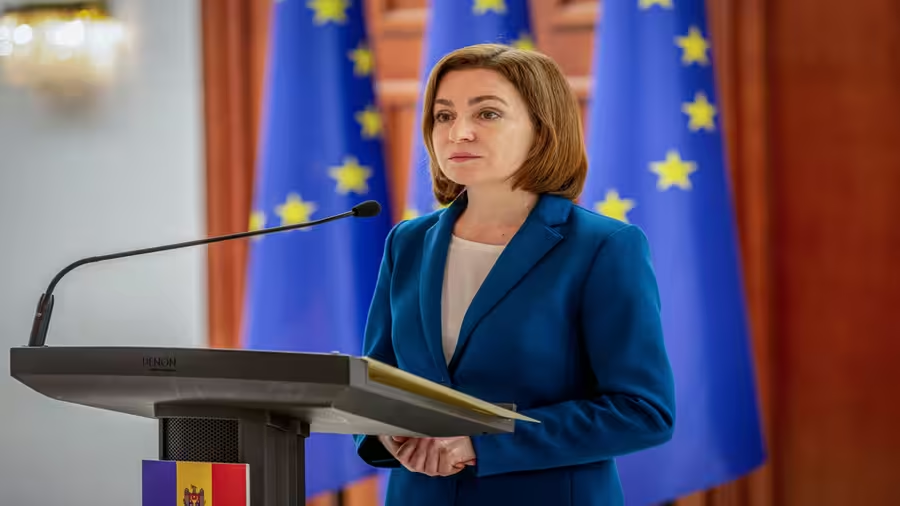
“If we have a referendum, I would vote for unification with Romania,” Moldovan President Maia Sandu said, arguing that it is becoming “increasingly difficult for a small country like Moldova to survive as a democracy, as a sovereign country, and to resist Russia.”
In a candid interview this month, Sandu reignited long-standing debates over the potential unification of Moldova and Romania, stating that she would personally vote in favor of such a move in a referendum. The remark, made on the popular British podcast The Rest Is Politics, drew sharp reactions from Moscow, renewed speculation in both countries, and served as a reminder that unification remains a distant and divisive prospect.
Sandu described unification as a potential “Plan B” to protect Moldova’s fragile sovereignty amid ongoing Russian pressure, hybrid warfare, and the frozen conflict in Transnistria.
Tempering Expectations and Public Sentiment
However, Sandu was quick to temper expectations. She acknowledged that there is currently no majority support in Moldova for immediate unification, with recent polls showing support ranging between 29% and 44%, depending on the wording. In Romania, public enthusiasm has also declined, with surveys indicating that only around 40% of Romanians favor a rapid merger—down from higher levels before Russia’s full-scale invasion of Ukraine in 2022.
Sandu emphasized that Moldova’s primary strategic goal remains accelerated integration into the European Union, a path she described as “much more realistic” and capable of safeguarding sovereignty without dissolving the Moldovan state.
Geopolitical Tensions and Moldova’s EU Path

The comments come amid heightened geopolitical tensions. Moldova, a former Soviet republic with a Romanian-speaking majority, has faced persistent Russian interference, including energy blackmail, disinformation campaigns, and attempts to destabilize its pro-European government.
In 2025, Moldova advanced its EU candidacy by opening accession negotiations and adopting a new national security strategy that explicitly identifies Russia as its main threat. The country also began procedures to withdraw from the Russia-led Commonwealth of Independent States.
Russia’s Stern Response
Russia responded swiftly to Sandu’s remarks. On January 20, the Kremlin warned that any “plans to merge with Romania” would “destroy Moldova’s statehood,” echoing Moscow’s long-standing opposition to closer ties between Chișinău and Bucharest. Russian officials have historically viewed unification as a red line, with some analysts noting that the 1992 Transnistria conflict was partly intended to prevent such a merger.
Romania’s Stance
In Romania, the government has welcomed deeper bilateral ties but has avoided endorsing immediate unification. Bucharest continues to support Moldova’s EU path, providing financial and technical assistance while emphasizing that any future merger must be voluntary and democratically decided.
Strategic signalling amid uncertainties
Observers say Sandu’s statement is more strategic signalling than a concrete policy shift. By floating unification as a hypothetical option, she appears to be pressuring the EU to accelerate Moldova’s accession process while reminding Moscow that Chișinău has alternatives if European integration stalls.
For now, the unification of Moldova and Romania remains a subject of passionate debate rather than an imminent reality. As Moldova navigates its European aspirations amid Russian threats, the idea of Unirea continues to function as both a cultural aspiration and a geopolitical bargaining chip.
For more such updates, follow us on The World Times.