U.S. President Donald Trump has proposed creating a new international organisation called the “Board of Peace.” The idea has caused concern among diplomats because it could change how peace and post-war rebuilding are managed around the world.
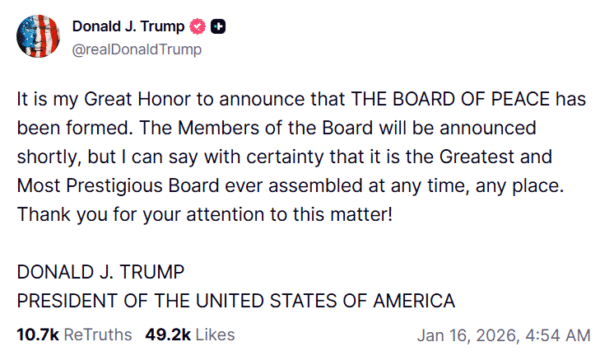
Announcing the proposal on his social media platform Truth Social, Trump wrote, “It is my great honor to announce that the Board of Peace has been formed… the greatest and most prestigious Board ever assembled at any time, any place,” adding that the members would be announced soon.
What Is the “Board of Peace”?
The Board of Peace is planned as a new global forum for peace and reconstruction, but it will not be part of the United Nations system. Instead of being open to all countries, it would function as a select group of powerful states.
According to draft documents, the Board would:
- Oversee rebuilding in war-affected areas
- Promote political stability
- Coordinate peace and governance efforts
The proposal is currently linked to Gaza’s post-war reconstruction, but it may later be used in other conflict zones.
How Would Membership Work?
The most controversial part of the proposal is the membership fee. Countries would have to pay USD 1 billion to qualify for long-term or permanent membership of the Board of Peace, while those that do not pay would be allowed to join only for short terms of about three years. Even this limited membership would be subject to renewal only with the approval of the Chair of the Board.
In effect, money would become the main way to gain influence over peace and reconstruction decisions. This is unusual because global institutions such as the United Nations, World Health Organization, and International Monetary Fund calculate contributions based on a country’s economic size and capacity to pay, rather than charging a single fixed entry fee.
Who Would Control the Board of Peace?
Donald Trump is expected to be the first Chairman of the Board.
As Chair of the Board, he would have wide-ranging powers, including the authority to approve new members, decide whether existing members can renew their terms, set the agenda for meetings, and oversee the organisation’s finances. This concentration of control in one position has raised concerns about weak institutional checks and balances.
This has raised concern because most international organisations are run by collective leadership and rules, not by one person. Diplomats worry this would make the system too dependent on individual authority.
Why Is Trump Proposing This?
The proposal matches Trump’s long-standing view that:
- Alliances should be paid for
- Security is a business deal, not charity
- International bodies should mainly serve national interests
This approach is similar to his past pressure on NATO allies to increase payments and his use of tariffs in diplomacy. The Board of Peace applies the same transaction-based logic to peacebuilding.
How Does the Board of Peace Affect the United Nations?
Many see the Board as a parallel system to the UN, especially to the UN Security Council and UN peacekeeping operations. The UN promotes universal participation, while the Board of Peace would focus on wealth and political alliances.
Critics worry this could split the world into U.S.-led paid alliances and China-Russia-led alternative groups. Such divisions could weaken global cooperation.
What Are the Global Implications?
Several countries are opposing the idea quietly. Their main concerns include the following: peace should not be determined by money, poorer countries could be left out, and too much power would rest in one person’s hands. However, some wealthy allies and countries wanting strong ties with the U.S. might support the plan, especially if it promises quicker rebuilding without UN delays.
Experts say the proposal shows a move away from rules-based global systems toward deal-based politics. For developing countries, this raises fears of being left out of important peace decisions, with wealthy nations controlling post-war governance and a smaller role for inclusive institutions. This situation has increased calls to reform the UN instead of replacing it with smaller, elite-driven groups.
Conclusion: A New Wall in Global Governance?
Just as physical walls once divided nations, critics argue the Board of Peace could create a new digital and political barrier in global diplomacy. Peace would then depend not on shared responsibility but on who pays and who has the power.
Whether this idea turns into reality or remains just a proposal, it has already sparked a significant discussion about the future of global peace and international cooperation.
For more such informative articles, stay tuned at The World Times.