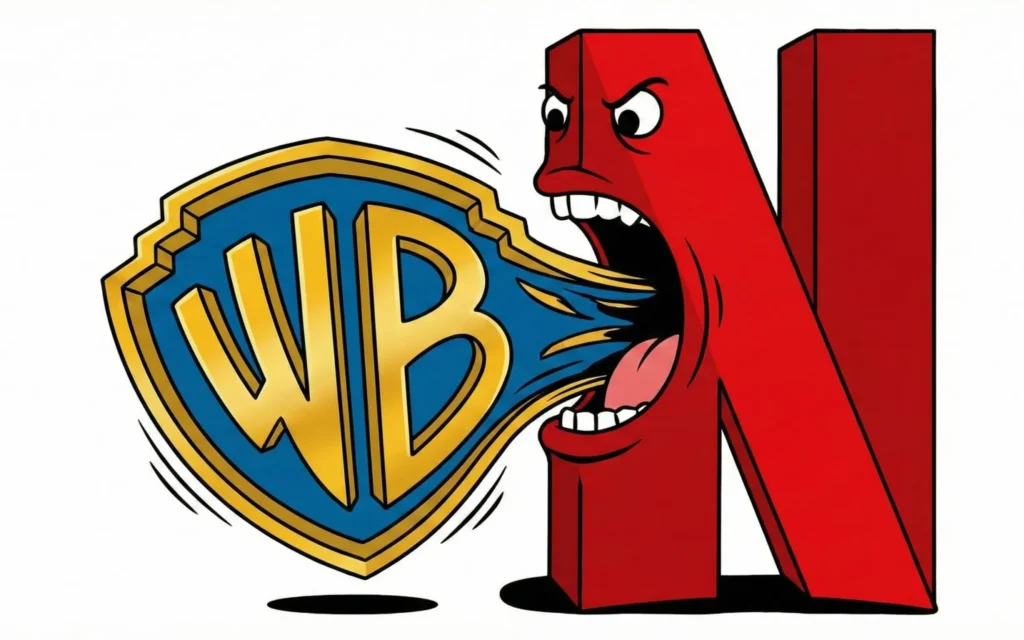
Ironically, before it became a global streaming giant, Netflix started as a DVD-by-mail service in 1997, eventually destroying what it began with. With 301.6 million paid subscribers and a reported revenue of 39 billion dollars in 2024, Netflix dominates the streaming market. But with its recent endeavour to swallow Warner Bros, one of the ‘Big 5’ Hollywood studios, it not only wants to cement its dominance over the streaming market but also establish itself as the central entity controlling the entire entertainment food chain.
David Zaslav and Ted Sarandos, partners in crime, have published statements laden with honey, assuring their consumers, but more importantly, their shareholders and board members that there is no need to ring an alarm and everything is A-okay under the roof. Yet an 82-billion-dollar deal does raise eyebrows. More importantly, it is the repercussions of this deal that trigger the limbic system of every cinephile and artist concerned with the sanctity of their art form, inducing a fight-or-flight response.
The Erosion of Theatrical Cinema in the Age of the Phone Screen

The current situation echoes a threat from the past, when the television boom threatened theatres and studios scrambled to defend their territory from a technological invention that endangered their livelihood. But now the threat has evolved into something far more grave — art itself.
Ted Sarandos has belittled the cinematic experience of the big screen plenty of times, probably because he knows no one buys it. A year ago, he brazenly suggested that the ‘Barbenheimer’ cultural phenomenon would have been just as great on a streaming platform. To support his claim, he added that his son, who is an editor, watched Lawrence of Arabia on his phone.
To quote the late David Lynch: “Now, if you are playing the movie on your telephone or on your computer, you will never in a trillion years experience the film. You will think you have experienced the film, but you will be cheated; you will be experiencing a weakness, an extreme putrefaction of a potential experience in another world. So don’t let your friends or some television advertisement into letting you accept a weakness, a sadness.”
When an Algorithm Overtakes Cinema
With Warner Bros. having two successful films in One Battle After Another and Sinners — two personal stories made on big budgets and potentially gunning for Best Picture — the Netflix acquisition threatens not just the film industry but also the future of the art form itself. Warner makes up 30% of the top ten highest-grossing theatrical releases in the US and Canada, and became the first studio to hit 4 billion dollars globally this year. This included a fresh take on a superhero film, resurrecting a horror franchise, and supporting auteur directors such as Paul Thomas Anderson and Ryan Coogler.
Netflix will not only shorten the theatrical release window to a few weeks, reducing the visibility and recognition of such films, but also threaten a communal experience shared between strangers in a dark room in an era where people are more divided than ever before. The theatrical experience — a brief reprieve from the mundane — will be replaced by an algorithm that seeks to permanently separate the watcher from reality, becoming his sole source of dopamine. The algorithm meticulously curates content, encouraging binge-watching and a surrender of self-control, deepening alienation in an already increasingly isolated world.
To make matters worse, Netflix uses generative AI in production workflows to cut costs, further enabling the disintegration of not just the art form but also the industry itself, impacting countless livelihoods for something cheaper, hollow and emotionless. The merger would also give Netflix access to Warner’s massive content archive stretching back nearly a century, material that can be used to train AI models for voice synthesis, character generation, storytelling structures, and audience-preference prediction. This not only puts the history of cinema in the hands of those who can misuse it but also places its future in jeopardy.
The Financial Repercussions of the Netflix Warner Deal
Perhaps such a financially profitable year for Warner is exactly why it is the perfect time for David Zaslav to sell, and it comes as no surprise that, in the end, the powers that be care neither about the theatrical experience nor the art of storytelling.
Netflix, on the other hand, does not care about the money it spends to buy Warner; it cares about eliminating the threat of a major Big 5 studio and its theatrical releases. Anything that deviates from the streaming format is a direct threat to Netflix’s existence, and to eliminate that threat, Netflix wants to capitalise on this golden opportunity.
Although the Directors Guild of America, led by their president Christopher Nolan, was scheduled to meet with Netflix to raise concerns about the future of the film industry, nothing conclusive has emerged. Meanwhile, Paramount has made yet another attempt to acquire Warner after having failed multiple times these past few months.
The Writers Guild of America stated the merger: “The world’s largest streaming company swallowing one of its biggest competitors is what antitrust laws were designed to prevent. The outcome would eliminate jobs, push down wages, worsen conditions for all entertainment workers, raise prices for consumers, and reduce the volume and diversity of content for all viewers.”
Senator Elizabeth Warren sounded a similar alarm, calling the merger an “anti-monopoly nightmare.” She added: “A Netflix-Warner Bros would create one massive media giant with control of close to half of the streaming market — threatening to force Americans into higher subscription prices and fewer choices over what and how they watch, while putting American workers at risk.”
The Future of Cinema Hangs in the Balance at Warner Bros
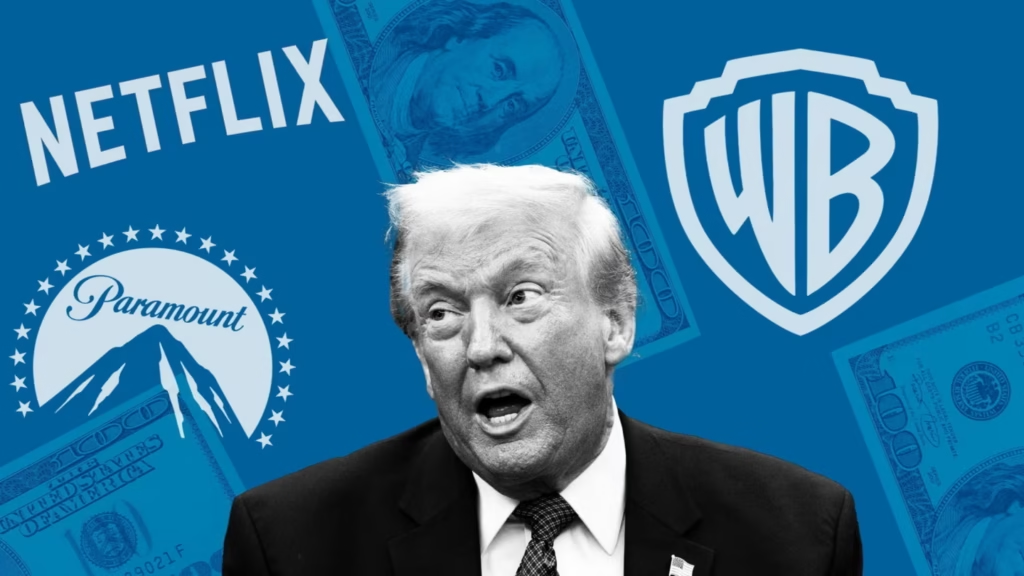
After the second-round bids, Paramount sent a letter to Warner Bros alleging foul practices in the sale process, accusing them of favouring Netflix and abandoning accountability to shareholders. With Netflix proposing a $5.8 billion breakup fee should the deal fall apart, Warner’s board accepted the offer.
But soon after news of the deal broke, Paramount launched a hostile bid to take over Warner Bros for a whopping 108 billion dollars at 30 dollars a share. Warner’s stock jumped by 6.7%. With President Trump stating that the Netflix-Warner deal “could be a problem,” and Kushner backing Paramount, things have become far trickier than anticipated, even amidst the loud clapping of the Netflix takeover.
On one hand lies a streaming giant threatening the integrity of the cinematic art form; on the other, a Big 5 studio that promises to maintain the integrity of the theatrical experience with its aim to release more than 30 films theatrically each year. The caveat, however, is that Paramount is headed by Larry Ellison’s son, a Trump ally and gaining control over CNN’s parent company may allow for heightened media influence in service of right-wing politics.
As Warner Bros carefully considers Paramount’s offer, it is yet to be seen in whose hands the future of the film industry and film as an art form will ultimately rest.
Follow more updates from the world of entertainment at The World Times.