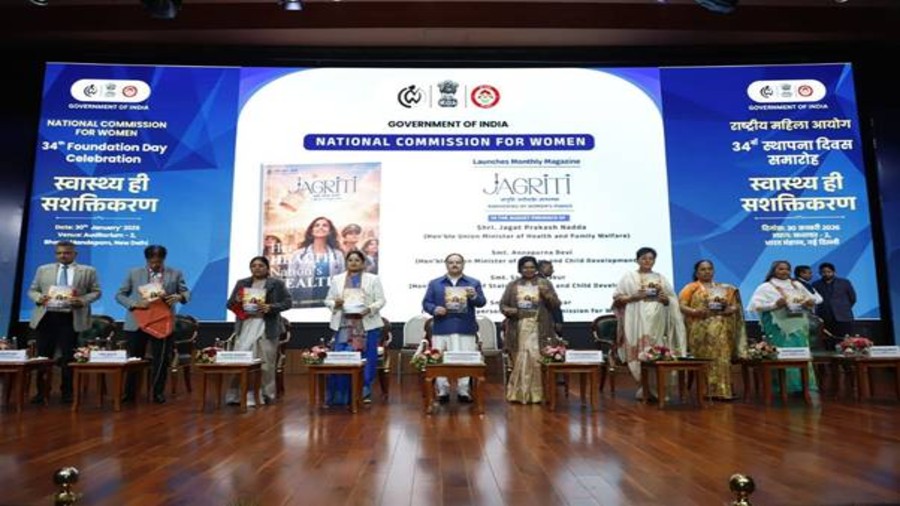
On January 30, 2026, the National Commission for Women (NCW) celebrated its 34th Foundation Day on Friday at Bharat Mandapam, New Delhi. The programme highlighted the central role of women’s health and empowerment in national development. The event brought together senior Union ministers, award-winning scientists and policy advocates to reflect on NCW’s three-decade journey and future priorities.
Union Minister for Health and Family Welfare, Shri Jagat Prakash Nadda, graced the occasion as the Chief Guest. He underlined the Indian government’s commitment to women-led development. In his address, he also emphasised that a healthy woman is foundational to a healthy society and nation. Further, stressing that investments in women’s health and preventive care are strategic imperatives.
He noted that over the years, government policies have shifted focus from mere curative healthcare to robust preventive frameworks. This includes strengthening maternal and child health services and expanding access to essential care nationwide. Nadda reiterated the government’s resolve to continue prioritising women’s wellbeing as central to India’s inclusive growth.
Union Minister for Women and Child Development, Smt Annpurna Devi, served as the Guest of Honour. She highlighted the significant impact of the POSHAN Abhiyaan, a flagship nutrition initiative designed to improve maternal and child nutrition across India. She pointed out that focused interventions have enhanced health outcomes for women and children, especially in underserved regions.
NCW Chairperson Smt Vijaya Rahatkar reaffirmed the Commission’s vision of a more equitable, safer, and healthier India for women. She said that the theme of this year’s Foundation Day, “Swasthya hi Sashaktikaran” (Health is Empowerment), reflects the core belief that physical wellbeing is inseparable from women’s social and economic empowerment.
Honouring Excellence and Innovation
As part of the celebrations, the NCW honoured eminent personalities who have contributed to nation-building. Dr Tessy Thomas, often referred to as the “Missile Woman of India” for her leadership in India’s defence science community, was felicitated for her exemplary work at DRDO.
The Commission also recognised Shri V. Kamakoti, Padma Shri awardee and Director of IIT Madras, for his role in developing an AI module for “Tere Mere Sapne”, an NCW-launched programme that supports pre-marital communication and counselling. These honours symbolise the Commission’s appreciation for contributions that intersect women’s development and technological innovation.
What the National Commission for Women Is and Why It Matters
Established in 1992 under the National Commission for Women Act, 1990, the NCW is a statutory body mandated to safeguard and promote the rights and dignity of women in India. It functions independently under the Ministry of Women and Child Development, with the authority to investigate complaints, review laws, and recommend policy reforms.
The Commission plays several key roles:
- Legal review and reform: It examines constitutional and legal safeguards for women and suggests legislative or policy improvements where necessary.
- Complaint redressal: NCW takes up complaints of rights violations, often intervening or liaising with authorities to ensure timely action.
- Advocacy and awareness: Through workshops, consultations and national events like Shakti Samvaad, the Commission fosters dialogue on gender equality and social justice.
Over the years, NCW has also contributed to strengthening the implementation of key laws, such as the Sexual Harassment of Women at Workplace (Prevention, Prohibition and Redressal) Act, 2013. It also addresses systemic issues like child marriage, gender-based violence and access to services.
The 34th Foundation Day reaffirmed NCW’s role not just as a watchdog but also as a platform for positive change. By focusing on women’s health, acknowledging leaders from diverse fields, and encouraging coordinated action across states and communities, the Commission continues its mission to build a more inclusive and equitable India.
Stay tuned to The World Times for more!