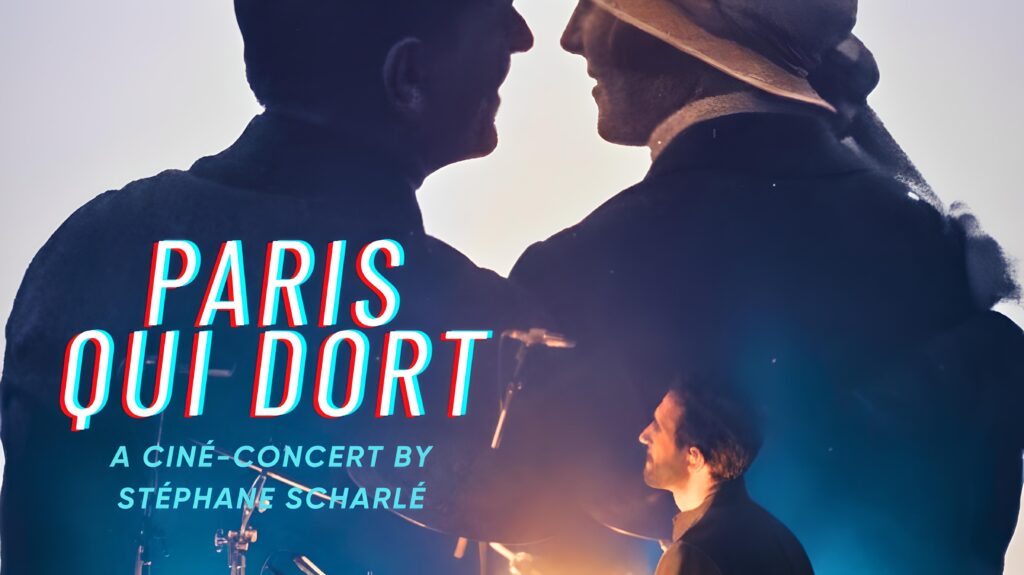
René Clair’s Paris Qui Dort (The Crazy Ray), a 1924 surrealist sci-fi gem, opens with a lone watchman perched atop the Eiffel Tower, who comes down to find Paris mysteriously frozen in time. Nearly a century later, at Alliance Française, the Cine Concert brought new life to this silent fever dream. Stéphane Scharlé, armed with what he affectionately calls his “spaceship,” an augmented drum kit, reshaped the silent film’s world through a live soundscape transporting the audience to a ‘surreality’.
The Early Interplay of Image and Music
Even though film has its genesis in art forms once solely crafted for the bourgeoisie and the aristocracy, film is mechanical, produced for the masses. However, early cinema was a novel marriage between the mechanical and the theatrical. In the Silent Era, before the advent of sound film, it had a separate component, a split that no longer exists. There was a tension between itself and a part that accompanied it outside its spatial dimension. This friction was produced between the mechanical movement of images and live music that accompanied them.
Live music in the 1890s masked the projector’s noise and heightened the emotional atmosphere. Small-town theatres relied on a pianist, while cities flaunted ensembles or the Mighty Wurlitzer, capable of simulating entire orchestras. Although films grew more sophisticated, early film music largely remained incidental and indifferent to the images it accompanied.
A Trans-Sensorial Experience
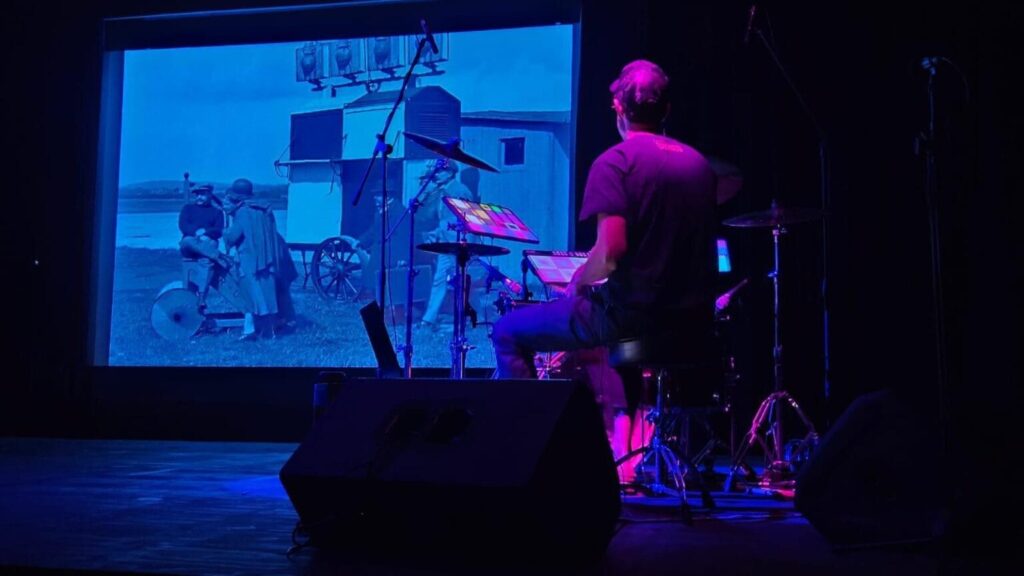
Yet music for film was merely a source of incidental delight. It had no intention of serving the emotional cues of the film. It added a bit of pep to the theaters but mostly remained indifferent to the images. As continuity editing emerged and cinema shifted toward narrative form for a more sophisticated audience, music’s role expanded. It was now required to support the film’s internal architecture by adding another layer of continuity. Yet Stéphane and his sound engineer, Eric, went beyond this inherited function. They revived the archaic tension that once defined silent cinema, the meeting of live sound and mechanical imagery. This infused the experience with an emotional articulation that felt both visceral and strangely primordial.
Stéphane’s score, composed specifically for the surrealist film, created what Michel Chion calls a trans-sensorial experience. In a world without dialogue, where semantic sound is absent, his music stepped in as the missing layer of meaning. Every sound carried an aural image, an emotional imprint. That which was purely incidental and casual was now intended and semantic. The aural image created a unified experience, one that felt analogous to reality itself. It gave the image a layer of consciousness previously absent. By fulfilling the audio-visual contract and merging two separate sensory sources, it constructed a narrative world that mimics reality, shaping the fabric of time and space through unified movement.
Through Chion’s idea of synchresis, the mind fuses sound and image into something larger. The speechless characters, the wordless mannequins that seemed akin to a plank of wood seemed to breathe again. Sound and image contaminated one another, projecting meaning across sensory boundaries. They invited the audience to reinterpret the film through this renewed, synergetic lens.
How Electronic Music Alters Consciousness

Research from the University of Barcelona helps explain why Stéphane’s live soundtrack felt so transformative. Participants exposed to snippets of electronic music entered an altered state of consciousness. They shifted from a normal waking state into what neuroscientists call entrainment. Here, rhythmic stimuli synchronize with neural firing patterns. This creates a sense of unity between the listener’s brain and the pulse of the music.
Electronic music’s hypnotic repetitions, layered synths, and slow structural build-ups naturally induce a flow state. Emotional resonance heightens, inner dialogue quiets, and immersion deepens. In this state, cinema becomes something not merely watched but physically felt.
Stéphane navigated these neurological responses with precision. A shift in tempo or rhythmic density could guide the audience’s consciousness. Fast tempos, which tend to produce gamma waves, sharpened awareness. They created an almost psychedelic edge suited to the surrealist chases unfolding at 16 fps. Slower tempos evoked theta waves, encouraging introspection. They softened temporal perception until 16 fps momentarily resembled the cadence of lived reality.
How René and Stéphane Construct a Surrealist Dialogue With the Unconscious
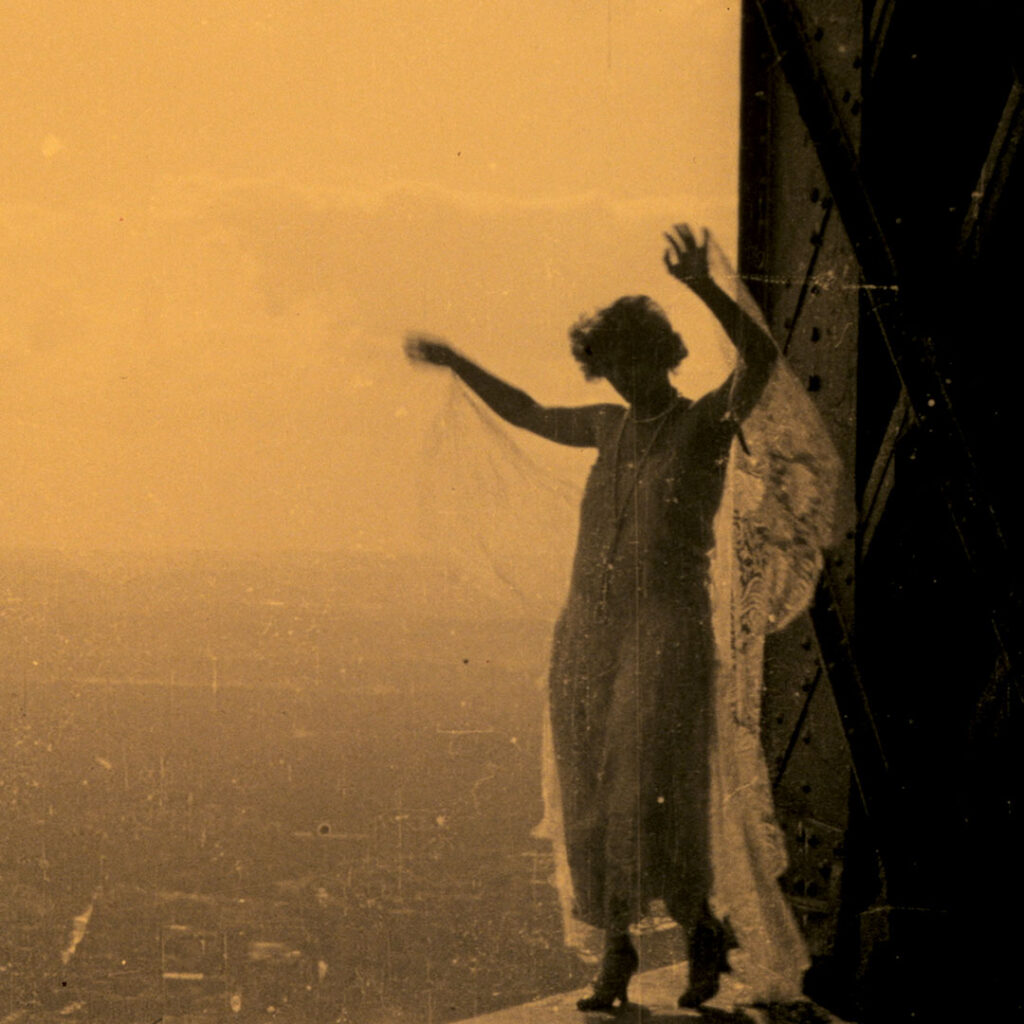
Surrealism was never just an art style. It was a philosophical stance that sought liberation of the human spirit by dissolving the boundary between dream and reality, creating a ‘surreality’. Paris Qui Dort stands as an early cinematic precursor, weaving fantasy and reality through techniques that suspend time, create dreamlike imagery, and defy logic to critique socio-economic conditions of modern life.
This cinematic surrealism finds its sonic counterpart in electronic music. Electronic sound manipulates and decontextualises audio, creating impossible spaces with reverb, severing the bond between sound and source, and juxtaposing textures that defy physical laws. Like surrealist imagery, these sonic worlds feel both familiar and alien.
Both surrealism and electronic music draw from the irrational and the unconscious. They break rules, abandon logic, and shape meaning through instinctive impulse rather than convention. The link between Clair and Scharlé lies precisely in this shared commitment to using avant-garde techniques to tap into the unconscious reservoir by altering traditional compositions and structures.
While René manipulated cinematic time through variable speeds and reverse motion, Stéphane reshaped sonic time through loops and augmented percussion. Both elongated and compressed duration, crafting dreamlike architectures that resemble associative thought more than linear storytelling. Their work bypasses rational perception and invites viewers into a momentary super-reality, a junction of time and space where the conscious intersects and merges with the unconscious.
Jungian Psychology Behind The Surrealist Blend of Sound and Image
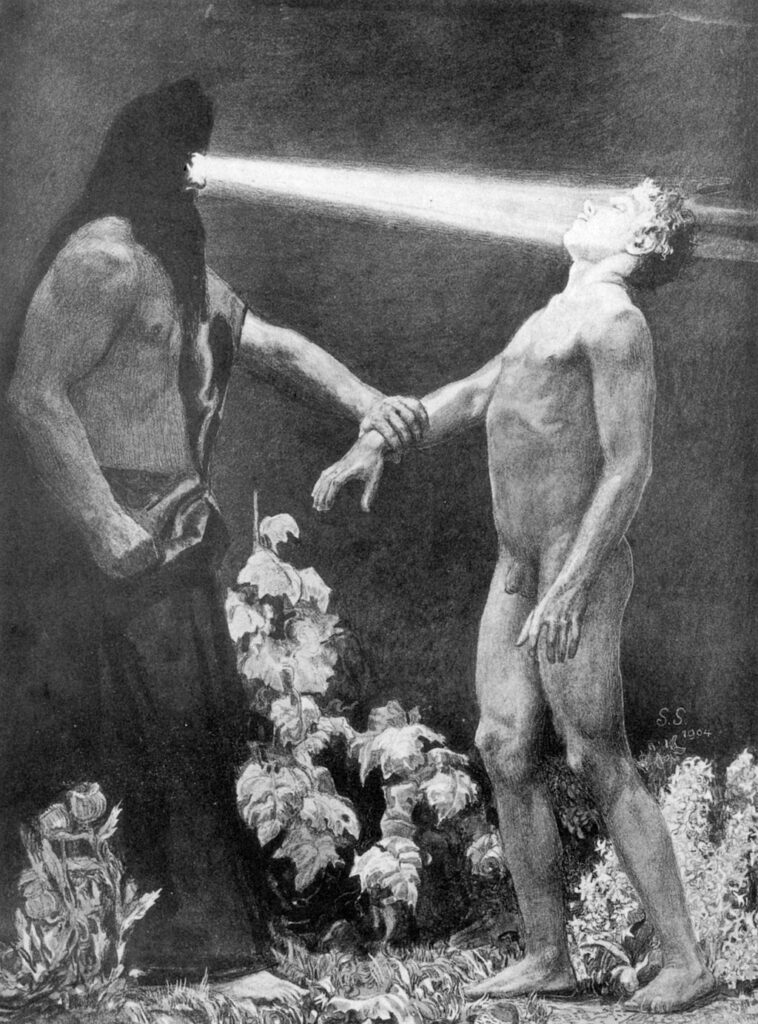
Using the surrealist plot of Paris frozen in time, René allows the unconscious to emerge through Jungian archetypes. The characters embody these archetypes, which René uses to critique the socio-economic conditions of modern life. Having been freed from the constraints of reality that once bound them, the troop marches on their mischievous mission through the Parisian streets. What starts off as a spree of looting the bourgeoise cafes ends up in the five men chasing after the woman, having discovered the futility of riches and wealth in a world with no value for them.
As the social mask wears off and the Persona disintegrates, the Shadow self comes to the forefront as their unconscious desires spill into the waking world of a sleeping Paris. In a city suspended in time, pleasure becomes their sole pursuit in the absence of consequence.
Once the city is freed from this surreality, the motley crew seeks to secure the same wealth they once carelessly squandered. Unlike the rest of the cabal, only the protagonist achieves the union of the unconscious and the conscious by developing what Jung calls The Self. He abandons the wealth he once sought after and finds companionship, securing his own bubble of time atop the Eiffel Tower in a city that is constantly moving.
By using incongruous electronic textures and deep basslines, Stéphane generated a dark ambient soundscape that created friction against the visual, yet served the required emotional cues of the film, helping to bring the Shadow self to the forefront. Stéphane also underscores the process of individuation of the protagonist using binaural beats and isochronic tones that produced theta waves, leading to a sense of introspection in us as the protagonist integrated different parts of his personality to form The Self.
Cine Concert as a Self-Reflexive Experience
René’s images and Stéphane’s sound do not simply accompany one another. They contaminate, reshape, and redefine each other, collapsing the boundaries between the mechanical and the live, the rational and the unconscious, the dream and the waking world. For a brief moment we inhabit this surreality with them. In that suspended space of this surrealist feature, where Paris stands frozen, we experience an encounter with a part of us that quietly lurks beneath the surface of reality.
For more insight on how sound and image affect us stay tuned at The World Times.