Thailand and Cambodia convened high-level diplomatic talks in China on December 28, 2025, aimed at solidifying a fragile ceasefire that ended weeks of deadly border clashes. This meeting marks a significant moment in regional diplomacy, with Beijing positioning itself as the primary mediator in one of Southeast Asia’s most volatile territorial disputes that has claimed over 100 lives in recent months.
The Deadly Trajectory
December 27 brought an end to 20 days of intense fighting that erupted in early December along the contested Thai-Cambodian border. 26 military casualties were reported by Thailand, and a death toll of approximately 44 was reported from collateral damage, while Cambodia documented 30 civilian fatalities and 90 injuries, with hundreds of thousands displaced on both sides. The violence represented the most severe escalation since July 2025, when initial clashes killed at least 42 soldiers and 62 civilians before a US-brokered ceasefire temporarily halted hostilities.
The conflict dates back to the colonial times during the colonial era. Franco-Siamese treaties of 1904 and 1907, where French surveyors’ maps deviated from agreed watershed boundaries to place ancient Khmer temples within Cambodian territory. Thai forces launched “Operation Sattawat” in December, which had F-16 strikes conducted deep into Cambodian territory and deployed tanks to contested zones. Under the current agreement, Thailand committed to releasing 18 captured Cambodian soldiers after a 72-hour observation period, which was one of the key Cambodian demands.
Role of China as mediator
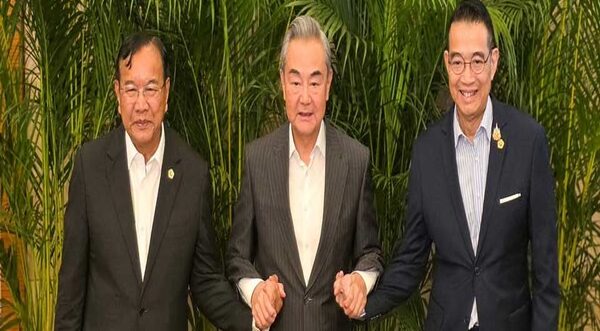
China has emerged as the dominant mediator in this crisis, deploying Foreign Ministry Special Envoy Deng Xijun for shuttle diplomacy between Bangkok and Phnom Penh. Wang Yi, the Chinese foreign minister, hosted both Thai Foreign Minister Maris Sangiampongsa and Cambodian Deputy Prime Minister Prak Sokhonn in discussions aimed at establishing a “complete and lasting ceasefire” and rebuilding mutual trust. Beijing announced $2.8 million in emergency humanitarian assistance for Cambodia while offering continued diplomatic support to facilitate comprehensive dialogue. Cambodia’s Prak Sokhonn expressed “profound gratitude” for China’s “crucial role” in achieving the ceasefire.
Impact on Regional order
This mediation effort represents China’s growing influence in Southeast Asian security architecture, especially when it competes with US involvement in regional conflict resolution. While President Trump previously brokered a July ceasefire by threatening trade privileges, China’s sustained diplomatic engagement demonstrates its determination to establish itself as an indispensable regional power broker. However, Beijing’s assertive diplomacy has raised concerns among ASEAN members about its support for “ASEAN centrality,” with critics noting China’s tendency to pursue bilateral arrangements that potentially undermine the bloc’s cohesion. The success or failure of this Chinese-mediated agreement will significantly impact perceptions of Beijing’s capability to manage regional crises and shape Southeast Asian security moving forward.
For more updates, follow us on The World Times