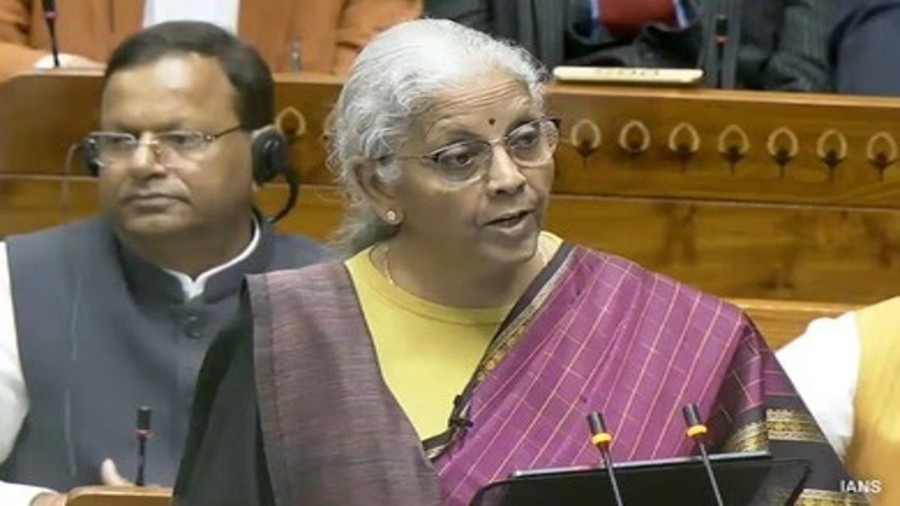
In a major infrastructure push, Finance Minister Nirmala Sitharaman announced the creation of seven new high-speed rail corridors while presenting the Union Budget 2026 – 27 at the Parliament on Sunday. The corridors, described as “growth connectors,” are designed to drastically reduce travel times, improve passenger mobility, and spur economic development across regions.
The announcement marks a significant expansion of India’s high-speed rail network beyond the ongoing Mumbai–Ahmedabad Bullet Train project, currently the only high-speed link under construction, and reflects the government’s long-term vision to modernise passenger transport in the country.
What Was Announced
In her budget 2026 speech, Sitharaman said the proposed corridors would support “environmentally sustainable passenger systems”. It will connect major cities, industrial hubs, and emerging urban centres.
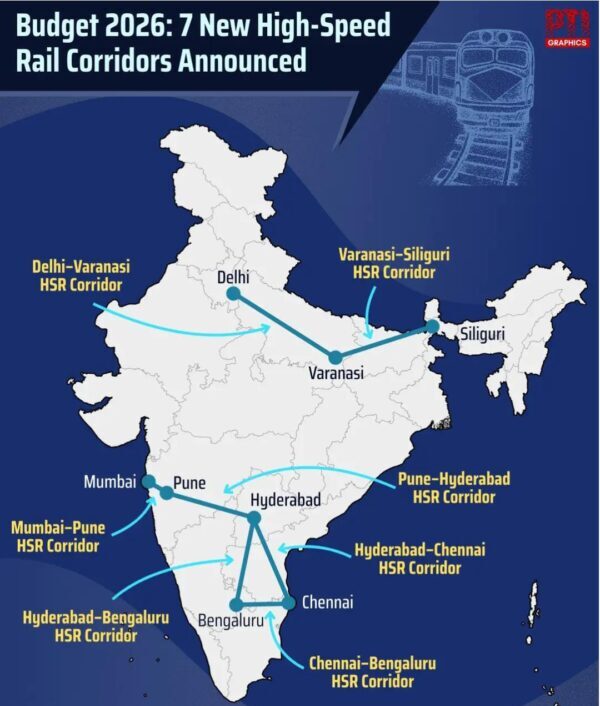
The seven high-speed rail routes identified are:
- Mumbai–Pune
- Pune–Hyderabad
- Hyderabad–Bengaluru
- Hyderabad–Chennai
- Chennai–Bengaluru
- Delhi–Varanasi
- Varanasi–Siliguri
These corridors are expected to significantly reduce travel times and ease the burden on conventional rail and road networks. They will bridge financial, technology, cultural, and religious centres across western, southern, eastern, and northern India.
Context and Significance
The corridors are part of a broader infrastructure strategy in the Budget 2026. These increase public capital expenditure to ₹12.2 lakh crore in the fiscal year 2027. This reflects the government’s focus on long-term investment in connectivity and sustainable growth.
Until now, India’s sole high-speed rail project, the Mumbai–Ahmedabad High Speed Rail Corridor, has been the flagship endeavour, designed for trains running at speeds above 320 km/h. The new corridors, while their operational speeds will depend on design and technology choices, are expected to function at high speeds above 250 km/h on dedicated tracks.
Why This Matters for the Nation
High-speed rail corridors can reshape India’s connectivity landscape in several ways:
- Economic Growth: Faster passenger travel helps link cities with strong industrial and IT bases. Further, potentially boosts investment and trade flows across regions.
- Regional Development: Routes such as Delhi–Varanasi and Varanasi–Siliguri open southern and eastern corridors. These can stimulate economic activity in Uttar Pradesh, Bihar, West Bengal, and beyond.
- Tourism and Culture: The Delhi–Varanasi corridor, for example, is expected to enhance access to one of India’s major spiritual hubs, facilitating pilgrimage tourism while significantly reducing travel times.
- Sustainability: These rail links aim to provide cleaner alternatives to conventional long-distance travel, reducing carbon emissions compared to road or air travel.
Uttar Pradesh: Twin Benefits
Railway Minister Ashwini Vaishnaw highlighted the impact of the high-speed corridors for Uttar Pradesh, where two routes are planned to pass through key districts.
- The Delhi–Varanasi corridor could connect the national capital with the historic city of Varanasi in under four hours, a sharp reduction from current rail or road travel times.
- The Varanasi–Siliguri corridor will extend connectivity toward the northeastern gateway, strengthening transport links across the region.
Lucknow, the state capital, is expected to emerge as a key station, linking political, industrial, and cultural centres. These routes are anticipated to boost pilgrimage tourism, business travel, and regional economic development.
Officials indicated that preparatory work, including detailed feasibility studies, land acquisition, and clearances, will begin soon. Construction is expected to follow in the coming months, with simultaneous progress planned on multiple corridors.
Implementation over the coming years will make these projects central to India’s transportation transformation. As the Government positions high-speed rail as a core part of its infrastructure agenda, millions of passengers could benefit from faster, cleaner, and more efficient travel.
Stay tuned to The World Times for more!