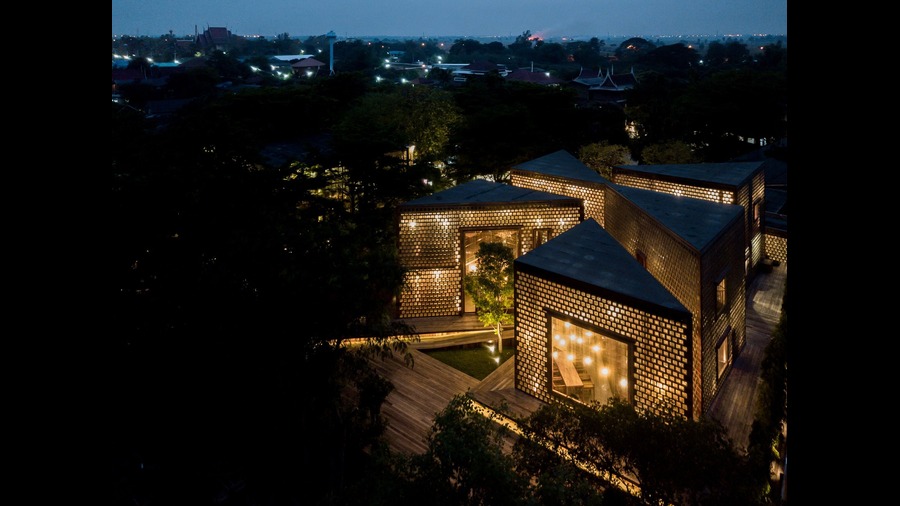
In a village near Thailand’s historic city of Ayutthaya sits a restaurant that employs widows and elderly women as chefs. Designed by award-winning architect Boonserm Premthada, the restaurant hopes to preserve centuries-old traditions by empowering the local community.
Boonserm Premthada

Architect and artist Boonserm Premthada is an Assistant Professor at the Faculty of Architecture at Chulalongkorn University and the founder of Bangkok Project Studio.
Boonserm’s work has won many international awards, including the ar+d Award for Emerging Architecture in 2011.
He has also been shortlisted for the Aga Khan Awards for Architecture 2013, the Grand Prize International Brick Architecture 2014, Overall Winner at The Plan Awards 2017, the Acknowledgement Prize at the Regional LafargeHolcim Awards Asia Pacific 2017, the Global Award for Sustainable Architecture 2018, the Royal Academy Dorfman Awards 2019, the 2021 Wallpaper* Design Award for “Best Sanctuary” (Elephant World), and The Golden Madonnina 2021 at THE DESIGN PRIZE in the category of Social Impact, Italy.
Boonserm has lectured and exhibited at the Royal Institute of British Architects (RIBA), Cité de l’Architecture et du Patrimoine (Paris), the Hong Kong Pavilion at the 16th International Architecture Exhibition (Venice), École Polytechnique Fédérale de Lausanne (EPFL), the University of Tokyo, the University of Hong Kong, the National University of Singapore, The Bartlett School of Architecture (UCL), and several other international universities.
In 2021, his pavilion “The House for Humans and The House for Elephants” represented Thailand at the Biennale Architettura.
Read more about him here: http://bangkokprojectstudio.co/bio.html#:~:text=Architect%20and%20artist%2C%20Boonserm%20Premthada,Founder%20of%20Bangkok%20Project%20Studio.
Artisans Ayutthaya Restaurant

Architect Boonserm Premthada calls it a “rural restaurant” and says that the building belongs to the community.
“I designed this building to look like it is hidden within the community, hidden among the villagers’ houses.” The restaurant employs elderly and widowed women, giving them an opportunity to reclaim financial autonomy and secure a livelihood with dignity and grace.
Premthada explains, “These women are often left behind. No one really cares about them. Their children or grandchildren usually send them only a fraction of their earnings. This restaurant gives them a chance to support themselves financially at an advanced age.”
The Cultural Significance Through Recipes
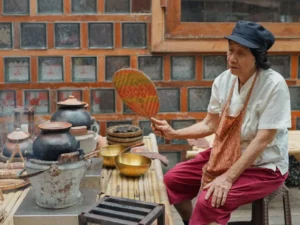
The women have inherited generations of culinary knowledge, carrying on a legacy that might otherwise disappear with the older generation.
Anai Tangjitprasert, a cook at the restaurant, shares: “My favourite recipes are the chilli pastes—green, red, all of them. I learned them from my mother and my aunt.”
Premthada adds, “These aunties and grandmas are getting older every day. One day they will be gone, but the knowledge of the food will not be lost.”
Premthada describes the restaurant’s architecture:
“There are five small triangular buildings with walkways in between. As you walk in, you feel like you are discovering something—like uncovering hidden recipes that are slowly going extinct.”
https://youtu.be/yR9ecNUzJnQ?si=kjF2YVQGb4DBD2Hb
Stay tuned to The World Times for more such updates!