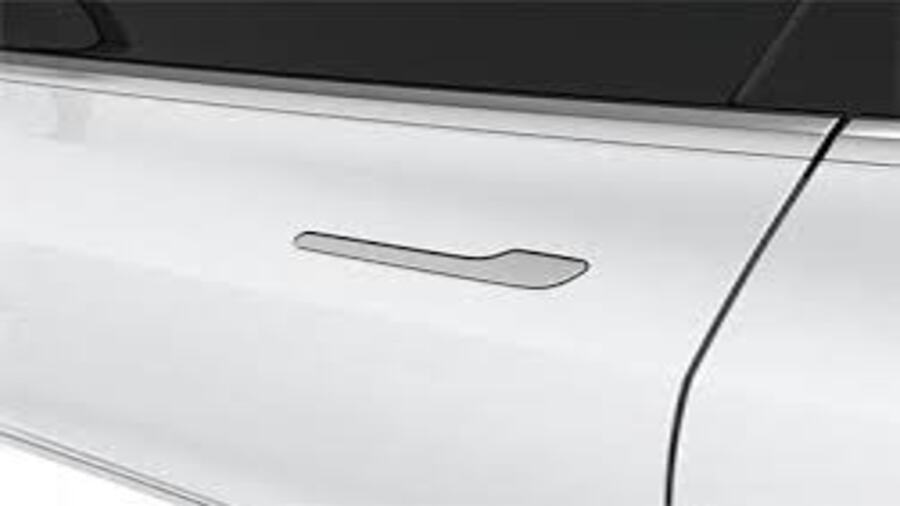
China’s Ban on the “Hidden Door” Policy
China’s Ministry of Industry and Information Technology (MIIT) announced on February 3, 2026, new vehicle safety regulations that will effectively ban hidden, flush, or retractable electronic door handles on all cars sold in the country, the world’s largest auto market. The ban on “hidden doors” requires mechanical door releases on both the interior and exterior of passenger doors, marking the first such nationwide prohibition globally.
The regulation will take effect on January 1, 2027, for new models and on January 1, 2029, for previously approved vehicles.
Trend analysis of Minimalist door designs
Hidden or pop-out handles gained prominence with Tesla’s Model S and Model 3. They are prized for aerodynamic efficiency, sleek aesthetics, and reduced wind noise in EVs. The design, activated by a key fob, app, or button press, retracts flush into the bodywork.
Chinese EV makers such as Xiaomi (SU7) and others quickly adopted the feature, with roughly 60% of top-selling new energy vehicles (NEVs, including EVs and hybrids) featuring such handles.
Risks exposed
Critics highlight risks during emergencies: electronic systems can fail in crashes due to power loss or damage, potentially trapping occupants inside burning or submerged vehicles and hindering rescuers.
In China, several fatal incidents have been reported. In one case in October, a driver perished in a burning SU7 after bystanders were unable to open the door. Other reports cite suspected power failures that prevented door operation, contributing to fatalities.
Internationally, a Bloomberg investigation identified about 140 Tesla incidents in which occupants were reportedly trapped due to handle malfunctions, sometimes forcing rescuers to break windows to save children. U.S. regulators have opened an NHTSA investigation into the Tesla Model 3’s emergency release system.
New Technical Requirements
Under the new rules, every passenger door (except the tailgate) must include a mechanical release operable from both the inside and outside, independent of electricity. Exterior doors must provide a recessed space measuring at least 6 cm × 2 cm × 2.5 cm to allow hand access to the handle from any angle.
Interior handles must be clearly visible to seated occupants and include instructional signage (minimum height of 1 cm) indicating proper operation. Traditional or semi-flush mechanical handles comply with the mandate, while electronic assistance remains optional.
Automakers and Markets are faced with a big hit
Tesla, which popularized the design and is already facing declining sales in China — its second-largest market — will likely need costly redesigns or retrofits. Xiaomi and other domestic EV producers that adopted similar minimalist features face comparable challenges.
The ban could increase production costs, slightly affect vehicle aerodynamics, and delay certain model launches. Consumers may see fewer futuristic designs but gain greater peace of mind in emergencies.
Future Outlook
As the first major market to implement such a rule, China’s policy banning “hidden doors” may influence global standards, including in the United States and Europe, where similar safety concerns have been raised. Automakers will need to balance innovation with safety, potentially accelerating the adoption of manual backup systems worldwide.
While some praise the move as a proactive safety measure amid China’s push for EV dominance, others worry it may limit aesthetic and efficiency innovations. The regulation reflects growing scrutiny of EV-specific safety risks as adoption accelerates globally.
For more such updates, follow us on The World Times.