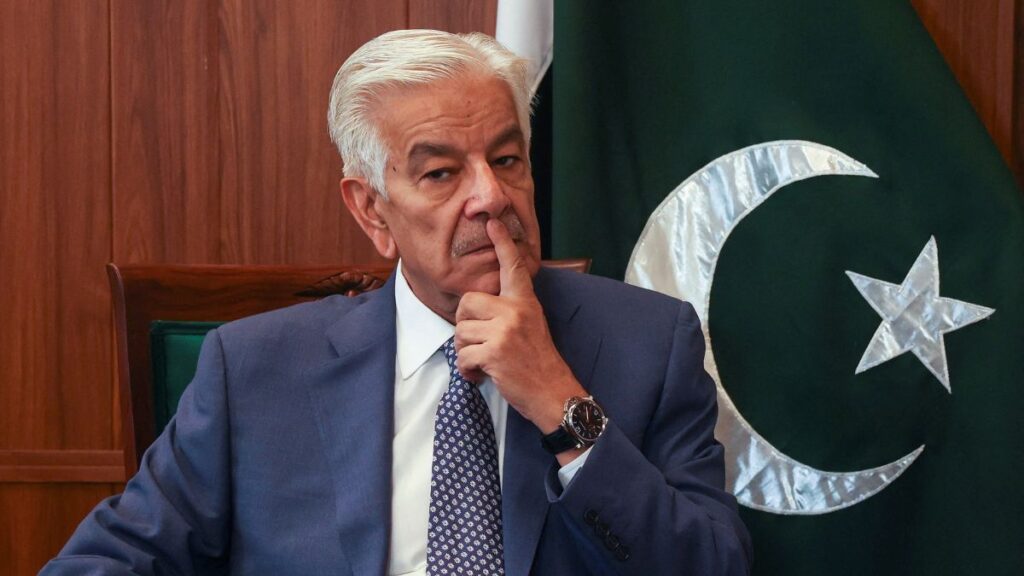
Pakistan’s Defence Minister, Khawaja Asif, has admitted in Parliament that Pakistani security forces are “physically handicapped” in controlling the security situation in Balochistan, highlighting the seriousness of the insurgency following fresh militant attacks. His statement came after a new wave of coordinated militant assaults across the province, including suicide bombings and ambushes targeting police stations, security posts, and government infrastructure. The Balochistan Liberation Army (BLA) claimed responsibility for the attacks. This underlines the seriousness of the ongoing insurgency.
Why Balochistan Is So Important
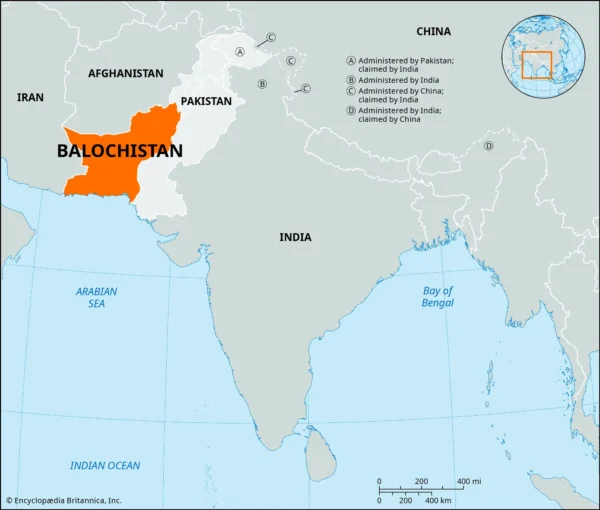
Balochistan is Pakistan’s largest province, covering nearly 44% of the country’s land area. Despite its size, it has the lowest population density. The region features rugged mountains, deserts, and a long coastline along the Arabian Sea. It is also rich in natural resources such as gas, copper, and gold. Strategically, it is important because it hosts the Gwadar Port and major routes of the China-Pakistan Economic Corridor (CPEC).
However, since Pakistan gained independence in 1947, Balochistan has remained economically underdeveloped and politically marginalized. This gap between strategic importance and local deprivation has fuelled long-standing resentment among sections of the Baloch population.
What the Defence Minister’s Statement Means for the Balochistan Insurgency
By describing the army as “physically handicapped,” Khawaja Asif acknowledged that Pakistan’s forces cannot effectively patrol or dominate the entire province. The vast and difficult terrain, along with the dispersed population, makes it challenging to maintain a strong security presence in all areas. Insurgent groups, familiar with the landscape, exploit this to their advantage. The statement also suggests that the state’s authority is inconsistent in Balochistan. In several rural and tribal areas, militants enjoy freedom of movement, and military strength does not always translate into effective control on the ground.
Militants Better Equipped Than Expected
Khawaja Asif also revealed that Baloch militants are using advanced and costly weapons, including modern rifles, thermal sights, and laser systems. According to him, some insurgents may be better equipped than regular Pakistani soldiers. This admission has raised serious questions about arms smuggling, funding networks, and the effectiveness of Pakistan’s counter-insurgency strategy.
Recent Attacks and Changing Tactics
The latest violence involved coordinated strikes at more than a dozen locations. For the first time, reports mention the use of female suicide bombers, indicating a shift in militant tactics. Both the Pakistani military and the BLA have made conflicting claims regarding casualties. This reflects an ongoing information war with no independent verification.
Why the Army Is Struggling Against the Balochistan Insurgency
Analysts identify three main reasons. First, the geography favours the insurgents and makes it difficult for the army to manage logistics and gather intelligence. Second, the insurgency is rooted in local communities and employs guerrilla tactics rather than attempting to hold territory. Third, Pakistan’s strategy relies predominantly on military force, with limited emphasis on political dialogue or reconciliation. Allegations of enforced disappearances and human rights abuses have further eroded trust between the government and local communities.
Is the Balochistan Insurgency Weakening State Control?
Pakistan has not lost Balochistan in legal or territorial terms. Major cities like Quetta and Gwadar remain firmly under state control. However, in many rural and tribal areas, the government struggles to prevent attacks before they occur. This suggests a weakening of strategic and administrative control rather than a loss of sovereignty.
Why This Admission Matters
A public acknowledgment of this nature from a senior minister is uncommon in Pakistan. It challenges the long-standing official narrative of complete control and shifts some focus from external factors to internal challenges. Experts believe the statement may prepare the public for prolonged instability, justify increased military spending, and signal the need for a revised approach to Balochistan policy.
In simple terms, Pakistan can still respond forcefully after attacks, but it finds it increasingly difficult to prevent them. This highlights a serious and ongoing insurgency problem in Balochistan.
For more such informative articles, stay tuned to The World Times.