
In a clear shift in political mood, Chile elected conservative leader José Antonio Kast as president, reflecting a wider regional turn toward law-and-order politics.
From Conservative Firebrand to President
José Antonio Kast’s political trajectory has shifted from mainstream conservatism to the forefront of Chile’s hard-right movement. Previously, he spent 16 years (2002–2018) as a congressman with the Centre-right Independent Democratic Union (UDI). Notably, the party is historically linked to the Pinochet era.
Disillusioned with what he viewed as the UDI’s growing moderation, Kast broke away in 2016. Subsequently, he went on to found the Republican Party in 2019. His rise has been marked by three presidential campaigns. Initially, he ran as an independent in 2017, where he placed fourth with about 8 percent of the vote. Later, it was a strong showing in 2021. At that time, he topped the first round but lost the runoff to President Gabriel Boric with 44 percent. Finally, in his successful 2025 bid, he defeated Communist Party candidate Jeannette Jara.
José Antonio Kast built his campaign around the “Implacable Plan.” Specifically, it was a hardline law-and-order agenda designed to address public fears over crime and instability. He promised an “iron fist” approach. In practice, this included deploying the military to high-crime areas, imposing tougher sentences, and isolating cartel leaders in maximum-security prisons. Immigration featured prominently. In particular, this included proposals for stricter border controls, border walls, and mass deportations. Alongside this, there was a deadline for undocumented migrants to leave voluntarily before his March 2026 inauguration.
Meanwhile, economically, Kast positioned himself as a defender of free-market principles, stressing job creation and stability over expanded welfare. Additionally, he was a staunch social conservative. He opposed abortion and same-sex marriage, though he softened his tone on these issues during the 2025 race to broaden his appeal.
Election Results at a Glance
José Antonio Kast of the Republican Party won the 2025 Chilean presidential election. In doing so, he secured a decisive victory in the runoff held on December 14. Kast captured 58.2 percent of the vote, thereby defeating Communist Party candidate Jeannette Jara, who received 41.8 percent. Overall, the result, backed by a record-breaking seven million votes, marks Chile’s most significant shift to the political right since 1990. Looking ahead, Chile will swear in José Antonio Kast as president on March 11, 2026.
The election campaign centered on pledges to strengthen security, curb irregular migration and revive economic growth. In context, Kast’s victory follows two previous presidential bids: a runoff defeat to Gabriel Boric in 2021, when he won 44.13 percent of the vote, and an independent run in 2017, where he finished fourth in the first round with around 8 percent.
Praise, Concern, and Caution
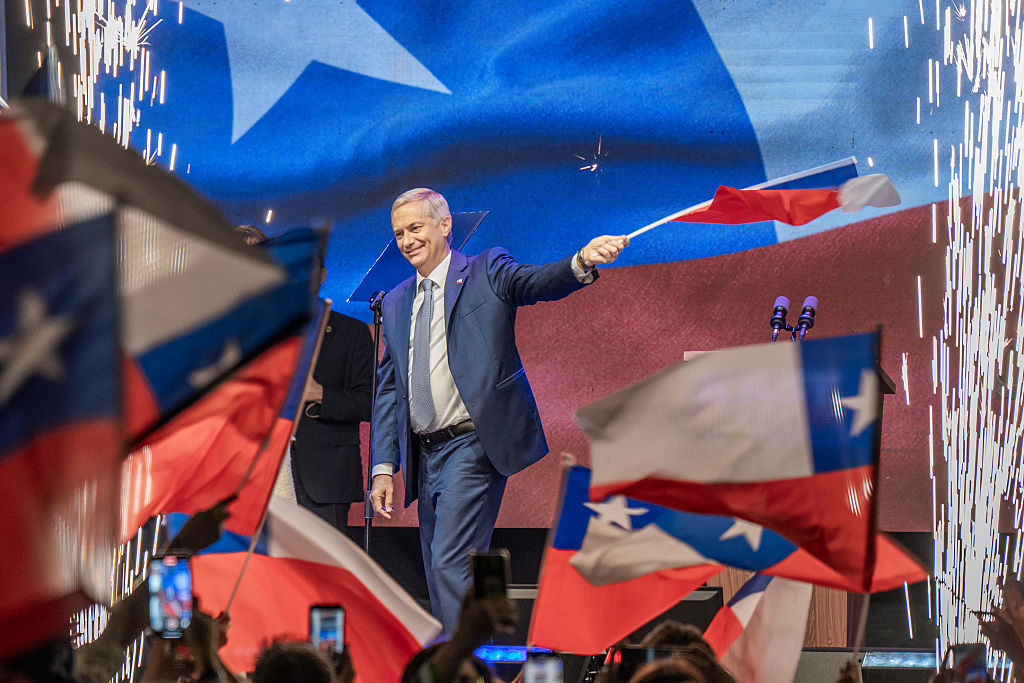
Kast’s victory has been welcomed by right-wing leaders across the region. In turn, they view the result as part of a wider conservative resurgence in Latin America. For example, Argentina’s libertarian President Javier Milei was among the first to offer congratulations. He said on X that he felt “enormous joy at the overwhelming victory of my friend José Antonio Kast.” Similarly, Ecuador’s right-wing President Daniel Noboa echoed the sentiment, declaring that “a new era is beginning for Chile and for the region.”
Beyond the region, international reactions also followed swiftly. US Secretary of State Marco Rubio said Washington “looks forward to partnering with his administration to strengthen regional security and revitalize our trade relationship.” By contrast, Spain’s Foreign Ministry, under a leftist government, struck a conciliatory note, saying it hoped to “continue strengthening the friendship between our peoples and the strategic relationship between our two countries.”
A New Chapter for Chile
Taken together, Chile’s election of José Antonio Kast marks a clear break from recent political currents, as voters prioritized security and stability. His presidency now faces the challenge of translating tough campaign promises into effective governance without deepening social divisions. Ultimately, how Kast balances law and order with democratic safeguards will shape Chile’s next chapter and influence the region beyond its borders.
For more such informative articles, stay tuned at The World Times.