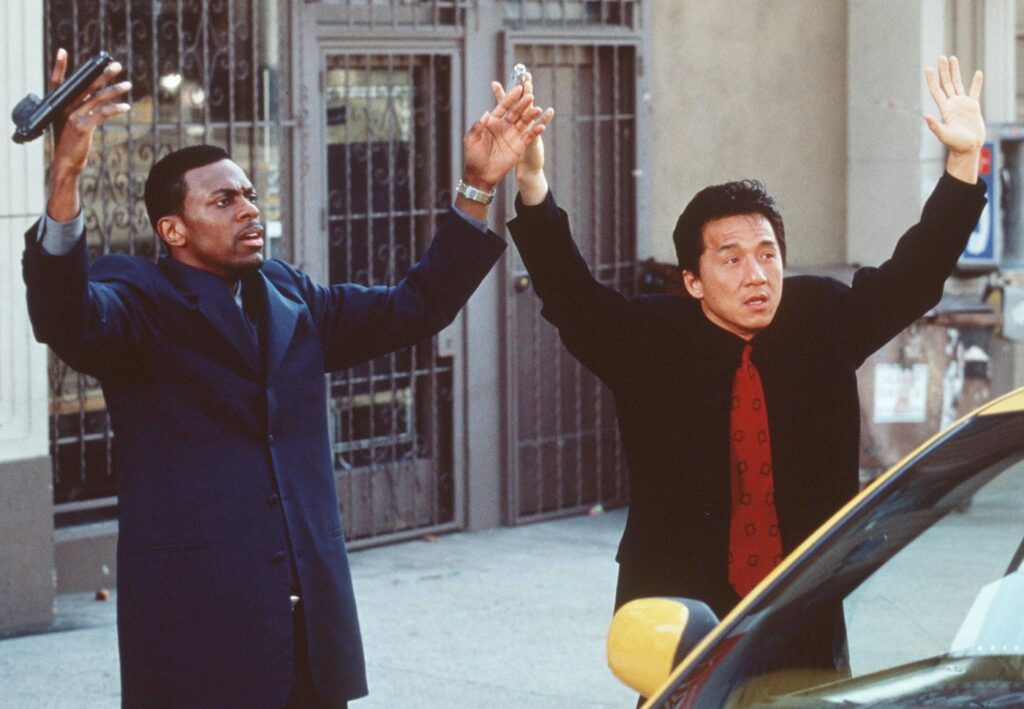
From being featured in a cameo in Home Alone to taking credit for firing media personalities and issuing tariffs on the film industry, Trump is not one to shy away from expressing his views on all matters film and media – political and apolitical, alike. But as is the case with Trump, everything is political. Often taking to Twitter to voice his views, Trump has now reportedly urged Paramount Skydance to restore the dead Rush Hour franchise. Unlike many of his frivolous remarks, this one fits more into the category of an autocrat’s extravagant demands which apparently seems to have been fulfilled as the film is already in the works. But how will Jackie Chan perform those iconic stunts at the ripe age of 72? Or perhaps the more important question is what does Trump want out of it?
A Revival Rooted in Old Fears
Among many of Trump’s public threats was to sanction 100% tariffs on films made outside America. It may seem to be in line with the core values of his political campaign enlisting economic measures that prioritise America by bringing all production back to the country but he has also indicated that any attempts to produce films outside America are an effort to spread anti-American propaganda and constitute a national security threat.
The underlying political and cultural connotations and implications of it are eerily synonymous with the infamous Red Scare back in the 50s when the rise of communism posed such a grave threat to the integrity of the American nation that boycotts and blacklisting of actors, writers and directors was carried out like a mass witch hunt. Instead of creating a feeling of unity and nationhood amongst the Americans, it produced a wave of mass hysteria and paranoia. It also deeply influenced the art form itself for when art and artists are coerced into conformity with the hegemony, they retaliate in a bitter fashion. This time, however, the threat may well be imaginary, and Trump’s warning could cost the film industry not just a lot of money but also strike at its cultural roots. Hollywood may have been dominated by Republicans in the past, but now they slither under the radar much like spies, as the new Hollywood prides itself on diversity and the inclusion of minorities, as famously pointed out by Meryl Streep in her 2017 Golden Globe speech for the Cecil B. deMille award.
The Racial Tensions That Shaped Rush Hour and its Identity
If Trump is trying to evoke a nationalist sentiment amongst the American folks through pop culture then it seems to be an approach that deviates from his traditional modus operandi which involves media control to create a cultural hegemony deeply rooted in race identity. And if he is trying to reshape or remake American culture according to his whims and fancies then what does he need out of Rush Hour, a buddy cop film about a Black man and an Asian that subverted the buddy cop genre through cultural diversity which he considers a threat to American integrity?
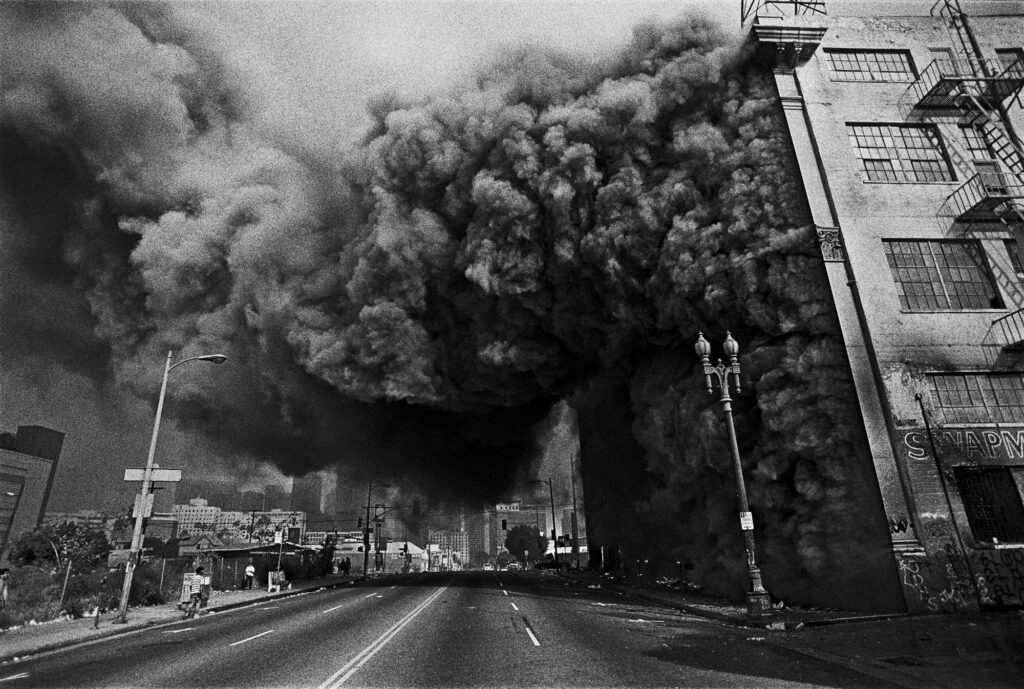
The first installment in the Rush Hour franchise came out a few years after the devastating Los Angeles riots involving Blacks and Asians in a heated racial conflict that soon turned to violence, looting and arson. The riots not only shattered the ‘American dream’ of many Asian immigrants but also laid bare their socio-economic position in the society as a more marginalized class in contrast to the usually presumed lower class—Black Americans. It also exposed the fragility of the American social fabric strained with racial tensions and class divide. In the wake of these riots, the American nationalist sentiment was under an internal attack with its diversity becoming a burden rather than a strength questioning its sense of unity.
When the nation was in doubt about its identity, Rush Hour took two differing cultures, sentiments, values and societal sections that reflected them and blended them together. The film reflected the same unease and friction between the two cultures that American society grappled with, but gradually eased into it with humour and crafty action. Building on this foundation, it cleverly played with stereotypes to create a unique cultural blend. It paired the Asian quietness and conflict avoidance personified by Chan’s character with the over-the-top exuberance and snappy wit of Tucker. What begins as an early source of conflict gradually transforms into mutual respect.
Rush Hour and The Subversion of The Buddy Cop Genre
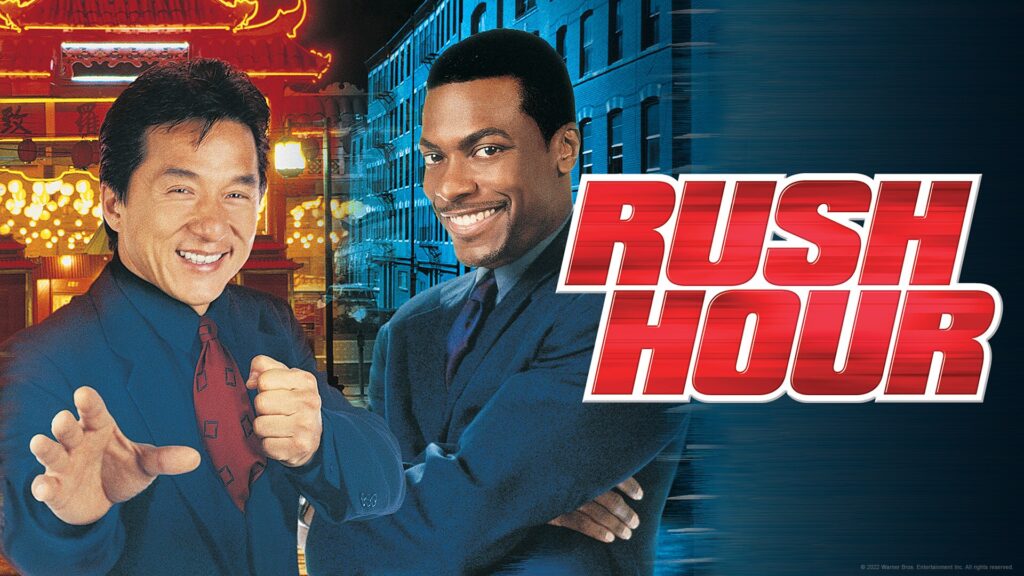
Many buddy cops films have played with the trope of a white protagonist paired with a senior black cop who serves as the sidekick but Rush Hour took a risk by putting the spotlight on two marginalized classes without the help of a protagonist from a hegemonic culture.
The white man dominates the urban topography of Los Angeles in the film yet he majorly fails, remains sidelined despite his intention to sideline the two men from marginalized cultures. Not only are the white men with good intentions posed as incompetent but the devious antagonist of the film happens to be a white man as well. Unlike most buddy-cop films, Rush Hour has no male white protagonist to balance it off. The hegemonic culture of the American landscape is pushed out of the limelight, and when it does appear, it is framed with a distinctly negative connotation.
It is not just the white man but rather the hegemonic culture that is painted as the bad guy. Sidelining what overpowers the senses in Hollywood cinema, provides sufficient space to explore men from marginalized communities that often lack enough representation in cinema. And though it is a big tentpole action flick that primarily feels like a white man’s idea of an action film particularly because it plays with common stereotypes of these two races from a white man’s perspective yet the film has its own consciousness. It refuses to yield and bend its knee to the white man’s pleasure.
While it does create humour from the cultural misunderstandings that arise when East meets West where the West is from a black man’s point of view, it shows a potential for acceptance, growth and respect. By owning those stereotypes it saves both the film and its characters from a victim complex. Rather, it makes them more endearing; we never laugh at them but with them. While the white men create a mess because of their ego, territorial dominance, and stubbornness, Chan—with his Asian emotional sincerity and spiritual devotion to the cause—and Tucker, with his unique flamboyance and wit, do a better job. The white “superiors” remain unwilling to take input from them, as was largely the case back then in the country.
The Clash Between Trump’s Agenda and Rush Hour
Trump is not merely resurrecting a piece of nostalgia but also bringing back something that is anything but a run of the mill buddy cop film—apolitical and harmless. At its core, the film is an advocate for multicultural harmony as it unites two oppressed communities with fraught relations which is at odds with Trump’s political rhetoric. It gently strips away the dominance and power of white identity, something that his political campaign vehemently opposes The film, with its cultural subversion sticks out like a sore in juxtaposition to Trump’s race-coded narratives and can never be fit in his narrow definition of American nationalism. Ironically, in his ambition to control media and culture, resuscitating this dead franchise might only undermine his political doctrine.
For a deeper look at the world of entertainment and politics, stay tuned at The World Times.