Yorgos’ cinema often operates on defamiliarizing linguistic structures, dismantling them and shifting their context to expose the fragility of meaning exposing a postmodern void. Saussure’s idea that language is a system of differences — signifiers floating only because of what they are not — already contains a seed of alienation. Language is fundamentally a barrier disguised as a bridge. It promises connection but delivers miscommunication, misunderstanding, and isolation. To further this idea the film approaches the material with an aim to create a set of binaries and then have them interact with each other to expose the fragility of these structures and the consequent human fallibility that arises out of our dependence on them.
The Fragility of Language
The “shibboleth” moment in Bugonia is the perfect structuralist joke. Todd and Michelle speak what seems like the same language, but their socio-cultural codes are miles apart. They end up tangled in a spiral of verbal diarrhea because their words carry different histories. Michelle’s technocratic precision and Todd’s Joe Rogan-esque conspiracy-poetry come from two entirely incompatible universes. Strip away their cultural contexts and everything they say becomes strange, uncanny, absurd because the linguistic system collapses and reveals its emptiness.
Michelle’s correction of Todd’s pronunciation of “shibboleths” isn’t pedantry; it exposes the entire architecture of difference between them. The original biblical shibboleth test — life or death decided by a single phoneme returns like a ghost. Language becomes both executioner and judge again. Structuralism and alienation embrace each other in this moment.
The Japanese saying, A man is whatever room he is in, sits like a quiet truth above Todd and Michelle. Their rooms are the cultural structures that shaped them. They seep into their syntax, their metaphors, their breath. They embody these rooms even outside them, trapped in their own linguistic echo chambers.
In the basement, these structures become displaced. They clash in a cultural vacuum, a place where neither of their systems exist. So they fight not as individuals but as representatives of two broken structures trying to overthrow each other. It’s less a battle of wits than a battle of power with linguistic systems trying to dominate, crush, and absorb.
The Collision of Structures in a Postmodern World
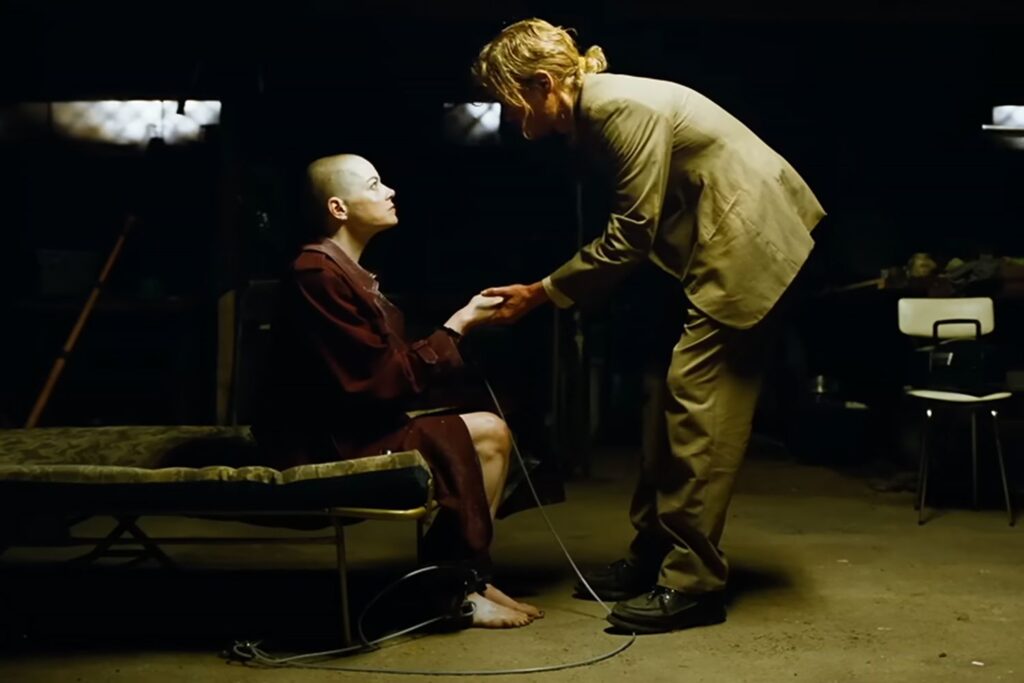
Where binaries are essential to structuralism as meaning is not inherent but relational, postmodernism seeks to deconstruct this rigid system of hierarchy. Even though Todd and Michelle’s aim is the same, submission of will but the semantics of their linguistics reflect how language can carry a faint residue of our gendered roles. These gendered codes emerge when Todd’s violent red-pilled tirades collide with Michelle’s cold business jargon, his aggression pushing her down as she stays composed, trying to outmanoeuvre him.
Postmodernism views gender as a social construct, merely performative and their exchanges mirror that as eventually these codes break down when Michelle abandons the euphemisms of corporate lingo trying to lull Teddy into defeat. Instead she raises her temper and the pitch of her voice with a blunt tone and shorter sentences to directly confront him as he weeps and stutters, now on the back foot as compared to the beginning of the film. This takes forward the film’s aim of setting up a pattern of showcasing binaries, then having them collide and collapse as things organically take an absurdist turn furthering its descent into a postmodernism mess.
And when linguistic structures collapse, the social power structures reflected in them collapse too. Yorgos’ critique is clear: there is no universal truth left, only subjective meanings, half-beliefs, echo chambers. Todd is born from this postmodern condition. Chomsky noted how postmodernism lets people dissociate from facts, wrap themselves in ornate language, and take radical stances. Todd is exactly that — right and wrong simultaneously, a prophet in a padded cell.
The film lays out the bleakness of the modern world where postmodernism fuels segregation, deepens alienation, and gives rise to both radicalism and corporate authoritarianism. Subjectivity becomes a slow poison. Half-truths become entire realities. Yet the film does not endorse structuralism or condemn postmodernism. It simply lays out the truth and it is deeply nihilistic. Humanity is too fragmented, too diverse, too crippled by the hegemonic structures it created. Michelle’s company tries to “fix” the death drive yet inadvertently ends up ensuring that Todd embodies the very destruction that leads to the doom of his species.
This is the paradox at the heart of it all: postmodernism wants to dismantle structures; but humans, as social animals, inevitably form the very fabric of these structures in order to co-exist. The desire to escape structure becomes the mechanism through which new ones form. It is a loop without a way out.
VistaVision and the Postmodern Void

Bugonia was shot on VistaVision, a format which allows more negative space in the frame since it runs the 35mm film horizontally as opposed to the traditionally vertical orientation. Yorgos utilizes this negative space to create a visually symbolic structure of binaries. This pattern of binaries is reflected in the narrative when Todd says it is us vs them; and it is present in Justin’s music between the hilarity and the horror it portrays from its high crescendos to low, sombre and ominous flat tones.
On one hand, the VistaVision format lends a portraiture-esque quality to the frame where individual characters photographed stand as monolithic structures surrounded by the threat of postmodernistic forces. Yorgos creates a realistic, single point of view of a three dimensional space using leading lines and the vanishing point, creating mathematical and geometric structures. On the other hand, the negative space that lurks around the structure, threatening its integrity, encapsulates the film by visually symbolizing the postmodernist threat to humanity. This visual juxtaposition within one frame reflects the pattern of binaries that runs throughout the film’s narrative.
The negative space is transformed into a concrete structure of its own under the philosophical framework laid down by postmodernism, where it symbolizes the boundless limitless possibilities that postmodernism promises, yet just like postmodernism it is trapped within the boundaries of the filmic frame. This negative space rejects singularities and universality, yet it becomes a structure of its own, with the limitations of the filmic two dimensional frame symbolizing the paradox of postmodernism itself.
It reflects the postmodernist paradox where the pursuit of freedom from structure is undone by the belief that emptiness and nothingness still take a shape of their own, and where the absence of structure ends up forming a concrete space as well.
Bees, Structure and Collapse of a Species
Bees are a critical part of the ecosystem. And the film draws a parallel between humans and bees. Without the queen, the hive collapses. Without structure, the species dies. Todd and his cousin inject themselves with a vial to kill their sexual drive unlike the drone bees whose only function is to mate with the queen. They are destroying the biological structure that keeps a species alive — the death drive Michelle wants to cure.
Their debate about bees reveals their fractured realities: Michelle admires the bees for their purposefulness; Todd sees purpose as oppression. Two worldviews unbridgeable, reflected visually as they stand alone in portraiture frames, centred but isolated.
The bees in the film run toward their death without a queen, believing they will survive. It mimics reality: in a postmodern mess, we run without direction, without hierarchy, without unity. Bees thrive because they have structure. The Andromedans thrive because they follow an empress. We crumble because we reject structure yet cannot live without it. Just like bees, we require a communal structure and without it, our fragmented realities guarantee collapse.
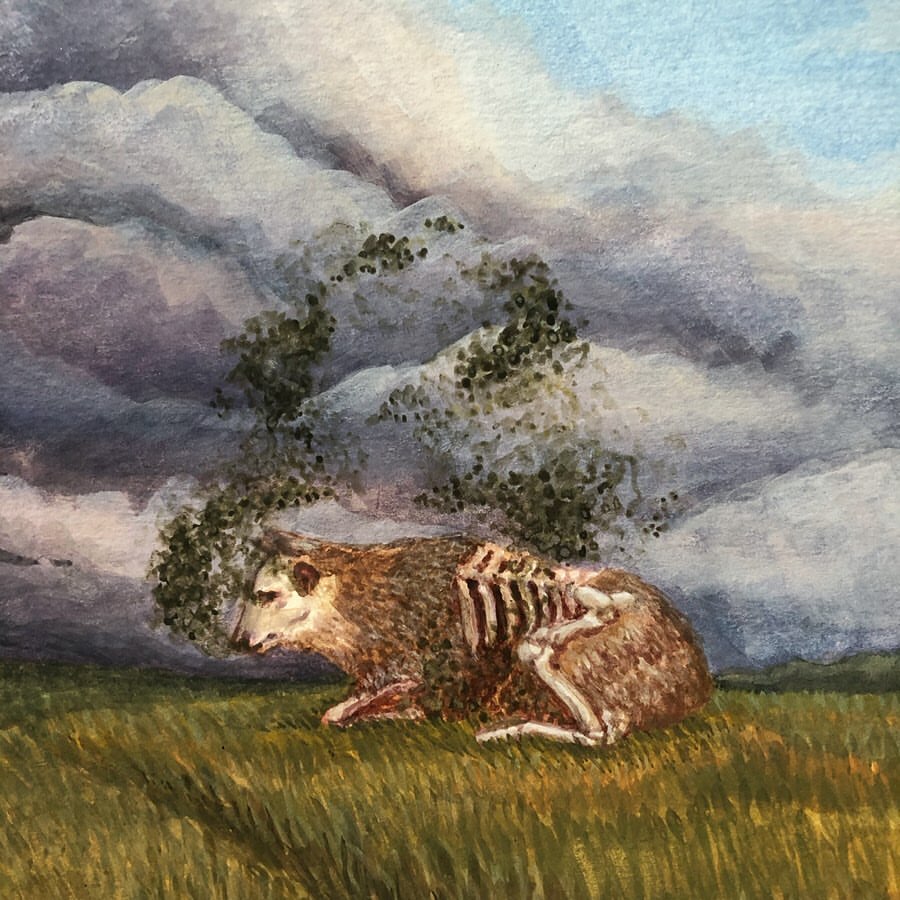
Bugonia is the myth of bees rising from the rotting carcass of an ox, new life born from decay. The film uses this myth to mirror our tragedy: only through the collapse of our morally decayed structures can something new rise. And as long as we persist, so do our social structures suggesting our fall is necessary, inevitable and natural.
Yorgos isn’t cynical about the world, he’s cynical about us.
We are the centipede too aware of its legs to walk. A species that became too conscious for its own survival, severed from nature by the very mind that evolved from it.
The film isn’t about aliens; it’s about alienation. Our hyper-awareness, our constant flood of information, our endless loops of self-analysis none of which bring empathy but paralysis. We are frogs in separate wells, each convinced our patch of sky is the entire universe. Outside our linguistic wells, we are inoperable like insects without legs trying to run.
We are the carcass. And from our carcass, something new will rise.
To explore how cinema builds strange, unsettling worlds that mirror our reality, follow The World Times.